

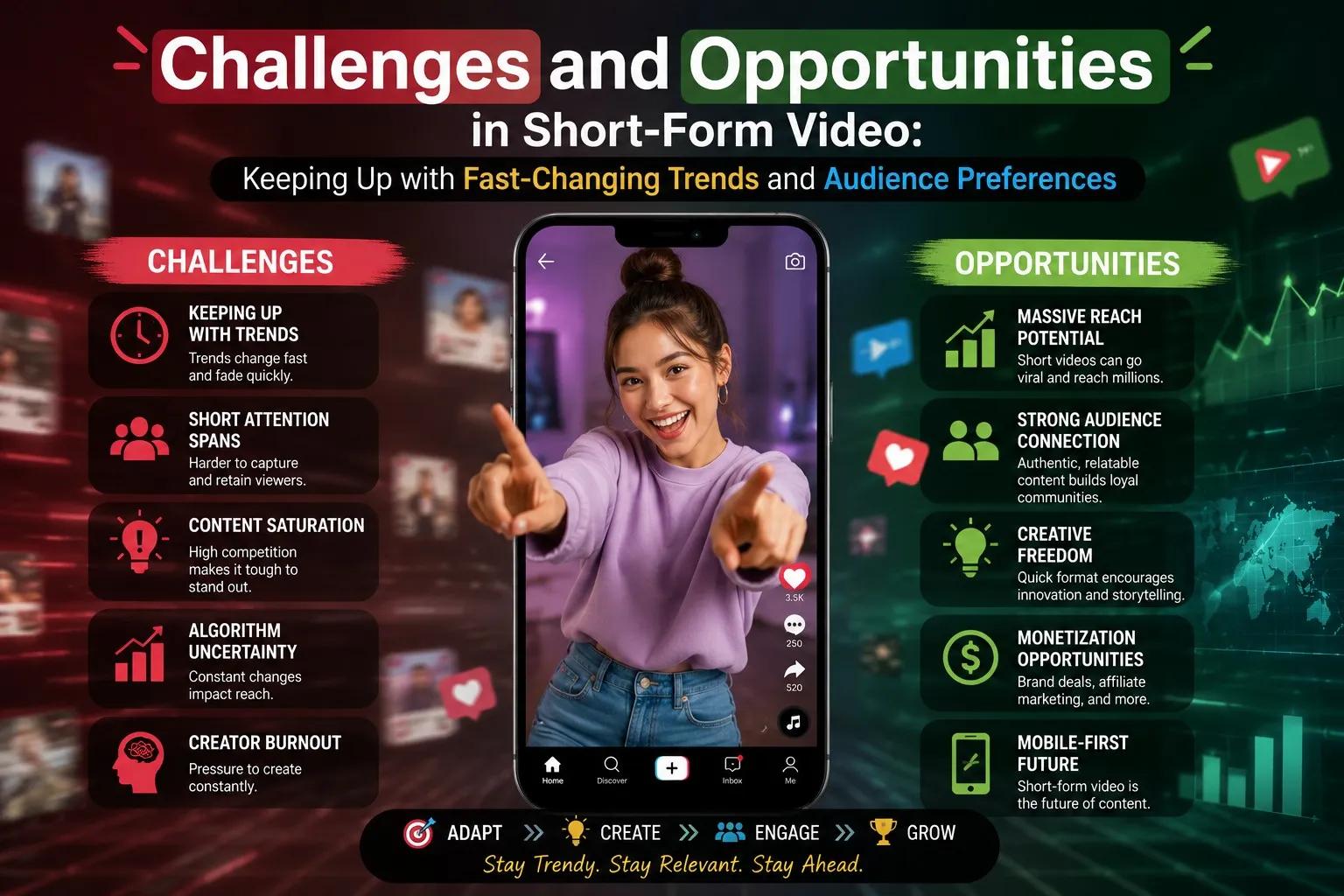
Challenges and Opportunities in Short-Form Video: Keeping Up with Fast-Changing Trends and Audience Preferences
Short-form video used to sit downstream from the “real” campaign.
Brands would produce the commercial first. Then somebody on the marketing side would ask for vertical cutdowns afterward because TikTok needed something, Instagram needed something, paid social needed six variations by Friday. The short-form pieces usually felt extracted rather than native. You could tell they were born somewhere else.
That separation disappeared pretty fast.
Now the short-form version often becomes the primary communication layer whether companies planned for that or not. Which changed a lot more than content formatting. It changed how audiences size up competence.
Not brand competence exactly. More like social awareness. Rhythm. Timing. Self-awareness. People make those judgments quickly now.
Sometimes too quickly, honestly.
But I’ve sat in enough edit reviews to know the friction usually starts inside the room long before the video goes live. Someone asks for more setup. Someone else worries the hook feels too abrupt. Legal wants an extra clarification line. Another stakeholder thinks the pacing feels “too internet.”
That phrase comes up more than you’d think.
Then the opening gets softened. Explanations creep in. Suddenly a 20-second piece is carrying the weight of a full campaign strategy deck.
Meanwhile, audiences are scrolling past kitchen videos filmed under bad overhead lighting because the person on camera sounds like they actually mean what they’re saying.
Short-Form Video Didn’t Just Change Attention Spans. It Changed Expectations.
I’ve never fully bought the “attention spans are dying” narrative.
People still focus intensely when something earns it. Long YouTube essays pull millions of views. Podcast clips become entire evening rabbit holes. Somebody can spend forty minutes watching a mechanic diagnose an engine problem they’ll never personally encounter.
The issue is hesitation.
Audiences have become very intolerant of uncertainty in content. Especially commercial content. If a video feels unsure of itself for even a few seconds, viewers start mentally exiting before the actual point arrives.
And oddly, higher production budgets sometimes make this worse.
There’s a type of polished brand content that feels over-discussed before it even reaches the audience. Every line balanced. Every joke pressure-tested. Every visual carefully protecting the brand image. You can practically feel the approval chain still attached to it.
That doesn’t mean audiences suddenly prefer ugly content. I think people misunderstand that part all the time.
Viewers still appreciate craftsmanship. They just don’t want to feel managed.
A lot of effective short-form work right now carries small amounts of friction. Slightly uneven delivery. Faster-than-expected cuts. Moments that don’t feel optimized into oblivion. The texture helps.
There’s also been a weird reversal in how people perceive professionalism. Ten years ago, polished lighting and smooth camera movement immediately communicated authority. Now excessive polish sometimes signals distance from reality instead.
Depends on the category though. Finance audiences behave differently than beauty audiences. Tech audiences respond differently than lifestyle audiences. Some industries can tolerate rawness better than others. That nuance gets flattened in a lot of marketing conversations.
The Shelf Life of Trends Is Now Shorter Than Most Production Timelines
One thing agencies quietly deal with now is explaining to clients that internet culture does not move at corporate speed.
Most companies still operate on campaign timelines. The internet doesn’t.
A trend can peak, saturate, get copied by fifteen brands, become self-aware, then die before some internal teams even finalize the caption copy. Everybody wants cultural relevance without cultural unpredictability. That’s usually where the tension starts.
And to be fair, brands have legitimate constraints. Legal review exists for reasons. Large companies cannot operate with creator-level impulsiveness. Nobody serious actually expects that.
Still, audiences don’t grade content on organizational complexity. They only react to what shows up in-feed.
By the Time Some Brands Approve a Trend, the Audience Already Moved On
You can almost pinpoint the exact moment certain trends stop feeling organic.
First creators use it naturally. Then early brands adapt it while the format still has energy. Then suddenly every industry starts participating at once and the whole thing collapses under repetition.
Certain audios on TikTok burned out this way incredibly fast. Same with hyper-fast subtitle pacing for a while. Same with those fake podcast clips brands kept staging.
That one got exhausted quickly.
I think companies often analyze trends too literally. They focus on the visible structure instead of the behavioral reason audiences responded in the first place. Usually the emotional mechanism matters more than the format itself.
Sometimes what people are actually responding to is confidence. Or specificity. Or mild unpredictability.
The trend is just carrying it temporarily.
Not Every Viral Format Deserves a Brand Version
Some brands force themselves into internet behavior that fundamentally conflicts with how audiences already perceive them.
Luxury companies suddenly acting chaotic. B2B software brands trying to sound aggressively casual. Healthcare companies chasing meme structures they clearly don’t understand. The mismatch creates discomfort fast.
And viewers rarely explain why something feels off. They just disengage.
Honestly, restraint is underrated in short-form strategy. Some teams would improve dramatically by participating less selectively instead of trying to maintain constant visibility.
Because audiences can sense tonal insecurity now. They may not consciously phrase it that way, but they recognize when a brand is borrowing a personality instead of communicating from an actual perspective.
Audiences Became Better Editors
The average viewer processes editing language much faster now than many marketers realize.
Hooks started becoming recognizable formulas. Then reaction structures became recognizable. Then “authentic” dialogue patterns became recognizable. At a certain point audiences began predicting emotional beats before they happened.
You can feel people pulling away from that predictability in real time.
This is partly why some founder videos outperform highly structured campaigns even when the production quality is objectively lower. There’s less visible optimization happening. Less evidence of strategic over-handling.
I’ve noticed this especially with product content.
Sometimes a founder casually explaining one tiny manufacturing frustration creates more trust than an entire polished campaign about “innovation.” Probably because specific operational details feel expensive to fake. General positioning language doesn’t.
That distinction matters more now.
And honestly, short-form exposed how much advertising relied on audience patience for abstraction. People tolerate less vague branding language in feeds because the environment itself is more behavior-driven. Content either feels connected to something real or it starts floating away almost immediately.
The Metrics Problem Nobody Talks About Enough
A lot of companies are still learning how misleading short-form metrics can become.
Views create emotional reassurance internally. High reach feels like momentum. Teams get excited. Leadership gets excited. Reports start circulating.
But audience attention and audience retention are separate things. Brand memory is separate again.
Some videos perform incredibly well while contributing very little to long-term positioning. The entertainment layer overwhelms everything underneath it.
High Views Can Hide Weak Brand Memory
There are viral brand videos people remember perfectly while forgetting the company attached to them an hour later.
That’s becoming more common, not less.
Short-form platforms reward immediate behavioral response. Laughter. Surprise. Curiosity. But those reactions do not automatically build durable association. Sometimes they just build temporary interruption value.
Different thing entirely.
And because social reporting dashboards emphasize visible engagement metrics, companies can accidentally optimize toward short-term stimulation instead of recognizable identity.
Sometimes the Best Performing Videos Don’t Look Like “Campaigns”
A lot of effective short-form content barely resembles traditional advertising now.
Warehouse walkthroughs. Product designers talking through material choices. Someone explaining why packaging failed during shipping. Raw production moments captured between setups.
Specificity carries weight because so much content online feels strategically generalized.
Also, audiences have become unusually sensitive to expertise theater. They know when somebody actually understands operational details versus when somebody memorized positioning language for camera delivery.
That gap shows up fast in short-form.
Production Teams Are Quietly Rebuilding Their Entire Workflow
Short-form changed production infrastructure more than people outside creative teams probably realize.
Shoots are planned differently now. Editors work differently. Coverage strategy changed. Aspect ratio decisions happen before production starts instead of after. Entire filming days are built around extraction flexibility because teams know they’ll need multiple openings, alternate pacing structures, different retention approaches.
The old “hero asset” mindset weakened quite a bit.
Now content systems matter more.
And the volume expectations are exhausting sometimes. Not dramatically exhausting in some theatrical creative-burnout sense. Just operationally relentless. There’s always another cut. Another version. Another platform shift. Another reporting cycle saying the first three seconds need to change again.
Short-form looks disposable from the outside. Usually isn’t.
The Opportunity Isn’t Just More Content. It’s Better Pattern Recognition.
The brands navigating short-form well tend to share one characteristic.
They observe carefully before reacting.
Not every trend deserves a response. Not every audience signal deserves a strategic pivot. Some companies keep reshaping themselves weekly because they mistake movement for relevance.
Audiences eventually feel that instability even if they can’t fully articulate it.
The more durable advantage is pattern recognition. Understanding what consistently creates trust around your category. Knowing what kinds of specificity resonate repeatedly. Recognizing which creative instincts survive format changes instead of collapsing with them.
Short-form exposes weak audience understanding quickly. Brutally sometimes.
But it also gives brands access to behavioral feedback loops older advertising models never provided at this speed. That part is genuinely valuable.
The difficult part is interpreting the signals without becoming controlled by them.
--- Author Bio:
Torrey Tayenaka
Torrey Tayenaka is the co-founder and CEO at Sparkhouse, an Orange County based commercial video production company. He is often asked to contribute expertise in publications like Entrepreneur, Single Grain and Forbes. Sparkhouse is known for transforming video marketing and advertising into real conversations. Rather than hitting the consumer over the head with blatant ads, Sparkhouse creates interesting, entertaining and useful videos that enrich the lives of his clients’ customers. In addition to Sparkhouse, Torrey has also founded the companies Eva Smart Shower, Litehouse & Forge54.