

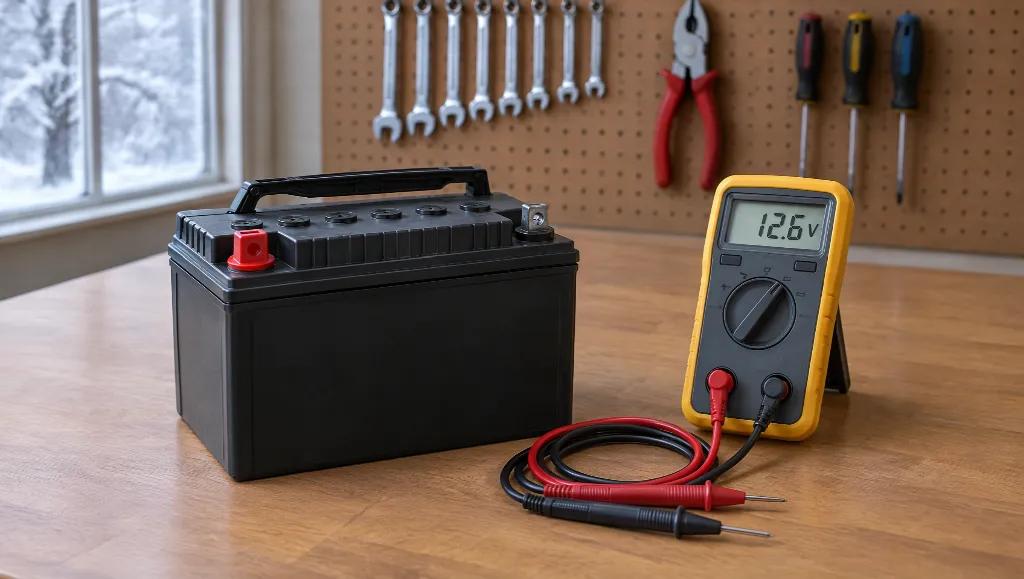
A lawn mower battery left in a cold shed all winter will be dead by spring. A discharged battery freezes. A frozen battery is scrap. Thirty minutes of work before the first freeze saves a hundred-dollar replacement.
Why Winter Storage Matters for Your Mower Battery
Most riding mowers use a 12-volt lead-acid battery. As it discharges, the sulfuric acid turns into water. Water freezes at a higher temperature than acid. A fully charged battery can take well below zero. A discharged one may crack its case at temperatures that do not even feel that cold.
Self-discharge is the other enemy. At room temperature, a lead-acid battery loses roughly 3 to 5 percent of its charge per month. Cold slows that rate. It does not stop it. Over four or five months, a battery that started half-full ends up empty. Come April, the mower clicks instead of cranks.
AGM batteries handle cold better and discharge slower. They still benefit from the same storage routine. Lithium-ion starter batteries are still rare on lawn equipment, but they should not be charged below freezing.
Step 1: Remove and Disconnect the Battery Safely
Park on level ground. Turn the key off and remove it. Disconnect the negative cable first, then the positive. If your wrench touches the frame, that order prevents a spark.
Locate the battery. It usually sits under the seat or hood.
Loosen the negative terminal nut. The negative cable is usually black.
Lift the cable off and tuck it away.
Loosen the positive cable nut next. The positive cable is usually red.
Remove the hold-down bracket and lift the battery out.
Batteries are heavier than they look. A typical lawn tractor battery weighs fifteen to twenty pounds. Keep it upright. At 4:30 on a November afternoon with cold air creeping into the garage, doing this carefully beats cleaning up an acid spill.
Step 2: Clean and Test the Battery
Corrosion on the terminals creates resistance. That weakens the electrical connection. Mix a tablespoon of baking soda with a cup of water, scrub the terminals with an old toothbrush, rinse with a damp rag, and dry thoroughly. Do not let the solution drip into the battery cells.
If the terminals are too corroded or the cables are frayed, compatible lawn mower parts matched to the mower model will keep the electrical system working right. A bad cable creates the same weak-start symptoms as a dead battery.
Now test the voltage with a multimeter. Let the battery rest for a few hours first so any surface charge can dissipate.
12.6 to 12.8 volts: fully charged, ready for storage.
12.4 volts: about 75 percent, needs a top-off.
Below 12.0 volts: deeply discharged. Charge immediately and retest.
Step 3: Charge the Battery Before Storage
A partially charged battery self-discharges faster and freezes sooner. A smart charger or battery maintainer is the safest option. It switches to float mode once the battery is full. A basic trickle charger works, but you must disconnect it manually when the battery reaches full voltage.
On a 2-amp charger, a typical 20 to 35 amp-hour lawn tractor battery that is half discharged needs roughly 6 to 10 hours. A deeply discharged battery may need 12 to 18 hours. Do not use a car charger on a high-amp starting mode. Charging a small battery at 10 amps or more overheats the plates.
Step 4: Choose the Right Storage Location
Cold is fine. Freezing is not. Store the battery somewhere that stays above freezing. A basement, heated garage, or utility room all work. If the only option is an unheated shed, place the battery on a wood shelf or rubber mat rather than directly on concrete.
Cold concrete transfers moisture and creates temperature differences. Condensation forms on the battery case. That creates a microscopic path that slowly discharges the battery. A block of wood or an old shelf board solves this for free.
Keep the battery away from sparks or open flame. Charging batteries produce small amounts of hydrogen gas. Good ventilation matters.
What If Your Battery Does Not Survive the Winter?
Most lawn mower batteries last three to five years. A battery stored and maintained correctly might push past five. If it reads below 10.5 volts after charging, a cell has likely shorted internally. If the case is cracked or bulging, replace it.
Conclusion
Pull the battery before winter. Disconnect negative first, clean the terminals, test the voltage, and charge it fully. Store it somewhere above freezing on wood or a mat, with a maintainer connected if possible. A battery that sits discharged in the cold for four months is a battery you buy twice.