

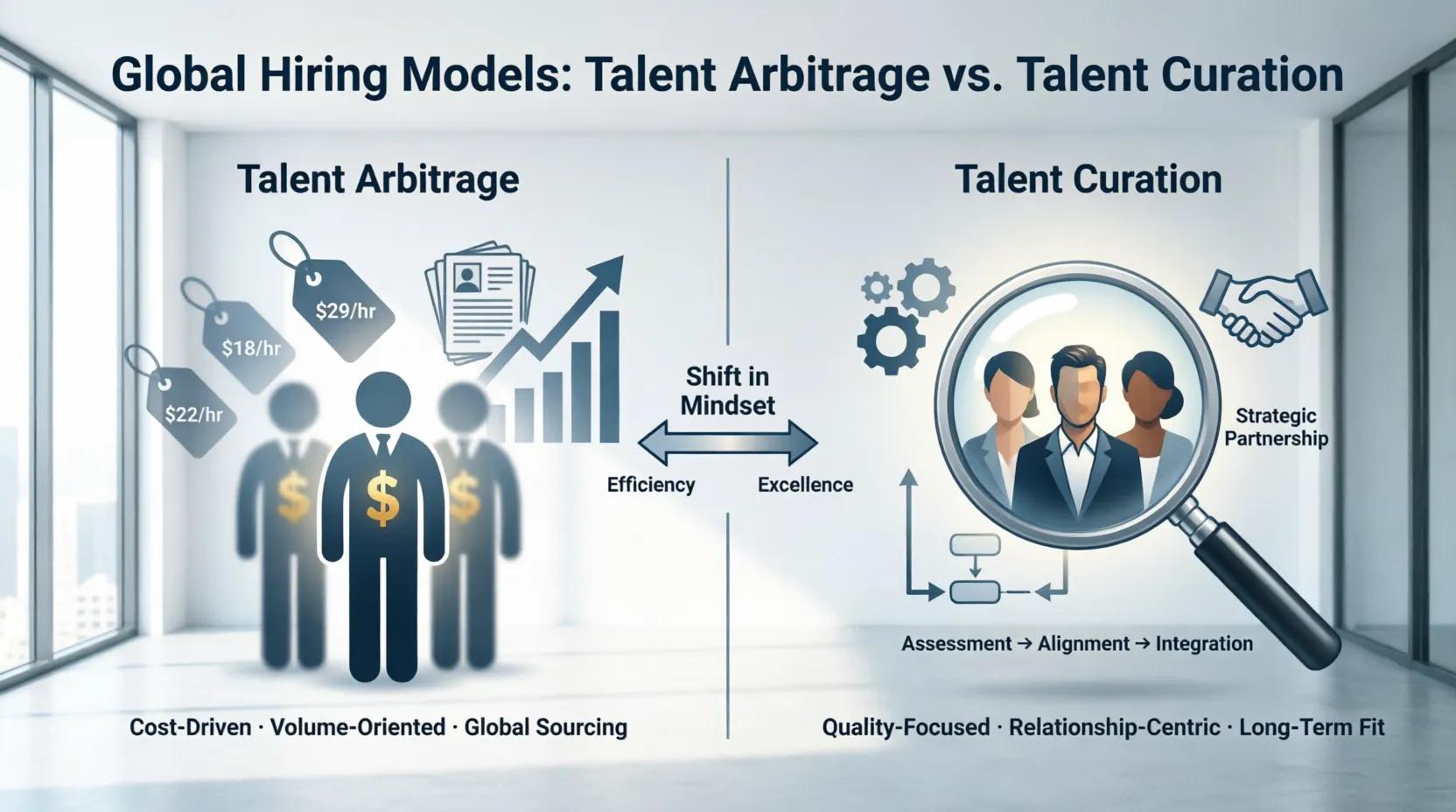
Most companies think they are choosing between price points when they evaluate global hiring options.
They are not. They are choosing between operating philosophies. And the gap between those philosophies compounds significantly over the two to three years following the initial hire.
Talent arbitrage vs talent curation is not a nuanced distinction between two versions of the same model. It is a fundamental divergence in what the hiring process is optimizing for, who benefits from the outcome, and what the engagement costs when the full picture is calculated honestly.
Understanding the difference is one of the highest-leverage decisions a scaling company can make. The wrong choice does not announce itself immediately. It accumulates quietly in rework, churn, and the widening gap between the team a company needs and the one it actually has.
What Talent Arbitrage Actually Means
Talent arbitrage is the practice of exploiting wage differentials between markets to acquire labor at below-market cost for the buyer. It is the economic engine behind the traditional agency model.
The logic is straightforward. An engineer in Pakistan costs less than an engineer in the United States. A company that hires from Pakistan instead of the US saves money on the same function. The delta between the two costs is the arbitrage.
This model has an internal logic that appears sound at the surface level. Labor is a cost. Lower cost for equivalent output is a rational optimization. The agency industry was built on this premise and has extracted enormous revenue from it for decades.
The structural problem is what the arbitrage model optimizes for. It optimizes for the cost of the input, not the quality of the output. Those two things are related, but they are not the same. And at the senior level, where the quality of judgment, ownership orientation, and institutional continuity compound over time, optimizing for input cost produces systematically wrong outcomes.
How the Arbitrage Model Produces What It Produces
Cost-based vs quality-based recruitment diverges most visibly at the sourcing stage.
Arbitrage-based vendors source from the same pool: inbound applicants, available bench talent, and professionals actively looking for the next engagement. This pool is efficient to access, fast to assemble, and optimized for margin extraction. It is also structurally skewed toward the wrong professionals for senior, high-ownership roles.
The vendor's incentive in the arbitrage model is to maximize the spread between what they pay the engineer and what they bill the client. This means sourcing from the most available segment of the talent pool, labeling it as senior or top-tier regardless of actual capability, and maintaining enough client satisfaction to avoid immediate churn while preserving the margin that makes the model profitable.
The result is predictable. Companies that hire through arbitrage models consistently receive teams that are technically adequate, ownership-deficient, and structured to benefit the vendor's margin rather than the client's outcomes. The junior-heavy delivery is not a failure of execution. It is the structural output of a model built to preserve spread.
What Talent Curation Means Instead
Talent curation operates from a different starting premise entirely. The question is not how much this professional costs relative to an equivalent in another market. The question is whether this professional is genuinely the right person for this role at this stage of this company's development.
Companies built on a curation model begin with a specific brief. Not a job description distributed broadly, but a detailed articulation of the role's context, the team's operating model, the technical problem, and the ownership expectations. That brief drives a closed-network search against a specific professional segment. The output is a small number of precisely matched introductions, not a shortlist of available candidates.
The economics look different too. A curated model charges once for the sourcing work and passes employment costs through at real cost, with no margin embedded in the salary being administered. The vendor's incentive is to produce a strong long-term hire, because the model does not profit from replacement cycles.
More precisely, the ongoing monthly employment and PeopleOps fee that sustains the engagement only continues for as long as the hire remains. Retention is not an abstract virtue in this model. It is a revenue condition.
This alignment of incentives is the structural difference that matters most. In the arbitrage model, the vendor profits from the spread and from churn. In the curation model, the vendor profits once from finding the right person and then only from maintaining the employment infrastructure that keeps them employed compliantly.
The Global Hiring Model Comparison: Direct and Honest
Dimension | Talent Arbitrage | Talent Curation |
Sourcing pool | Inbound, available, bench-based | Closed network, off-market, passive |
Optimization target | Input cost reduction | Output quality and ownership |
Candidate profile | Available talent, often junior-heavy | Senior, off-market, ownership-oriented |
Vendor revenue model | Margin on every salary, indefinitely | One-time curation fee, no salary markup |
Churn incentive | High, replacement cycles generate revenue | Low, retention is a product feature |
Post-hire accountability | None | Full lifecycle ownership |
Transparency on cost | Opaque, margin hidden in billing | Transparent, employment cost disclosed |
Employment ownership | Vendor-held or client-inherited | Partner-managed, client-owned |
3-year total cost | Higher, compounds with churn | Lower, compounds with retention |
Alignment with client outcomes | Misaligned | Aligned |
The global hiring model comparison above makes the philosophical difference visible. Every dimension reflects a different answer to the same underlying question: whose outcomes is this model built to serve?
Why Arbitrage Fails Specifically at the Senior Level
Talent arbitrage vs talent curation as a comparison is most consequential at the senior professional level. At the junior level, arbitrage produces acceptable results. The talent pool is wide, the ownership bar is lower, and the cost of a mismatch is manageable.
At the senior level, three things happen simultaneously that make the arbitrage model structurally wrong.
The professionals worth hiring are not in the available pool. Senior engineers, product leads, and data architects with genuine ownership orientation are not sitting on agency benches waiting to be placed. They are operating inside existing high-performing organizations and moving through trusted professional introductions, not inbound applications. The arbitrage model rarely reaches them, because its sourcing infrastructure is built around the available pool, not the off-market networks where senior professionals actually move.
The cost of ownership deficiency compounds. A senior professional who lacks genuine ownership orientation does not just underperform. They create downstream costs: rework, delayed roadmap, leadership overhead, team instability, and eventually churn that resets the entire engagement. These costs are invisible in any single billing cycle and devastating across a full engagement horizon.
The replacement cycle destroys the economics. When a senior hire churns, which in arbitrage models is structurally incentivized, the vendor earns another placement fee. The client absorbs the institutional knowledge loss, the team disruption, and the onboarding overhead of starting again. The arbitrage model looks affordable per month. The three-year total, including two or three replacement cycles with associated costs, is expensive by any honest calculation.
The Pakistan Market: Arbitrage vs Curation in Practice
Pakistan's professional talent market illustrates the divergence between these two models with particular clarity.
The arbitrage layer of Pakistan's market is large, well-established, and visible. Agencies that have operated for years supply junior-heavy teams, embed margin in billing rates, and profit from the volume and churn that arbitrage economics produce. This is what most companies encounter when they first look at Pakistan as a hiring market. It is not representative of what Pakistan's senior professional community actually contains.
The curation layer of Pakistan's market is smaller, less visible, and significantly more valuable. Senior engineers, product leaders, data architects, and cloud professionals with a decade or more of experience building systems at a global scale operate inside closed professional networks. They do not appear on job boards. They are not on agency benches. They move through trusted introductions inside communities that the standard agency market infrastructure has no access to.
Companies that approach Pakistan through the arbitrage model access the volume layer and miss the senior layer entirely. The companies that approach it through a curation model access professionals that the rest of the market cannot reach, at economics that do not include recurring agency margin on every salary administered.
Rise92 was built to operate exclusively on the curation side of this divide. The sourcing is closed-network and introduction-based. The commercial model is a one-time curation fee plus at-cost employment. There is no margin embedded in salaries, no churn incentive, and no vendor interest in replacement cycles. The employment layer, compliant contracts, in-country payroll, structured onboarding, and ongoing PeopleOps support, is managed end-to-end so the professional experience matches the sourcing standard.
For companies that have been operating inside the arbitrage model and are ready to see what the curation alternative produces, start with a role briefing at Rise92. The pricing is transparent, at-cost, and shared in full before any search begins.
When Arbitrage Is Acceptable and When It Is Not
Cost-based vs quality-based recruitment is not a binary moral choice. Arbitrage-based hiring produces acceptable outcomes in specific contexts. Understanding those contexts prevents the model from being applied where it structurally fails.
Arbitrage works when the role is genuinely junior, the output is easily supervised and corrected, the stakes of a mismatch are low, and the volume of capacity is more important than the quality of judgment. In these contexts, accessing the available pool at a competitive cost is a rational decision.
Arbitrage fails when the role requires senior ownership, the output is difficult to supervise in real-time, the stakes of a mismatch are high, and the quality of judgment compounds over time into team capability or fragility. In these contexts, optimizing for input cost produces systematically wrong hires at systematically higher real cost than a curation model would have generated.
The mistake most companies make is applying the arbitrage model uniformly across all seniority levels because it is familiar and fast, and because the failure mode at the senior level takes months to become visible.
Frequently Asked Questions
What is talent arbitrage in global hiring?
Exploiting wage differentials between markets to hire labor at below-market cost for the buyer. The vendor profits from the spread between what they pay the professional and what they bill the client, embedded invisibly inside the monthly fee.
What is talent curation as a hiring model?
A closed-network, introduction-based model that sources professionals against a specific brief, charges once for the sourcing work, and passes employment costs through at real cost. The vendor profits from getting the hire right, not from the margin on each monthly billing.
Why does talent arbitrage fail at the senior engineering level specifically?
Because senior professionals worth hiring are not in the available pool that arbitrage models access. And because the ownership deficiency of arbitrage-sourced senior hires produces rework, churn, and leadership overhead that makes the real cost significantly higher than the apparent monthly rate.
How does the global hiring model comparison favor curation over time?
At the point of hire, the models look comparable. Across two to three years, curation produces lower total cost through reduced churn, no replacement cycle fees, no recurring margin on salaries, and compounding institutional knowledge from high-retention senior hires.
Is talent curation only for large companies with large hiring budgets?
No. It is specifically well-suited for scale-ups and growth-stage companies where the cost of a senior hiring miss is highest relative to the company's runway and operational capacity. The economics favor companies that cannot afford to absorb the downstream costs of arbitrage-driven churn.
What makes the global talent strategy for startups different from enterprise hiring strategy?
Startups cannot absorb the management overhead of junior-heavy volume teams. The curation model, delivering fewer, more senior, ownership-oriented professionals, is structurally more aligned with how startups actually need to operate.
How does a company transition from an arbitrage model to a curation model?
By starting with a single senior role, briefing a curation partner with genuine closed-network access, evaluating the quality of the introduction against what the arbitrage model typically produced, and assessing the downstream performance difference across six to twelve months.
Does curation mean paying more per hire?
The one-time curation fee is comparable to a standard placement fee. After that, Rise92 charges a flat monthly fee for EOR and PeopleOps support. What is eliminated is the recurring margin embedded invisibly in salary billing, which in arbitrage models compounds indefinitely. Rise92's monthly fee is disclosed upfront, fixed, and not tied to salary level.