


Your biggest advertising risk in 2026 is a dashboard that drowns you in numbers. If you are among the online business owners who aim for better ecommerce performance marketing results, this article is just for you.
Recent reports from marketing experts reveal how teams feel immersed in huge amounts of data, yet unsure which numbers to focus on. That gap between reporting and decision-making is where growth leaks out.
If you feel stuck in a similar chaos about performance marketing for ecommerce, now is the time to overcome it through this detailed guide. It helps you know how to measure the right metrics because that information can really streamline your business operations.
Top 6 Ecommerce Performance Marketing KPIs You Can’t Miss
Most businesses are tracking 1000s of metrics every week. But what they are missing out on is the core KPIs in performance marketing for e-commerce that majorly influence the results. This table gives you a quick snapshot of each core metric, how to calculate it, and how it can help you.
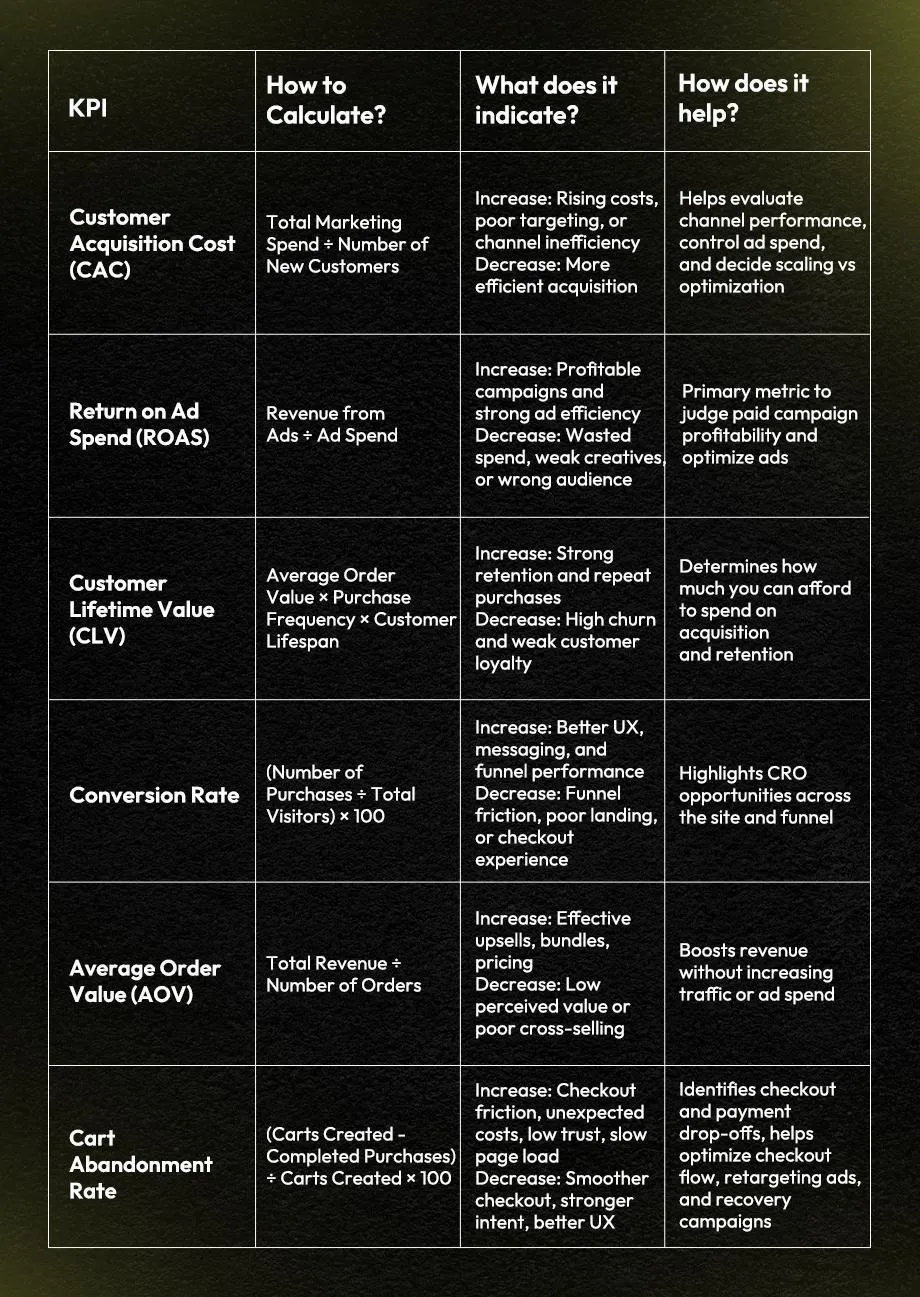
These KPIs work best when analyzed together. A higher CAC can be sustainable with strong ROAS and CLV. But drops in conversion rate often point to CRO or funnel issues rather than traffic problems. Ecommerce performance marketing businesses shouldn’t forget to track these metrics…be it conversion rate, CAC, CLV, ROAS, or AOV. They support your revenue, efficiency, customer value, retention, and belong to your main scorecard. This changes everything about how you approach performance marketing for ecommerce.
How To Track Your Ecommerce Performance Marketing KPIs: The Expert Way
Clicks, conversions, ROAS…do these metrics seem boring spreadsheets to you? Wait…they’re your receipts. And tracking them is not rocket science. Feed your ecommerce with data and see how easily it grows. Here are the easiest ways to keep your ecommerce performance optimization metrics in check.
Install Conversion Pixels
Your ecommerce marketing needs to have conversion pixels on your checkout page. Why? Because you can track when someone completes a purchase and send that data back to your ad platform. And that’s not the full story! Facebook pixel, Google Ads conversion tracking, and TikTok pixel work similarly. When someone buys, the pixel fires and logs that conversion back to your ad platform. Interesting, right?
Use UTM Parameters
Add simple tags to your URLs, and tracking campaign performance marketing for e-commerce across multiple channels becomes easy. These are nothing but UTM parameters. Instead of just knowing "someone purchased from you," you get to know "someone purchased from your Facebook ad about winter coats." That's the level of precision you get. All these details change your take on ecommerce performance marketing.
Connect Your Analytics Platform
This is where things get interesting. Google Analytics, Shopify analytics, or other dashboards…whatever you use, just connect it to your ad platforms. Wondering why? This syncing lets you see the complete customer journey from click to purchase.
Create A Performance Dashboard
Numbers everywhere can get overwhelming. You need one clear place to see your ecommerce performance marketing metrics. Pull all your numbers into one place that you check weekly. Include ROAS, CPA, Conversion Rate, CTR, and daily spend. Check this every week. Most professionals check daily, but weekly is a solid baseline.
Even top brands go wrong here. Most marketers can’t even articulate what "success" means for their campaigns. If you can't define the destination, how do you know when you've arrived? Don't worry. You don’t need to keep track of 1000s of metrics now. Save your efforts by working on what drives real outcomes. Do that well, and measuring results becomes super easy!
5 Best Tools To Measure Your Ecommerce Performance Marketing KPIs
Wanna scale your ecommerce brand globally? Well, the trial-and-error method will get you nowhere. You need expert tools to track performance, optimize spend, and generate revenue, irrespective of the industry you’re selling in. Every growth oriented ecommerce brand worldwide is using these tools. To make sure you're not left behind, check the table below:
Tools | Used for | How does it help? |
Google Ads | Campaign & conversion performance | Track cost, ROAS, and purchase intent |
Meta Ads Manager | Ad-level performance | Know which creatives and audiences bring conversions |
Google Analytics 4 (GA4) | User behavior & conversions | See how users interact and where they drop off |
Microsoft Clarity | Free heatmaps and session recordings | Follow where customers "rage click" or drop off in the checkout process, complementing the raw data from GA4 |
Shopify Analytics | Ecommerce performance analysis | Get clear insights into sales, products, and customer behaviour |
When you use the right performance marketing tools, you start making data-backed decisions. Your spending feels right. You see what’s working, fix what isn’t, and scale faster across regions, platforms, and customer segments. If your goal is to grow globally, improve your ROAS, or build a sustainable ecommerce brand, these tools are your must-haves.
Why You Need An Ecommerce Performance Marketing Agency to Measure Your KPIs?
You can have clear GA4, dashboards and reports. But without expert interpretation, those numbers can easily send you in the wrong direction.
An ecommerce performance marketing agency tracks, analyzes, and optimizes your KPIs with one goal: long-term profitability and growth. It turns complex, scattered data to know: Which campaigns create high-value customers? Which channels waste budget? Which offers actually move revenue? Here’s how it helps you:
Accurate data tracking and interpretation: A performance marketing agency sets up and maintains analytics tools correctly GA4, Google Tag Manager, and attribution platforms, so decisions come from reliable data.
Performance optimization across the funnel: By analyzing metrics like AOV, CLV, and Conversion Rate, an agency spots friction in your funnel. Weak audiences, poor offers, broken steps…and adjusts campaigns and landing experiences for higher efficiency.
Maximizing ROI and reducing wasted spend: With a constant focus on CAC, ROAS, and profitable orders, agencies cut unproductive campaigns, reallocate budget to winning segments, and align spend with the channels that actually drive revenue and retention.
Benchmarking against your market: Agencies compare your KPIs against industry averages and competitor ranges, giving context for where you lag, where you lead, and where realistic growth targets sit.
Specialized expertise in complex metrics: ROAS, blended CAC, and CLV are easy to misread. A specialist team in ecommerce performance optimization uses advanced tools and proven methods to track and interpret them correctly, especially at scale.
Bringing in an ecommerce performance marketing agency moves you from passive data collection to proactive, data-led decision-making. That shift is crucial if you want your KPIs to guide real growth instead of just filling slides.
Remember, more ad spend can't fix poor ecommerce advertising strategies. If your performance is dropping or something’s off, you are probably getting the basics wrong. That’s where you need an expert intervention. They lead you with precision and get results that can take your business to greater heights.
Ready For Profitable Ecommerce Marketing In 2026?
The takeaway here is simple.Measuring your ecommerce performance marketing results is easy. You just need the right guidance. Start with ROAS, CPA, and conversion rate. Get the cores right, and then you can upgrade your ecommerce advertising strategies by adding more metrics to them.
When you track ecommerce performance marketing KPIs properly, your ad spend turns systematic. Plan your tracking, watch your metrics each week, and treat every change as one more test that moves you toward steady growth.
The businesses that lead aren't just spending more money on ecommerce marketing. They're measuring everything and optimizing based on interpreted data. All it takes is an expert to look at those numbers and make decisions based on what they tell you!