

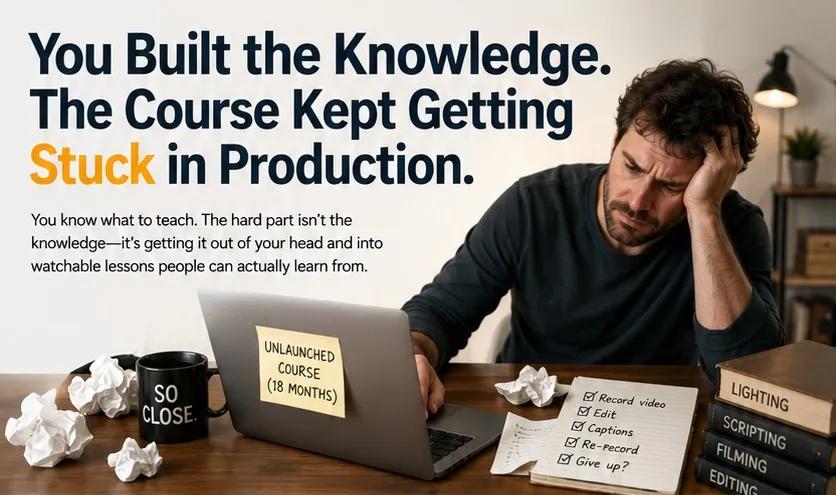
Someone I mentor spent three years getting genuinely good at one thing: helping small service businesses price their work. He had the frameworks, the case studies, the worksheets. What he also had was an unlaunched course that had lived on his hard drive for eighteen months, because every time he sat down to "finally record it," the setup swallowed the whole afternoon. Lighting. A script that sounded natural on camera. A dozen takes because he stumbled on one line. By dinner he had four rough minutes and a strong urge to give up.
His problem was never the knowledge. It was that turning knowledge into watchable lessons had become a production job he never signed up for. And that's the quiet tax on so many people who know something worth teaching: the lesson is ready long before the studio skills are, so the course, the workshop, the video series stays perpetually "almost." The dream of passing on what you know keeps getting postponed by the mechanics of filming it.
Why the Production Step Is Where It Dies
A written module gets skimmed; a guided lesson gets watched. Anyone who has tried to teach online knows this, which is why the plan is always video. But video, done the traditional way, means scripting for the screen, filming, editing, and captioning. Four skills unrelated to the thing you're actually good at. For one person doing it in the margins of an already full life, that's a second job. Add the very common discomfort of being on camera, and the whole project quietly stalls at exactly the point where it would start to matter.
Turning Your Material Into Lessons Without the Studio
What breaks the logjam is a tool that builds the lesson from the material you already have, instead of asking you to perform a new one. You bring the deck or the notes; the software drafts the structure, lays out the scenes, and generates the narration.
An AI lecture video generator like Leadde is designed around that. You upload your course notes, a PDF, a slide deck, or pasted text, and it drafts an outline, builds the on-screen scenes, and produces the voiceover. It's not a flat read-through: you can set the narrative style (explanatory and structured for a teaching module, warmer for an intro), choose a level of detail from a tight summary to something comprehensive, and name your audience and learning goal so the script teaches rather than lists.
Two things help specifically if being on camera is the sticking point. There are 200-plus built-in presenters, and you can generate a personal avatar from a single photo, so you can put a consistent, familiar face on every lesson without filming a frame, and fix a flubbed line by editing text instead of re-recording. Support for 88 languages and 175 dialects also lets you offer a lesson to a wider audience by translating the finished video, script and on-screen text together. Useful if the people you want to reach aren't all in one place.
Where It Fits for Everyday Teachers
The uses show up fast. A retired nurse turns years of caregiving know-how into a short series for new families. A hobbyist woodworker packages a signature build into an evergreen mini-course. A community volunteer finally ships the "how this works" walkthrough that's been sitting in drafts, because "record it" no longer means a lost weekend. In each case the material was done. It was the format that never got finished.
Where It Falls Short
Straight talk serves you better than a sales pitch. AI presenters have improved a lot, but on close attention they still read as slightly synthetic, so for the personal welcome message where your real warmth is the point, film yourself. The format suits conceptual, explain-this teaching much more than anything built on live energy or physical demonstration. And it only reflects what you feed it: a vague, unstructured lesson produces a vague video, so the clarity of your own thinking still does the heavy lifting. Intricate worksheets are better handed over as a download than narrated on screen.
A Small First Test
Don't try to produce the whole course this week. Take the single lesson you could teach in your sleep, the one people always thank you for, run it through a free tier, and put the result somewhere real: a page, a free module, an email to friends or followers. Watch how far people get and whether it actually helps anyone. If a watchable version earns its keep on your strongest lesson, the rest of the course stops being a someday project and starts being a thing you actually finish.
Written by a lifestyle and personal-growth writer who covers learning, healthy routines, and turning what you know into something you can share without burning out.