

Your Brand Reputation Now Has a Different Score on Every AI Platform and Most Brands Don't Know It
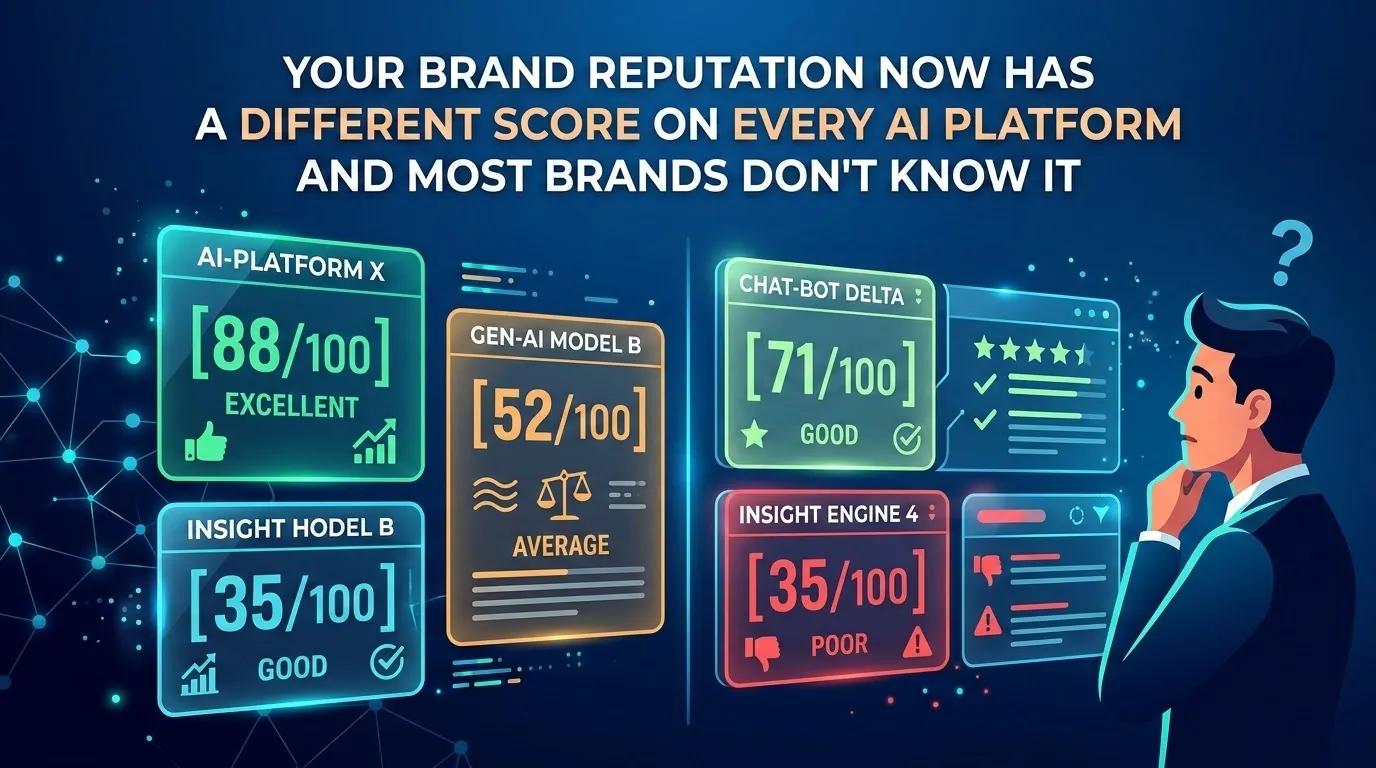
Brand reputation no longer lives in one place. It's being scored, rated, and summarized across ChatGPT, Gemini, Claude, and Perplexity simultaneously, and those scores don't match. Your brand might earn an 8.7 on one platform and a 6.2 on another, with no alert, no dashboard, and no way to know unless you go looking.
This isn't a fringe concern. It's a structural shift in how consumers discover and evaluate brands, yet most marketing teams still treat AI platforms as if they don't exist.
The Hidden Problem: Brand Reputation Scores Vary Dramatically Across AI Platforms
Nike scores 8.7/10 on ChatGPT. Gemini rates it 6.2/10. Tesla pulls a 9.1 from ChatGPT and a 7.2 from Claude. These aren't rounding errors. They reflect genuinely different interpretations of the same public information, processed through different models with different priorities.
This is what's known as AI reputation fragmentation. It happens when a brand's perceived trustworthiness, sentiment, and authority are calculated differently depending on which AI platform a user happens to query.
Platform | Tesla Score |
ChatGPT | 9.1 |
Claude | 7.8 |
Perplexity | 8.4 |
The variance is consistent enough to be meaningful. And because most brands aren't tracking it, the fragmentation compounds silently over time.
Why AI Platforms Generate Different Scores for the Same Brand
Three factors drive the divergence.
Training data cutoffs. GPT-4 has a knowledge cutoff of September 2023. Gemini extended its baseline to January 2024. Any brand development, crisis, or reputation shift that fell between those dates gets weighted differently across models.
Model architecture. Gemini processes text alongside images and video, which means visual brand signals like ad creative, product photography, and logo associations factor into its scoring. Text-only models don't have that input.
Fine-tuning priorities. Claude's training emphasizes safety and ethical evaluation. Perplexity prioritizes recency using live web crawling. The same brand story gets filtered through different value systems.
Tesla's Elon Musk coverage is a clear example. Coverage that reads as bold innovation in one dataset reads as governance risk in another. The brand is the same. The interpretive lens is not.
How the Four Major AI Platforms Score Your Brand
These four platforms collectively handle the vast majority of AI search traffic.
Platform | Market Share | Scoring Method | Key Strength |
ChatGPT | 62% | LLM inference | Conversational depth |
Gemini | 18% | Multimodal AI | Visual brand analysis |
Claude | 12% | Constitutional AI | Ethical scoring |
Perplexity | 5% | Real-time search | Current events impact |
Each platform approaches brand evaluation differently. ChatGPT draws from a large training corpus and excels at sentiment inference through natural language. Gemini blends text, image, and video signals, making it uniquely sensitive to how brands appear visually across the web.
Claude applies what it calls 'constitutional AI,' drawing on curated sources and weighting outputs against ethical guidelines. Perplexity's approach is the most time-sensitive: it indexes the live web, which means a news cycle from last week can shift a score today.
To test this yourself, run the query "Rate [brand] reputation 1-10 with 3 reasons" across all four platforms. Record the responses verbatim. The variance will likely surprise you.
How AI Platforms Actually Calculate a Reputation Score
The underlying process follows a consistent pipeline, even if the outputs differ.
Step 1: Query parsing. The platform uses BERT-style tokenization to break the query into tokens and identify intent. "Is Nike reliable for athletic gear?" gets parsed into entities, modifiers, and relational signals.
Step 2: Named entity recognition. Tools like spaCy extract brand entities from scraped web content and knowledge graphs. "Nike" is tagged as an organization and linked to structured data sources, including Wikidata.
Step 3: Sentiment aggregation. VADER or a similar model scores text on a scale from -1 (negative) to +1 (positive). Reviews, news mentions, social content, and forum posts all feed this layer.
Step 4: Authority weighting. A PageRank-style algorithm evaluates the source quality behind each mention. A brand referenced in a high-authority publication carries more weight than the same mention in a low-traffic blog.
Step 5: Final synthesis. The platform combines signals using a weighting formula. A common approximation looks like this:
score = 0.4 × sentiment + 0.3 × recency + 0.2 × volume + 0.1 × authority
The reason scores vary across platforms is that each one applies different weights to these inputs. Claude may down-weight recency in favor of source curation. Perplexity may invert that ratio entirely. The formula is the same in structure. The coefficients are not.
Why Most Brands Have No Visibility Into This
A 2024 Gartner survey found that 92% of marketing executives cannot query their brand's AI reputation scores across major platforms. That number is high, but it's not surprising.
Traditional SEO tools, Ahrefs, Semrush, Moz, and the rest, were built to track search rankings, backlinks, and keyword positions. None of them were designed to surface how a generative model is characterizing your brand in conversational responses. Those are fundamentally different outputs.
There are no native dashboards for AI reputation monitoring, as Google Analytics does for web traffic. Tracking multi-platform scores requires custom prompt setups, manual queries, or third-party workflows that most marketing teams haven't built.
The assumption that traditional SEO covers AI search is widespread and incorrect. Organic rankings and AI-generated brand assessments are related but not the same thing.
Companies like NetReputation have documented this gap in depth, noting that brands optimized for Google's algorithm often have significant blind spots in how AI platforms characterize them. The problem isn't just a lack of tools. It's a lack of awareness that the problem exists.
Real-World Score Disparities and What They Reveal
Brand | ChatGPT | Gemini | Claude | Perplexity | Variance | Key Factor |
Tesla | 9.1 | 8.4 | 7.2 | 8.9 | 1.9 | Musk factor |
Nike | 8.7 | 6.2 | 8.1 | 7.8 | 2.5 | Labor issues |
Boeing | 5.8 | 4.1 | 6.3 | 4.9 | 2.2 | Safety crisis |
Nike's 2.5-point spread is particularly instructive. Gemini's multimodal training appears to place greater weight on labor supply chain coverage than ChatGPT's corpus does. Neither platform is wrong. They're reflecting different aspects of a complex brand story.
Boeing's variance shows something different. Safety-related coverage appears across all training datasets, which is why scores are consistently low. But the spread still reaches 2.2 points, suggesting that how platforms weight severity versus recency produces meaningfully different outputs even when the underlying facts are similar.
The Business Risks of Fragmented AI Reputation Scores
Trust Erosion in Consumer Decision-Making
Consumers increasingly rely on AI platforms to evaluate purchases, particularly in younger demographics. When a user queries ChatGPT and sees an 8/10, then cross-checks with Gemini and gets a 5/10, the result is cognitive dissonance. Neither score feels authoritative. Both create doubt.
That doubt has measurable conversion implications. A brand score drop on a single platform, if it's the one a customer happens to use first, can interrupt a purchase decision before any human interaction occurs.
B2B and Enterprise Sales Friction
In B2B contexts, procurement teams and executives increasingly use AI tools to evaluate vendor credibility before entering negotiations. Conflicting scores across platforms create friction at precisely the moment a brand needs to build confidence.
The aftermath of the Equifax data breach is an example worth studying. AI platforms diverged in their risk assessments, with some models rating their trust score positively while others flagged systemic issues. That inconsistency made the reputation damage harder to manage and longer to repair.
How to Audit Your AI Reputation in 90 Minutes
This process works with any brand and requires no specialized tools to get started.
Step 1: Query four platforms (15 minutes). Use this exact template on ChatGPT, Gemini, Claude, and Perplexity: "Rate [brand] reputation 1-10 with 3 reasons." Record the scores and the reasoning verbatim.
Step 2: Extract and normalize scores (10 minutes). Pull the numerical rating from each response. If a platform gives a range or qualifier, note it. You're looking for a single comparable number per platform.
Step 3: Calculate variance (5 minutes). Compute the standard deviation across your four scores. A standard deviation above 1.5 indicates high-risk fragmentation that warrants immediate attention.
Step 4: Analyze the discrepancies (20 minutes). Run a follow-up prompt: "Why might different AI platforms rate [brand] differently?" The responses will surface the specific factors, labor practices, executive coverage, and product recalls that each platform is weighing.
Step 5: Benchmark against three competitors (25 minutes). Run the same process for your closest competitors. Map where you lead and where you lag relative to their multi-platform scores.
Step 6: Build a tracking sheet (10 minutes). Set up a Google Sheet to log scores by platform and date. Even a manual monthly audit creates useful trend data over time.
Step 7: Set change alerts (5 minutes). Use IFTTT or Zapier to alert you when automated queries return scores that deviate from your baseline.
Five Strategies to Align Your Brand Reputation Scores Across AI Platforms
1. Unify Your Core Messaging Across Every Channel
AI platforms build their understanding of your brand by aggregating signals from across the web. When your website, press releases, social profiles, and media coverage all use consistent language that aligns with your brand values and positioning, entity recognition improves and hallucinations decrease.
Audit your owned channels for semantic consistency. Your LinkedIn bio, your about page, and your boilerplate press copy should reinforce the same core narrative.
2. Optimize for E-E-A-T Across Your Content
E-E-A-T, which stands for experience, expertise, authoritativeness, and trustworthiness, is the framework Google uses to evaluate content quality. Large language models apply similar criteria when weighting sources.
Detailed author bios, schema markup for your organization and key personnel, citations to verifiable sources, and regularly updated content all contribute to how authoritative your brand appears to AI crawlers.
3. Run Competitive Gap Analysis Through "Vs" Queries
Query "YourBrand vs [Competitor]" on ChatGPT and Gemini separately. These queries reveal how AI platforms position your brand relative to alternatives, which is often how consumers frame their actual searches.
Where competitors score higher, examine what content or signals are driving that advantage. Build content specifically targeting the gaps your analysis reveals.
4. Prepare Crisis Response Content Before You Need It
When a brand crisis occurs, the absence of clear, factual, structured content creates a vacuum. AI platforms fill that vacuum with whatever they can find, often negative coverage.
Prepare FAQ-style content that proactively addresses your most vulnerable reputation topics. Publish it on your site with appropriate schema markup. Test periodically with Perplexity to see how live-indexed platforms are characterizing the issue.
5. Use Employee Advocacy to Build Authentic Brand Signals
Consistent brand mentions from credible human sources raise sentiment scores across platforms. An employee advocacy program where staff shares branded content with consistent framing builds the volume and authenticity signals that LLMs reward.
This works best when it's genuinely voluntary and thematically consistent rather than scripted. Authentic shares outperform templated ones in AI sentiment weighting.
Tools for Ongoing AI Reputation Monitoring
Tool | Monthly Cost | Platforms Covered | Best For |
Brand24 | $49 | 4/4 | News and mention monitoring |
Zapier + OpenAI | $20 | Custom | Automated score queries |
Gaps.com | $29 | 3/4 | Executive dashboards |
Google Sheets | Free | Manual | Startups and initial audits |
A practical starting pipeline connects RSS feeds to Zapier, routes them through OpenAI for sentiment analysis, and logs outputs in Google Sheets. This setup costs under $50 per month and creates a functional baseline for tracking AI reputation across platforms.
Three monitoring practices worth maintaining:
Run weekly queries across all four platforms to catch score shifts before they compound
Set alerts for any single-platform change greater than 5% from your established baseline
Conduct quarterly competitive benchmarking to track your share of voice in AI-generated brand comparisons
AI reputation monitoring isn't a one-time audit. It's an ongoing discipline, and the brands that establish it now will have a significant advantage as AI-assisted decision-making becomes the default for more consumers.