

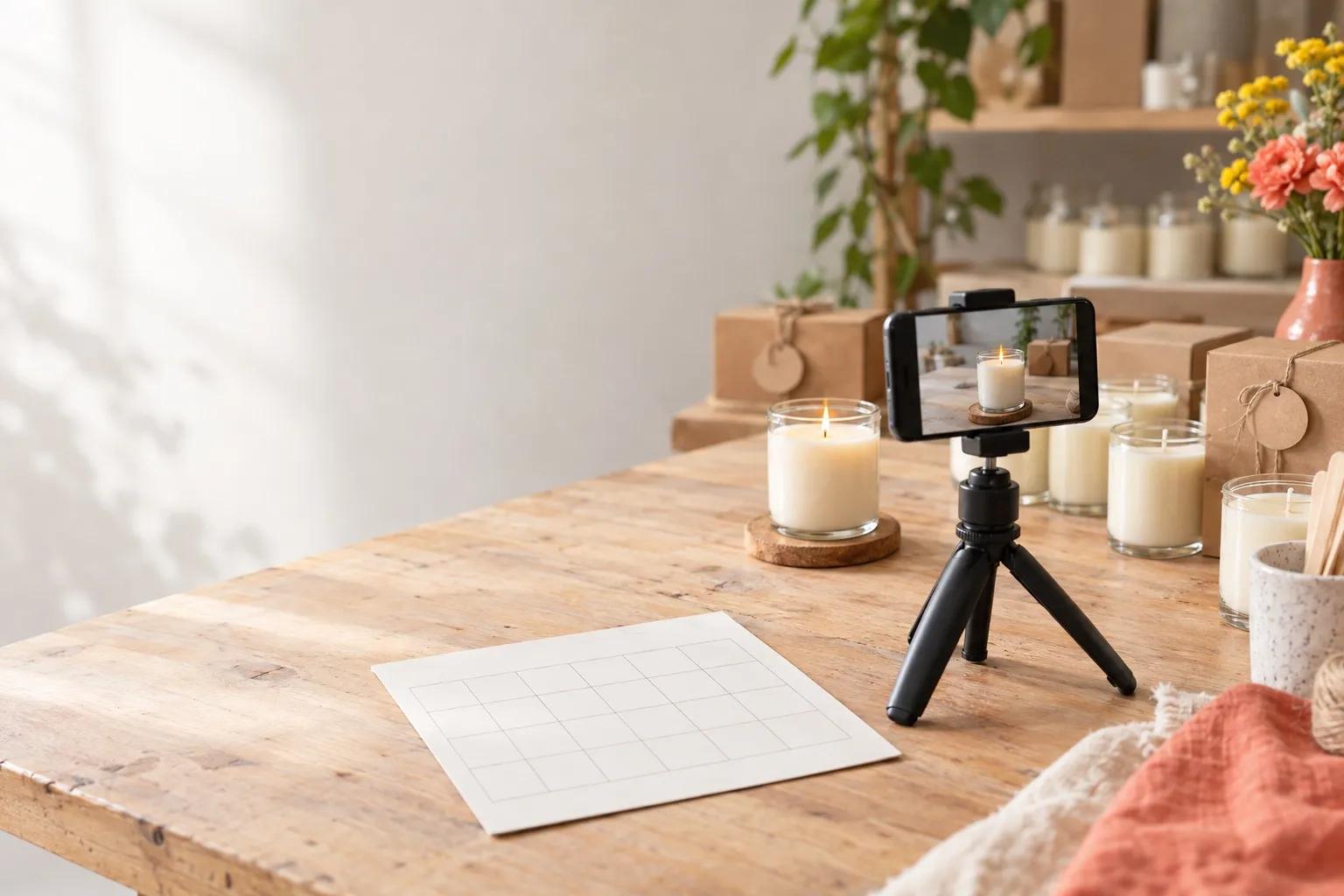
Your small business does not need a large Instagram budget on day one. It needs a useful profile, a few things to post and enough time to notice what customers actually ask about.
Treat the first month as a practical test. Before you pay for ads, book a photographer or consider a paid growth service, find out what you can learn with your phone and a notebook.
Imagine you run a neighborhood candle business. You make the candles yourself and sell at local markets. That gives you plenty to work with, but it does not tell you which Instagram activity deserves your money. The first 30 days can help you make that decision.
Week 1: Make Your Profile Useful Before Making It Busy
Start with the information a potential customer needs. Your bio should explain what you sell, where you operate and how someone can place an order.
For the candle business, that means describing the product plainly and mentioning your town. If local collection is available, say so. Avoid spending the whole bio on a slogan that leaves visitors guessing.
Choose a recognizable profile picture. A clear logo can work, but a simple product image may be easier to read at a small size. Check it on your phone rather than judging it only on a laptop.
Give your profile link one clear job. Send visitors to the most useful destination, such as your shop or current market schedule. Open it yourself and check that the next step is obvious.
Set up a professional account so you can access Insights and relevant contact options. Add an appropriate contact button, but only publish details you are comfortable making public. Test it before inviting customers to use it.
Build a few Highlights from useful Stories. For a candle maker, “Scents,” “Ordering” and “Candle Care” would be sensible starting points.
You do not need custom graphics for all of this. Plain text that someone can read is more useful than an attractive cover hiding missing information.
Week 2: Try Different Formats Without Producing a Whole Campaign
Now give yourself a small posting experiment. Try a product photo, a short video and a Story that asks a straightforward question.
Use the same candle across these formats where possible. That keeps production manageable and helps you compare how different presentations work without changing everything at once.
Your photo might show the candle beside an object that makes its size clear. Your video could show you trimming a wick before packing an order. Your Story could ask whether people prefer lighter or richer scents.
Give each post a purpose. A product photo can show exactly what someone would take home. A making video can answer a question about your process. A Story can invite a quick response.
Look beyond likes. Notice whether people save care instructions, visit your profile or ask about prices. Those actions may be more useful to your business than a passing reaction, although none proves that a sale will follow.
Keep a simple record of what you posted and what happened. Include the time it took to make each piece.
A format that attracts questions but takes an entire afternoon may need simplifying. One quiet post is not enough reason to abandon an idea, either. Your early comparisons are clues, not firm conclusions.
Week 3: Have Conversations That Help You Understand Customers
This week, spend less energy filling the feed and more energy listening.
Reply to comments with useful answers. If someone asks how long a candle should burn at once, explain the guidance for that product. If the same question keeps appearing, turn the answer into a future post or Highlight.
Use direct messages carefully. Respond when people contact you, but do not treat every new follower as an invitation to send a sales pitch.
Look at local accounts that connect naturally with your business. For the candle maker, that might include a nearby gift shop or the organizer of a neighborhood market.
Read before commenting. A specific response to a market announcement makes more sense than leaving the same promotional line under unrelated posts.
You can also ask existing customers what information would make ordering easier. Keep the question narrow. Asking whether scent descriptions are clear is easier to answer than asking what people think of your entire account.
Conversations take time, and not every exchange will lead to a sale. Their value is partly in revealing confusion you can fix for free.
Week 4: Review Insights Before Reaching for Your Wallet
Open Insights and look for patterns across the month. Which posts prompted profile visits? What brought questions about price or collection? Did anyone tap through to your shop?
Compare similar content where you can. A short video and a product photograph may serve different purposes, so judging them only by views can lead you toward the wrong spending decision.
Your account is still young. A small amount of activity is not a reliable forecast of future sales. Combine Insights with the questions people asked and the practical effort each post required.
Then identify the problem you would be paying to solve.
If your product photographs leave colors unclear, a limited photography session may be worth considering. Ask for a defined set of images rather than committing to an open-ended booking.
If customers understand the offer and your shop page works, a small ad test could be reasonable. Set a spending limit and decide what you want to learn before starting.
Paid growth services deserve the same caution. Some of them offer a small free sample, which shows how the process works at no cost, provided you read the terms and understand the limits.
If you consider a free Instagram followers trial, use it to examine the process, not as proof that your business is attracting customers. Added followers do not show real interest in your candles and can make audience activity harder to interpret.
Check whether a trial creates any ongoing commitment. Do not hand over your Instagram password. You may decide that a service does not address your actual business need, which is a useful decision to reach before paying.
Finish the Month With One Clear Next Step
You do not need to fund every promising idea at once.
Choose one next step based on what you observed. That might be improving product photographs, repeating a useful video format or testing a tightly limited ad.
Write down why you chose it and what would make you continue or stop. Keep time in the calculation as well as money.
For your candle business, the best first month is not necessarily the busiest one. It is a month that leaves customers better informed and gives you a clearer reason for whatever you spend next.