

Best Retirement Planning Firms in Miami: Fees, Assets and Client Satisfaction Compared

Image source: freepik
Sunshine, zero state income tax, and a booming retiree scene keep drawing newcomers to Miami. Florida welcomed roughly 467,000 new residents in 2024 alone—many chasing a warmer, wallet-friendlier retirement, according to a Kiplinger analysis.
Yet those same perks create planning puzzles a quick Google search can’t untangle. The SECURE 2.0 Act, for instance, pushed required minimum distributions to age 73 and schedules another jump to 75, according to retirement-plan administrator FuturePlan. Mis-time a withdrawal and the IRS bites back.
We reviewed two dozen Miami-area advisory firms, scored them on fees, service depth, credentials, technology, and client satisfaction, and crowned the ten stand-outs below. Let’s dive in.
Why retirement planning in Miami calls for a specialist
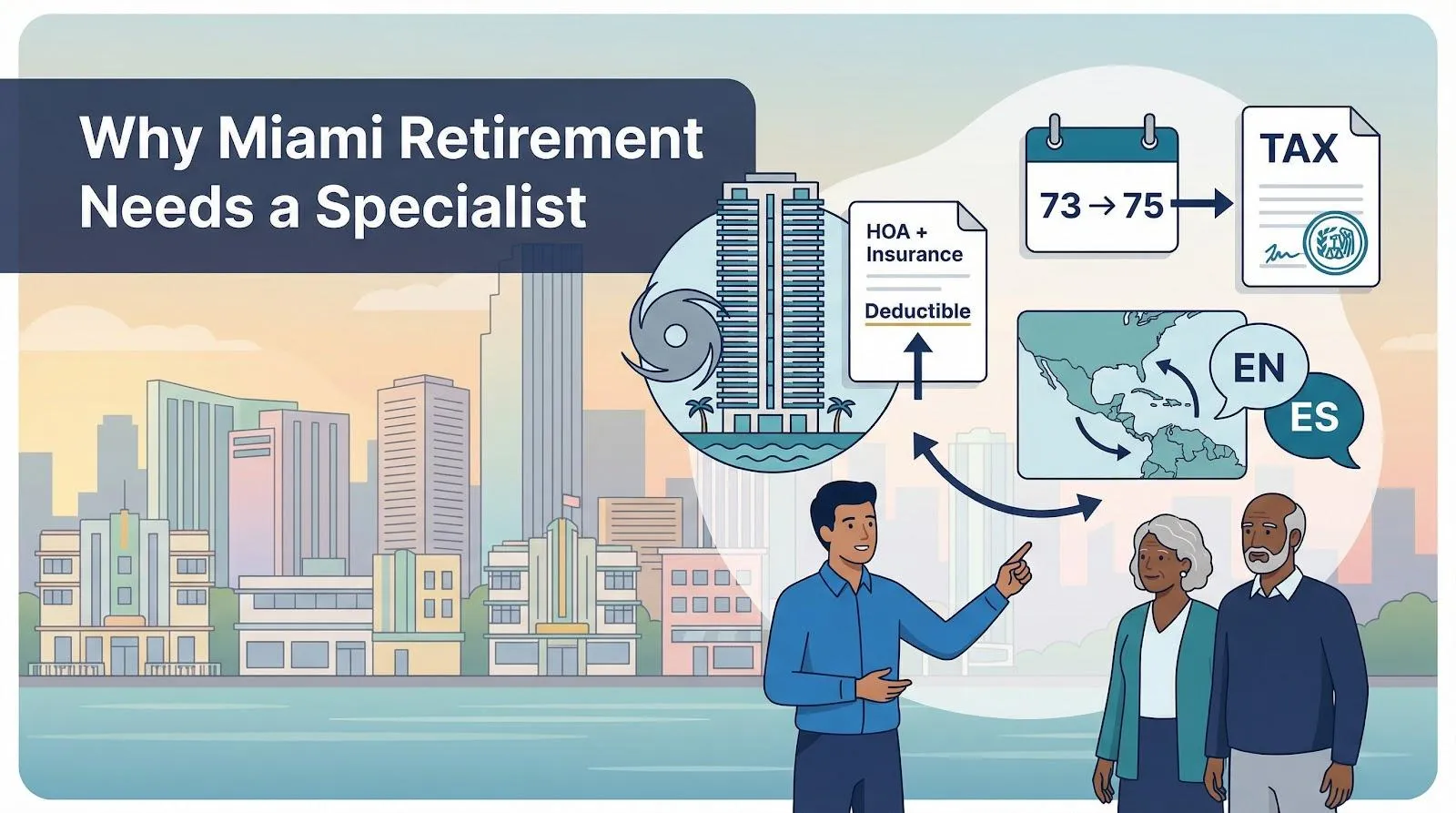
Miami isn’t just warm weather and pastel skylines. It’s a mash-up of global wealth, snowbird lifestyles, and family-owned businesses moving cash in several currencies at once. Those quirks bend almost every rule of thumb you’ve read on national money blogs.
Property costs often jump after hurricane season, and insurance deductibles follow suit. A plan that looks solid in Chicago can spring leaks here once you price a waterfront condo’s HOA fees and required storm coverage.
Taxes flip the usual script, too. Florida’s zero state income tax frees room in your cash-flow plan, yet the lack of a state levy pushes federal choices such as Roth conversions, capital-gain timing, and Social Security withholding to center stage. A one-size-fits-all calculator can’t juggle those trade-offs.
Add legislation such as SECURE 2.0, which resets required minimum distribution ages, and the picture gets even busier. Miss the new timetable and the IRS penalty can swallow half the amount you should have withdrawn.
Finally, Miami is bilingual and international to its core. Cross-border assets, inherited property in Latin America, or adult children living abroad call for advisors fluent in both languages and treaties.
Bottom line: you’ll sleep better with a planner who understands how South Florida really works, not someone answering calls from a thousand miles away.
How we picked and scored Miami’s stand-outs
Transparency matters, so here’s the recipe we used before handing out any trophies.
First, we compiled a list of two dozen SEC-registered firms with offices in Miami-Dade or Broward. Then we reviewed each firm’s Form ADV, fee disclosures, BBB file, and Google reviews. Every data point fed into a five-factor scorecard.
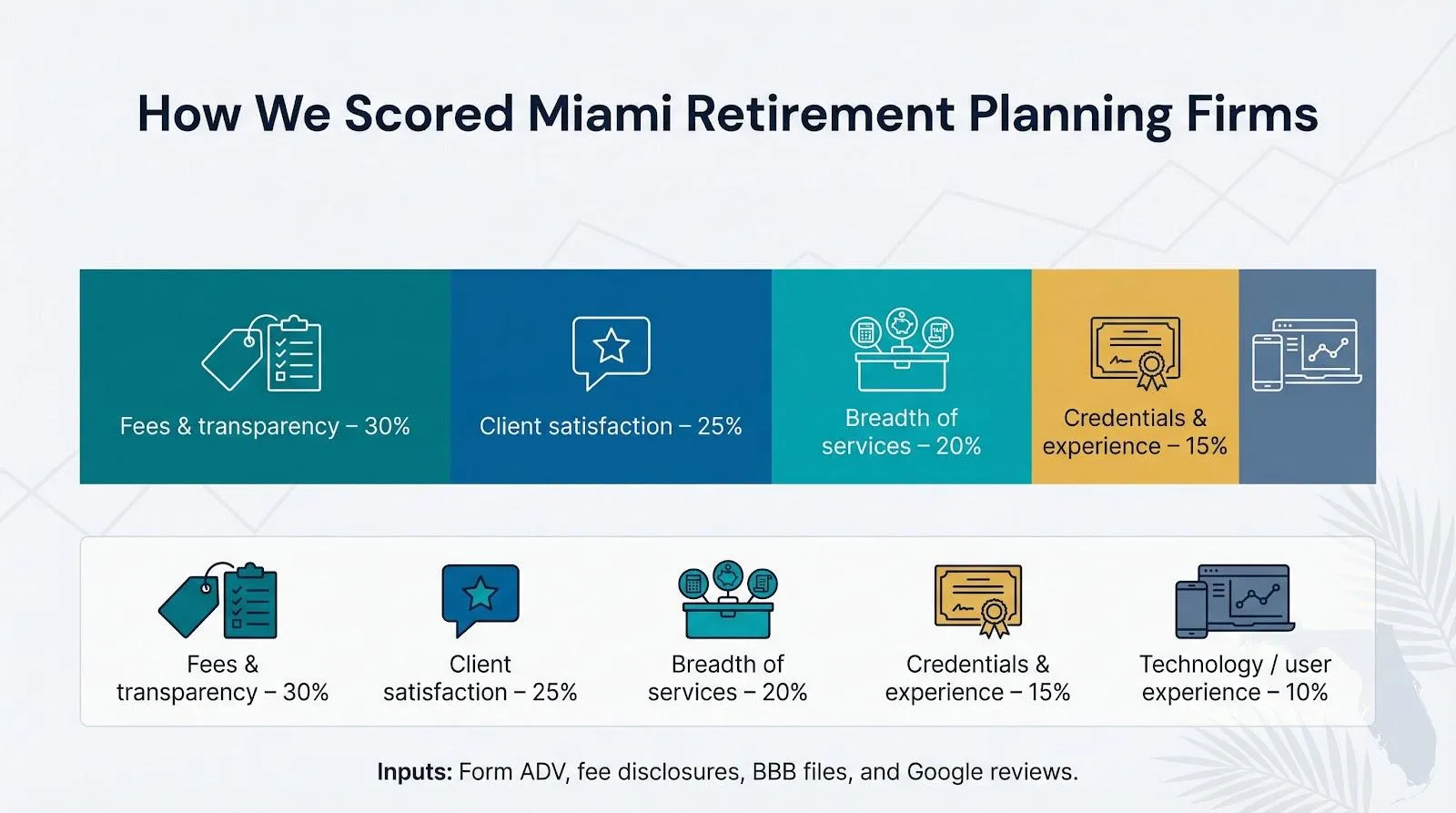
Fees & transparency (30 percent): clear pricing with no surprise add-ons.
Client satisfaction (25 percent): complaint history, third-party ratings, and depth of positive reviews.
Breadth of services (20 percent): retirement income models, tax planning, estate coordination, and tech tools.
Credentials & experience (15 percent): CFP®, CFA, CPA designations plus firm tenure in Florida.
Technology / user experience (10 percent): secure portals, mobile apps, and real-time reporting.
Each firm earned a raw score in every category. We multiplied by the weight, tallied the totals, and let the math decide the ranking. Nobody could buy a higher spot.
If you want the nitty-gritty, the full scoring matrix, sample worksheets, and data-pull dates sit in a downloadable PDF at the end of this article. For now, know that the numbers behind the names are objective, current, and easy to replicate.
The 2026 leaderboard: ten firms, one quick scan
Before we unpack each advisor in detail, here’s the fifty-thousand-foot view. A quick glance shows who plays in your asset range and which specialty fits your top worry.
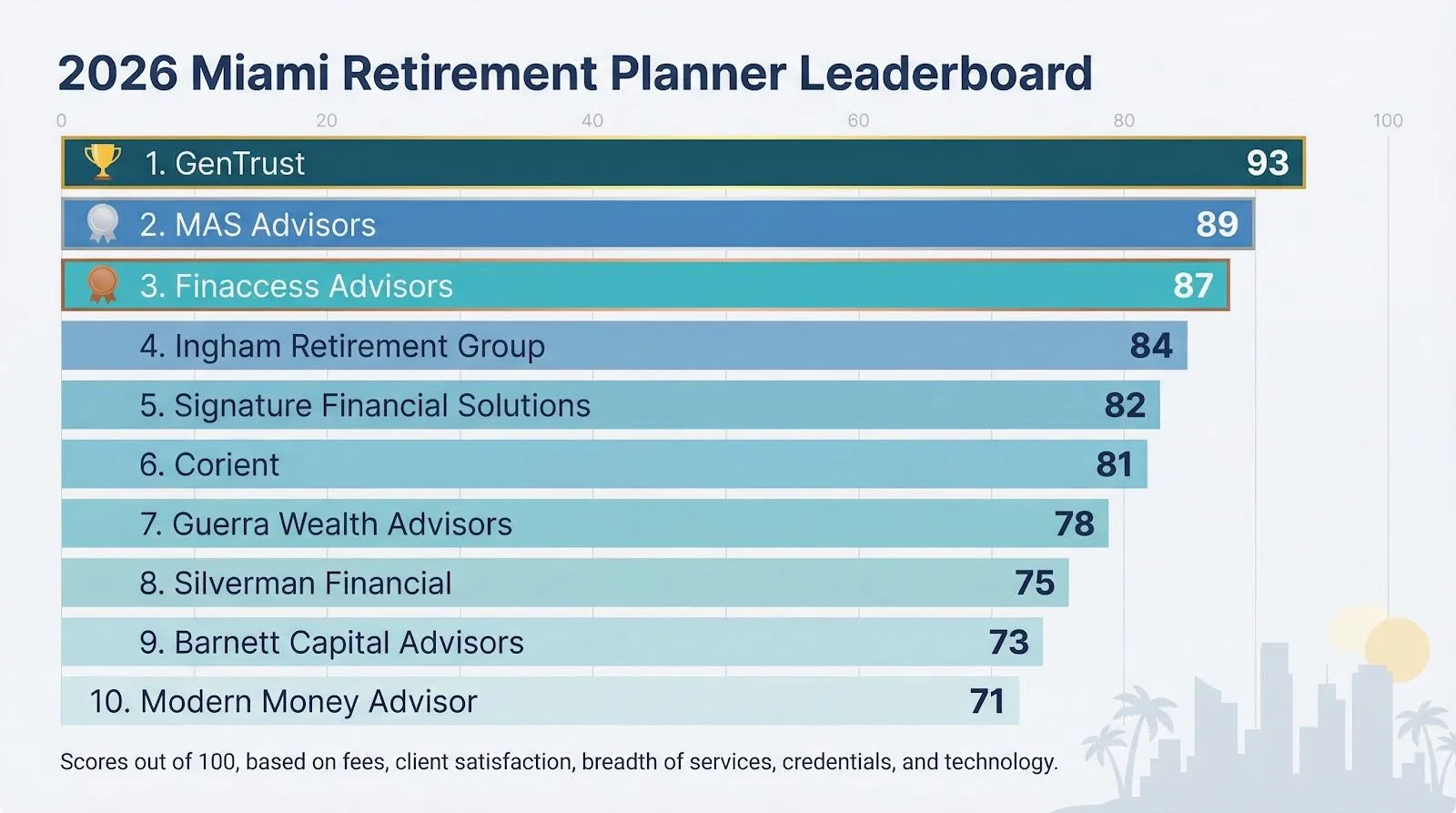
Rank | Firm | Total score (/100) | Typical minimum | Core edge |
1 | GenTrust | 93 | $10 million | Deep bench for ultra-wealthy, institutional research |
2 | MAS Advisors | 89 | $250 k | Tax-efficient investing and PPLI know-how |
3 | Finaccess Advisors | 87 | $1 million* | Cross-border planning for LatAm families |
4 | Ingham Retirement Group | 84 | $100 k | Pension and 401(k) rollover mastery |
5 | Signature Financial Solutions | 82 | Varies | Education-first, statewide reach |
6 | Corient | 81 | None (practical $1 million+) | Big-firm tools, boutique feel |
7 | Guerra Wealth Advisors | 78 | None | Bilingual focus on middle-class households |
8 | Silverman Financial | 75 | Flexible | One-advisor intimacy for recent retirees |
9 | Barnett Capital Advisors | 73 | None | Planning-only option with coaching vibe |
10 | Modern Money Advisor | 71 | None | Debt-conscious approach for Gen X/Y savers |
*Finaccess publishes no hard floor, but most clients land north of a million in investable assets.
Scores reflect the weighted criteria we covered earlier. They will update when fresh regulatory filings or major firm events justify a refresh, so you can trust the ranking mirrors the Miami market as it stands today.
1. GenTrust: best for high-net-worth retirement planning
GenTrust tops our list for a simple reason: it delivers family-office muscle without Wall Street sales quotas. Founded in 2011 by former institutional traders, the firm now stewards about $4.46 billion, according to its latest Form ADV.
Walk into the Brickell Avenue office and you’ll meet a team packed with CFPs, CFAs, and former hedge-fund analysts. That depth shows up in the menu: direct indexing for tax efficiency, private-equity co-investments, and in-house fixed-income research. Every recommendation flows through a fiduciary, fee-only lens, so pricing stays a clear percentage of assets with no hidden commissions.
GenTrust’s real edge for retirees is risk management. Portfolios rely on factor-based models that balance growth with downside protection, a relief when market squalls threaten decades of savings. The firm layers on concierge extras such as bill pay, heir education, and cross-border tax coordination to smooth day-to-day life for wealthy families.
Ideal fit: investors with $10 million or more who want Wall Street sophistication minus the bank-brand baggage. If your retirement priorities include diversifying concentrated stock, funding charitable trusts, or guiding the next generation, GenTrust belongs on your short list.
2. MAS Advisors: best for tax-smart investing

If sharing a slice of every gain with the IRS keeps you up at night, MAS Advisors belongs on your short list. Head-quartered in Coral Gables since 2012, this boutique RIA manages about $1.5 billion, according to its most recent regulatory filing, and builds strategies that strip out avoidable tax drag.
Step into the office and you’re as likely to meet a CPA as a CFP. That blend shows up immediately: advisors run side-by-side projections on Roth conversions, asset location, and tax-loss harvesting before recommending a single fund. For qualified clients they even use Private Placement Life Insurance, sheltering growth in a wrapper the IRS largely ignores.
Fees stay straightforward. A sliding AUM charge starts near one percent for smaller balances and eases lower as assets grow. Planning is bundled in, so you’re not charged extra for every cash-flow update or Social Security tweak.
Technology rounds out the picture. The MAS portal lets you toggle between pre-tax and after-tax views of your net worth with one click, turning complex math into clear visuals.
Ideal fit: high-income professionals, business sellers, or anyone holding a large taxable account who wants to keep more and surrender less. If retirement success is measured in after-tax dollars, MAS has the toolkit.
3. Finaccess Advisors: best for international and Latin American investors
Miami serves as the northern capital of Latin America, and Finaccess Advisors meets that market head-on. Backed by Grupo Finaccess, the firm manages about $4 billion for entrepreneurs and executives who split time and assets between countries, based on its latest ADV filing.
The team’s edge is true cross-border fluency. Need to fund a U.S. retirement while holding a Mexican brokerage account and a Panama trust? They map tax treaties, currency swings, and reporting rules before you can say FATCA. Meetings unfold in either Spanish or English, so details stay clear.
Portfolios lean global, often mixing U.S. core holdings with selective Latin American opportunities and alternative funds sourced through the parent group abroad. Fees remain fee-only, hovering near one percent and scaling down for larger balances, with no hidden spreads.
Clients most often praise the cultural fit. Advisors understand multi-generation dynamics where parents, children, and siblings all share financial roles. Estate plans span borders, and review sessions frequently include two generations at the same table.
Ideal fit: bilingual families, expats, or anyone juggling assets in multiple jurisdictions. If your balance sheet carries more than one passport, Finaccess brings both the roadmap and the language skills.
4. Ingham Retirement Group: best for employer plans and 401(k) rollovers
If most of your nest egg sits inside a workplace plan, Ingham has probably seen its twin. Founded in Miami in 1972, this employee-owned RIA oversees about $2.31 billion, according to its Part 2A brochure, and still earns most of its stripes designing and fixing 401(k) and pension plans.
That history pays dividends for individual retirees. Advisors translate dense summary-plan descriptions into plain English, model the math on lump-sum offers, and walk you through Florida Retirement System rules. When it’s time to roll assets out, they structure the move so you avoid withholding traps and keep your money working.
Fees stay familiar—around one percent for smaller household accounts, sliding lower as balances rise. Planning time is bundled, so you can ask, “What if I take the survivor option?” without watching a billing clock.
The vibe is steady and methodical. Many staff members have logged two decades with the firm, and that tenure shows in calm counsel during market swings. Technology is solid: expect a user-friendly portal and quarterly deep-dive reports rather than flashy updates.
Ideal fit: corporate or public-sector employees facing a sizable 401(k) or pension decision. If your biggest retirement question is “What do I do with my work plan now?” Ingham offers the clearest playbook in town.
5. Signature Financial Solutions: best for in-depth education and holistic planning
Some firms promise to empower clients; Signature Financial Solutions builds a curriculum around it. With a Coconut Grove office backed by a statewide network dating to 1993, the firm layers every plan with plain-language guides and workshops. It also maintains an online hub of financial planning FAQs that walks clients through fees, fiduciary duty, and retirement-income tactics, which makes it ideal for late-night browsing.
Advisors wear two hats: coach and quarterback. Meetings start with goal-setting exercises that turn lifestyle wishes into hard numbers, then branch into investments, tax moves, insurance, and estate coordination. Because many planners also hold insurance licenses, the team can fold annuities or long-term-care coverage into the mix under a fiduciary mandate.
Costs stay transparent. Expect an AUM fee near one percent for average-sized accounts, with breakpoints as assets grow. Flat-fee planning is available if you only need a blueprint and prefer to self-manage investments.
Tech completes the circle. A secure portal and mobile app pull every account—401(k), brokerage, and bank—into one dashboard so you can track progress in real time. Few platforms show both performance stats and an easy read on how each holding supports your retirement income targets.
Ideal fit: retirees or near-retirees who want to learn as they go and value having investment, insurance, and planning pros under one Florida-savvy roof.
6. Corient: best for one-stop, big-firm resources
Sometimes you want the scale of a national powerhouse without the commission pressure of a wirehouse. Corient fits that need. The partnership oversees about $224 billion in client assets, according to its corporate website, and runs a seasoned team in Brickell, giving Miami retirees access to institutional research and deep planning benches.
Service feels like a private bank operating under a fiduciary umbrella. You meet with a lead advisor who coordinates specialists in tax, trusts, philanthropy, and concentrated-stock hedging. Meetings end with a clear action list, not a product pitch.
Fees stay transparent: a tiered AUM schedule starts near one percent on the first million and drops at higher levels. Planning is bundled, and while no formal minimum applies, most local clients carry seven-figure portfolios.
Technology is a showpiece. Corient’s portal sweeps in every account you hold, then models what-if scenarios on cash flow, Social Security timing, and Roth conversions in real time. Think of it as a single cockpit for your financial life.
Ideal fit: affluent families who want investments, estate plans, and charitable goals managed from one dashboard. If you like big-firm breadth delivered by advisors who answer to clients instead of shareholders, Corient earns a call.
7. Guerra Wealth Advisors: best for middle-class families and bilingual service
You don’t need a seven-figure portfolio to receive first-class advice. Guerra Wealth Advisors shows that every day. The family-run firm manages a little over $600 million, according to its Form CRS, and keeps its culture warm, bilingual, and practical.
Conversations move easily between English and Spanish, and so do the planning tools. From budgeting templates to the signature “Guerra Freedom Plan,” materials arrive in the language you prefer, with zero jargon. That accessibility draws teachers, nurses, and small-business owners who want clarity without condescension.
Fee choices stay flexible. AUM pricing hovers near one percent, but many clients start with a flat-fee plan to test the waters. Any potential insurance commission is disclosed in writing before you sign.
Beyond investments, Guerra tackles debt payoff, Medicare decisions, and adult-child financial coaching. These extras matter when retirement money must stretch across three generations.
Ideal fit: Miami-area couples or solo retirees with modest portfolios who value a warm, bilingual relationship and step-by-step guidance.
8. Silverman Financial: best for personal, hands-on guidance
Picture retirement advice delivered at your kitchen table rather than across a boardroom. That’s Silverman Financial. Marc Silverman, CFP®, has served Miami retirees for more than thirty years, and he remains the primary point of contact for every client.
The boutique scale means no hand-offs to junior staff. You call, Marc answers. Review meetings run until every Social Security or Medicare question feels settled, and follow-ups often happen the same afternoon. It’s personal service in a city racing toward automation.
Investment management follows a balanced, plain-vanilla approach built on low-cost funds and steady withdrawal strategies. Where Silverman truly shines is income planning. Clients leave with bucket schedules, required-minimum-distribution calendars, and contingency plans for market downturns—written in language family members can follow.
Fees come in two flavors. Ongoing management lands near one percent of assets, while a one-time comprehensive plan costs a few thousand dollars. That à-la-carte option appeals to do-it-yourself investors who want a second set of eyes before pulling the retirement trigger.
Ideal fit: recent or soon-to-be retirees who crave continuity with a single, veteran advisor and prefer conversation over client portals.
9. Barnett Capital Advisors: best for planning-first coaching
Not everyone wants to hand over a portfolio; some of us just want a game plan and a coach on speed dial. Barnett Capital Advisors fits that need. The lean team manages about $88 million in assets, according to data compiled by FinanceHQ, and founder Andrew Carrillo, CFP®, built the practice around deep-dive planning sessions and year-round check-ins, not product pushes.
Engagements start with a forensic look at cash flow, employer plans, pensions, and debt. Monte Carlo simulations then stress-test your timeline against market bumps and longevity risk. Only after the roadmap feels right does Carrillo discuss investment management, and even that step stays optional.
The fee menu mirrors the philosophy. Pay a flat $2,000 to $5,000 for a comprehensive plan and quarterly coaching, or add portfolio oversight for about one percent of assets. No minimum balance. That openness attracts diligent savers who might feel “too small” elsewhere.
Education flows through every meeting. Expect homework sheets on Social Security timing, side-by-side charts for Roth conversions, and plain summaries you can share with family members. Workshops at local libraries and community centers reinforce each lesson.
Ideal fit: conscientious pre-retirees five to ten years out who want a roadmap more than a fancy fund lineup and who prefer a teacher’s mindset over a salesperson’s pitch.
10. Modern Money Advisor: best for debt-savvy Gen X and early-retiree planners
Angela Moore, CFP®, founded Modern Money Advisor to answer a question many traditional firms ignore: How do you plan for retirement while juggling student loans, a mortgage, and kids’ tuition? Working virtually from Miami Beach, her team uses flat monthly retainers that start around a few hundred dollars.
That subscription unlocks ongoing coaching on budgeting, debt payoff, and investment strategy. Clients meet quarterly on Zoom, track progress on a real-time dashboard, and can text quick questions such as, “Should I exercise these stock options?”
Investment management is available at 0.75 percent of assets but remains optional. This separation lets clients choose advice first and asset management later, if ever.
Technology drives the experience. Clients sync bank, loan, and brokerage accounts into a colorful portal that displays net-worth growth next to debt reduction. Watching a student-loan balance shrink while a 401(k) bar rises is powerful motivation.
Moore’s communication style is candid and culturally aware; local media often cite her as a fresh voice demystifying money for millennials and Gen Xers. Educational content arrives in bite-size videos and action checklists rather than long white papers.
Ideal fit: professionals in their thirties to fifties who want a coach as much as an advisor and who prefer predictable, subscription-style fees while knocking out debt on the path to financial independence.
Which firm fits you? A quick decision grid
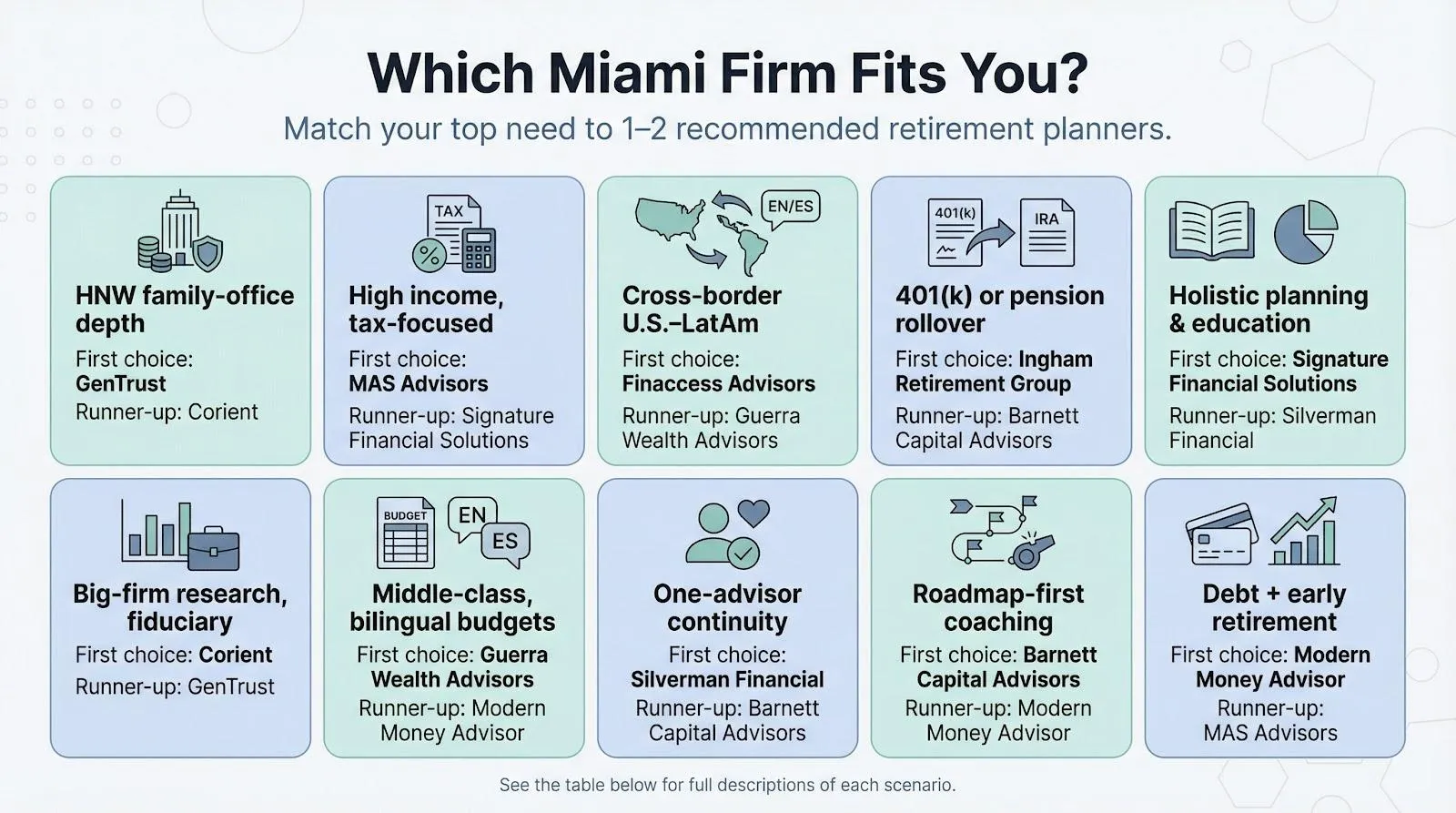
You’ve met the players; now match them to real-life situations. Find the description that sounds most like you and see who rises to the top.
Your top need | First choice | Close runner-up |
$10 million or more, want family-office depth | GenTrust | Corient |
High income, worried about taxes more than markets | MAS Advisors | Signature Financial Solutions |
Assets split between the United States and Latin America, prefer Spanish service | Finaccess Advisors | Guerra Wealth Advisors |
Big 401(k) or pension rollover looming | Ingham Retirement Group | Barnett Capital Advisors |
Want holistic planning plus steady education | Signature Financial Solutions | Silverman Financial |
Prefer big-firm research with fiduciary advice | Corient | GenTrust |
Middle-class family, bilingual, value clear budgets | Guerra Wealth Advisors | Modern Money Advisor |
Crave one-advisor continuity and bedside manner | Silverman Financial | Barnett Capital Advisors |
Need a roadmap first, not asset management | Barnett Capital Advisors | Modern Money Advisor |
Juggling debt, aiming for early retirement | Modern Money Advisor | MAS Advisors |
Treat the grid as a starting point, not gospel. If two firms appear in your row, schedule intro calls with both and let culture and chemistry break the tie.
Frequently asked questions
How much will a Miami retirement planner cost me?
Most advisory relationships land near the one-percent mark for ongoing management. On a $500,000 portfolio, that is about $5,000 per year, billed quarterly. Flat-fee plans run $2,000 to $5,000 for a one-time roadmap, while modern retainers start at a few hundred dollars a month and cover coaching, tax chats, and budget tweaks. Always request a written fee schedule before you sign.
What is the difference between fee-only and fee-based?
A fee-only advisor earns income solely from the fees you pay—no commissions or sales quotas. A fee-based advisor may also receive an insurance commission if you buy a policy through them. If zero product incentive matters to you, look for “fee-only” on the firm’s Form ADV and ask the advisor to confirm that status in writing.
When should I start working with a planner?
Starting roughly ten to fifteen years before you retire gives you room to adjust savings, refinance debt, and build a tax strategy around future required minimum distributions. That said, advisors can still help if you walk in at sixty-two with a pension decision due next week; earlier just means more options.
Are all Florida advisors fiduciaries?
No. Registered Investment Advisers must act in your best interest at all times, but brokers follow a best-interest rule that applies only at the moment of sale. Confirm fiduciary status by asking, “Will you act as a fiduciary one hundred percent of the time and put that in our agreement?”
Can I work with a Miami advisor if I live elsewhere?
Yes. Video meetings, secure portals, and e-signatures make geography optional. Many snowbirds keep the same planner year-round, switching between Zoom calls up north and in-person visits when they winter in Coral Gables. Just be sure the firm is registered in your resident state or with the SEC.
Conclusion
Still have questions? Jot them down and bring them to your free intro call—every firm above offers one.