

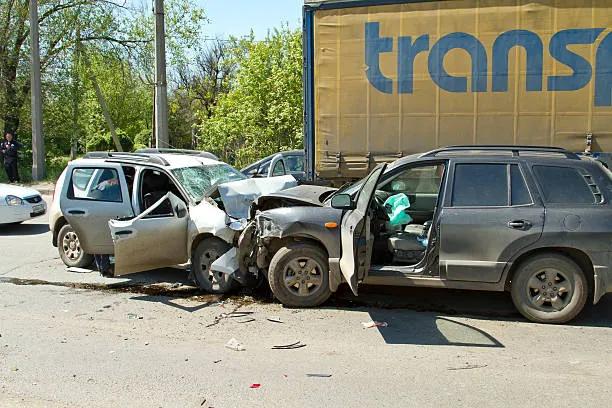
To figure out who is at fault in a head-on collision, you look at which driver broke the law that caused the impact. To determine what happened, investigators and insurance companies look at the position of the vehicles on the road, the behavior of the drivers, and physical evidence.
The main question is which party was careless given the circumstances.
In head-on crashes, fault usually depends on who was in the right lane and who had the right of way. Even a brief lane change could be considered reckless because these collisions typically occur when two vehicles are traveling in opposite directions. However, culpability is not automatically presumed and must be proven.
The National Highway Traffic Safety Administration says that driving the wrong way, being impaired, and being distracted are the main causes of deadly crashes where cars are going in opposite directions. These patterns help claims adjusters and lawyers figure out who is at fault. In that process, official crash reports and evidence from the scene are very important.
What Proof is Used to Show Fault?
Establishing liability relies on substantiated evidence rather than solely on driver assertions. We look at different pieces of evidence to find which one matches the physical record.
Some common proof includes:
Police reports made by police officers
Where the skid tracks and debris are
Patterns of damage to vehicles and angles of impact
Video from a dashcam or traffic camera
Statements from people who saw it happen
Downloads for the event data recorder (black box)
When these things are in the right place, they can display the direction of travel, speed, how effectively the brakes are being used, and lane position moments before the crash.
Why Lane Position Is So Important
In most two-way road systems, each driver must stay in their lane. Crossing the middle line without a satisfactory justification is a major sign of fault. To find out where the crash happened, investigators look at gouge markings, scrape tracks, and fluid leaks.
There are only a few exceptions. A driver who crosses the line to avert a sudden danger may say they had a good reason to do so. Mechanical failure can also be used as a defense, although it usually needs maintenance records and a professional inspection to work.
How to Judge Driver Behavior
In addition to where the car is parked, the driver is closely watched when making decisions. Risky behavior right before the crash can change or confirm who is at fault.
Important behavior factors are
Speed in relation to the state of the road
Being drunk or high on drugs
Distraction from phone calls or while driving
Signs of tiredness
Trying to pass someone illegally
According to the Centers for Disease Control and Prevention, impairment and distraction are responsible for a large number of serious traffic injuries.
Can Drivers Share the Blame?
Yes. In some head-on situations, both parties are responsible. Comparative fault standards allow courts or insurers to assign percentages when both drivers were at fault. One driver may have drifted to the left while the other was fast or driving without headlights.
In comparable systems, each party's share of culpability determines how much compensation they get. In these cases where the fault is split, accurate reconstruction is even more crucial.
What Happens When Stories Do Not Match Up?
After a tragic crash, it is usual for people to give different stories of what happened. In that case, the outcome is determined by objective records. More weight is given to physical proof, electronic data, and observations from third parties than to recollection alone.
Key Takeaways
In head-on crashes, fault is based on lane position and careless behavior.
Most decisions are based on police reports and physical evidence.
Camera video and vehicle data recorders can be quite helpful.
Crossing the middle line usually means you are at fault unless you have a good reason.
Findings are greatly affected by impairment, distraction, and velocity.
Comparative fault can split the blame between drivers.
Objective reconstruction settles conflicting accounts from drivers.