

Top 5 Best 529 Plan for Grandparents Gifting With Gift Tax Exemption Benefits

Image source: freepik
You want to slash your grandchild’s future tuition, not their financial aid. Thanks to the 2024–25 FAFSA overhaul, withdrawals from a grandparent-owned 529 no longer appear as student income—so need-based grants stay intact. Pair that rule with 2025’s $19,000 annual gift-tax exclusion (or $95,000 through five-year “super-funding”) and you have a tax-smart, low-friction way to give. A 529 also compounds tax-free, turning each dividend and capital gain into tuition credit. We reviewed dozens of state programs and analyst ratings to spotlight the five plans that deliver the most value for generous grandparents.
How we chose the five stand-out plans

We began with one question: Which 529 plan stretches a grandparent’s dollar the furthest today?
Answering it took more than a quick skim of a “best plans” list. We dug into fee tables, state tax codes, analyst notes, and user forums, then pressure-tested every insight against concerns advisers hear from grandparents.
Three gaps surfaced:
Most rankings ignore the new FAFSA rule that makes grandparent withdrawals invisible to aid offices.
Few explain the five-year super-funding move that lets you front-load gifts without gift-tax hassle.
Many celebrate state tax perks but overlook usability—if a plan’s site feels like 1999, no one logs in to add birthday money.
Our scorecard zeroed in on what matters:
Fees and long-term returns carried the most weight.
State income-tax breaks earned extra credit when they rivaled or beat the federal exclusion.
Gifting tools—zero-dollar minimums, shareable contribution links, simple successor forms—made generosity painless.
Ownership flexibility under the new aid rules was essential; plans that complicated transfers lost points.
Investment menus had to include age-based tracks; extras like FDIC-insured portfolios scored bonus marks for near-college savers.
Running more than 70 plans through that lens revealed a clear top tier. Past the fifth spot, differences shrank to rounding errors, so we focused on the elite five to give you specifics—not surface-level blurbs—and make picking a plan as easy as writing the first check.

1. Bright Start 529 College Savings – Illinois
Bright Start tops our list because it pairs ultra-low fees with reliable returns. Morningstar raised the plan to Gold in its 2024 review, calling the fee cut “a decisive win for families” and noting that its age-based portfolios “consistently land in the top quartile.”
For grandparents, trimming costs turns into real gains. The index track charges about 0.19 percent a year, roughly one-third of the national 529 average. The moderate portfolio earned just over seven percent a year in the five years ending September 2025, outpacing many higher-priced rivals.
Illinois adds a state income-tax deduction: up to ten thousand dollars for single filers or twenty thousand for couples. Non-residents still enjoy the low fee and tax-free growth; they simply miss the state break.
Opening the account is easy, and pinpointing a savings target is just as simple. Bright Start’s calculator can calculate how much to save for college by factoring in your grandchild’s age, projected tuition, and assumed investment growth, illustrating that every dollar saved today may be one less borrowed tomorrow.

There is no minimum contribution, and the plan’s Ugift link lets relatives pitch in with a few clicks. Add a successor owner during setup, and you fold basic estate planning into the same five-minute task.
Put it together—rock-bottom costs, strong oversight, and an immediate state tax benefit—and Bright Start gives every grandparent a clear head start.
2. my529 college savings plan – Utah
Utah’s my529 proves how far low-cost investing can go. The default age-based index track charges about 0.13 percent a year, a fraction of the national average. That saving stays in the account, compounds, and helps explain why Morningstar kept the plan at Gold in its 2024 report.
Performance keeps pace. The moderate portfolio returned just under seven percent annually over the past five years, an impressive result at this price. You can stick with the glide path or build a custom mix from Vanguard and Dimensional funds, giving you control without complexity.
Opening an account is simple. There is no minimum. Fund it with one dollar or set a monthly draft and forget it. Ugift links let siblings, aunts, and friends contribute with a few clicks.

Utah residents receive a 4.65 percent tax credit on contributions. Even if you live elsewhere, the low fee often outweighs home-state perks. Contribution limits above five hundred sixty thousand dollars mean the plan never caps your ambition.
With joint ownership and a quick successor form, my529 stands out for grandparents who value flexibility as much as growth.
3. U.Fund college investing plan – Massachusetts
If you already track your retirement at Fidelity, U.Fund feels like adding one more tile to a familiar dashboard. Massachusetts hired the brokerage giant to run its direct plan, then cut costs so sharply that Morningstar raised the program to Gold in its 2024 review.
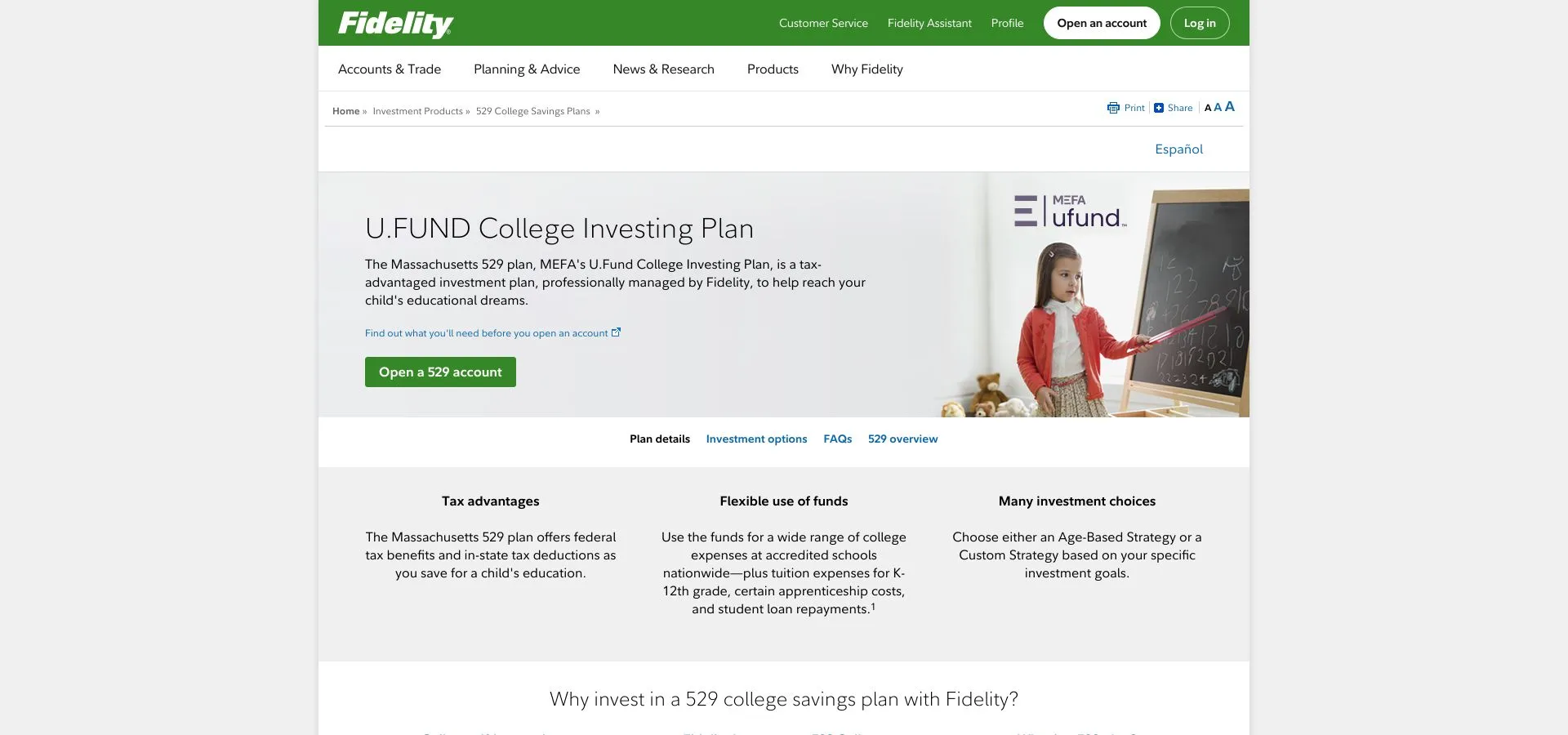
The indexed age-based track charges about 0.12 percent a year. That tiny cost, paired with Fidelity’s straightforward glide path, delivered five-year returns near eight percent, ahead of many flashier rivals.
State perks add immediate value for Bay Staters. Contribute up to one thousand dollars a year as a single filer or two thousand as a couple and subtract that amount from your Massachusetts income. Parents may still claim the fifty-dollar “BabySteps” newborn bonus, and grandparents often coordinate to capture both benefits in year one.
Opening the account is simple. Link a bank, start with fifty dollars, or skip the minimum by turning on an automatic draft. Share a ready-made gifting link with the family. Successor-owner paperwork sits one click away, so estate planning never slows you down.
Taken together—household-name convenience, low fees, and a quick state tax break—U.Fund earns an easy yes for Fidelity loyalists and Massachusetts residents alike.
4. PA 529 investment plan – Pennsylvania
Pennsylvania proves that the best offense can be a generous tax defense. Residents may deduct up to nineteen thousand dollars per beneficiary in 2025, and couples can double that amount, no matter which state’s 529 they choose. Combine that perk with a home plan that charges Vanguard-level fees and the value becomes clear.

Age-based portfolios cost about 0.20 percent a year. That modest drag, paired with broad index funds, produced five-year returns a bit above six percent, solid for a comfort-focused risk level. Morningstar’s 2024 Gold rating confirmed what many locals suspected: the plan now ranks with national leaders.
Opening an account is simple. Start with ten dollars, or five if you set an automatic draft, and share a Ugift link so family can contribute. The dashboard guides you through adding a successor owner in minutes, keeping estate tasks tidy.
Because the state deduction also applies to out-of-state plans, grandparents here enjoy real flexibility. Many still keep dollars at home, claim the instant tax break, and let Vanguard’s low costs power growth. The approach is frugal, efficient, and easy—qualities grandparents appreciate.
5. T. Rowe Price college savings plan – Alaska
Alaska supplies the growth engine in this top five. T. Rowe Price’s seasoned managers run the plan, and their stock-picking has produced five-year returns close to ten percent, third among all direct-sold programs, even after a higher fee of about fifty-five basis points.

That cost is the trade-off. You pay roughly half a percent, not a tenth, yet the net performance gap shows the managers earn their keep. For grandparents who favor active management, this plan stands out.
There is no state income tax, so Alaska offers no extra tax breaks. The minimum contribution drops to twenty-five dollars with an automatic draft, and phone-first customer service earns praise from less tech-inclined grandparents. Printed gift certificates let you slip a physical “tuition ticket” into a birthday card.
The plan also includes a principal-protected portfolio for near-term tuition and standard age-based tracks that dial down risk automatically. Contribution caps near half a million dollars and easy rollovers round out an attractive choice for donors chasing a little extra horsepower.
At a glance: how the five plans stack up
You know the story behind each plan. Now see the key numbers in one place. The table compares fees, recent performance, tax perks, and minimums so you can size up an account for every grandchild.
529 plan | Annual fee (age-based) | 5-year return* | State tax benefit (resident) | Minimum to open | Morningstar 2024 rating |
Bright Start – IL | ~0.19 percent | ~7.0 percent | Deduct up to $10,000 single / $20,000 joint | $0 | Gold |
my529 – UT | ~0.13 percent | ~6.8 percent | 4.65 percent credit, about $112 single / $224 joint cap | $0 | Gold |
U.Fund – MA | ~0.12 percent | ~7.8 percent | Deduct $1,000 single / $2,000 joint | $50 (or $0 with auto-draft) | Gold |
PA 529 Investment – PA | ~0.20 percent | ~6.3 percent | Deduct $19,000 single / $38,000 joint | $10 ($5 auto-draft) | Gold |
T. Rowe Price – AK | ~0.55 percent | ~9.5 percent | None (no state income tax) | $25 auto / $250 manual | Gold |
*Returns are annualized for the moderate age-based portfolio through September 2025.
FAQs every grandparent asks
Can I open a 529 if the parents already have one?
Yes. A child can be the beneficiary on multiple accounts. Your plan stays under your control, and starting with the 2024–25 FAFSA, money you withdraw no longer counts as the student’s income. The change removes the old aid penalty and lets you use funds in any year.
How much can we give without triggering taxes?
In 2025 you may give $19,000 per grandchild, or $38,000 as a couple, without filing a gift-tax return. Prefer to front-load? The five-year averaging rule lets you contribute up to $95,000 at once ($190,000 for couples) and treat it as five annual gifts within the exclusion, according to Savingforcollege.com.
What happens if college costs less than we saved?
Consider three options:
Change the beneficiary to a sibling or to a parent pursuing graduate school.
Roll up to $35,000 into the student’s Roth IRA once the account is at least 15 years old.
Withdraw an amount equal to any scholarship the child receives; you pay income tax on the earnings but avoid the 10 percent penalty.
Can we switch plans later?
Yes. Federal rules allow one tax-free rollover per beneficiary every 12 months. Contact the new plan, request a direct trustee-to-trustee transfer, and the money moves without touching your bank account. Confirm whether your state will recapture past deductions before you leave.
Any quick tips for smooth sailing?
Match withdrawals and qualified expenses within the same calendar year, automate contributions so birthdays and holidays never slip, and name a successor owner now to avoid future stress.
Conclusion
Numbers reveal trade-offs. Illinois and Utah lead on low cost, Alaska delivers the highest return, and Pennsylvania offers the largest immediate tax break. Focus on the column that matters most to your family, and the right choice usually becomes clear.