

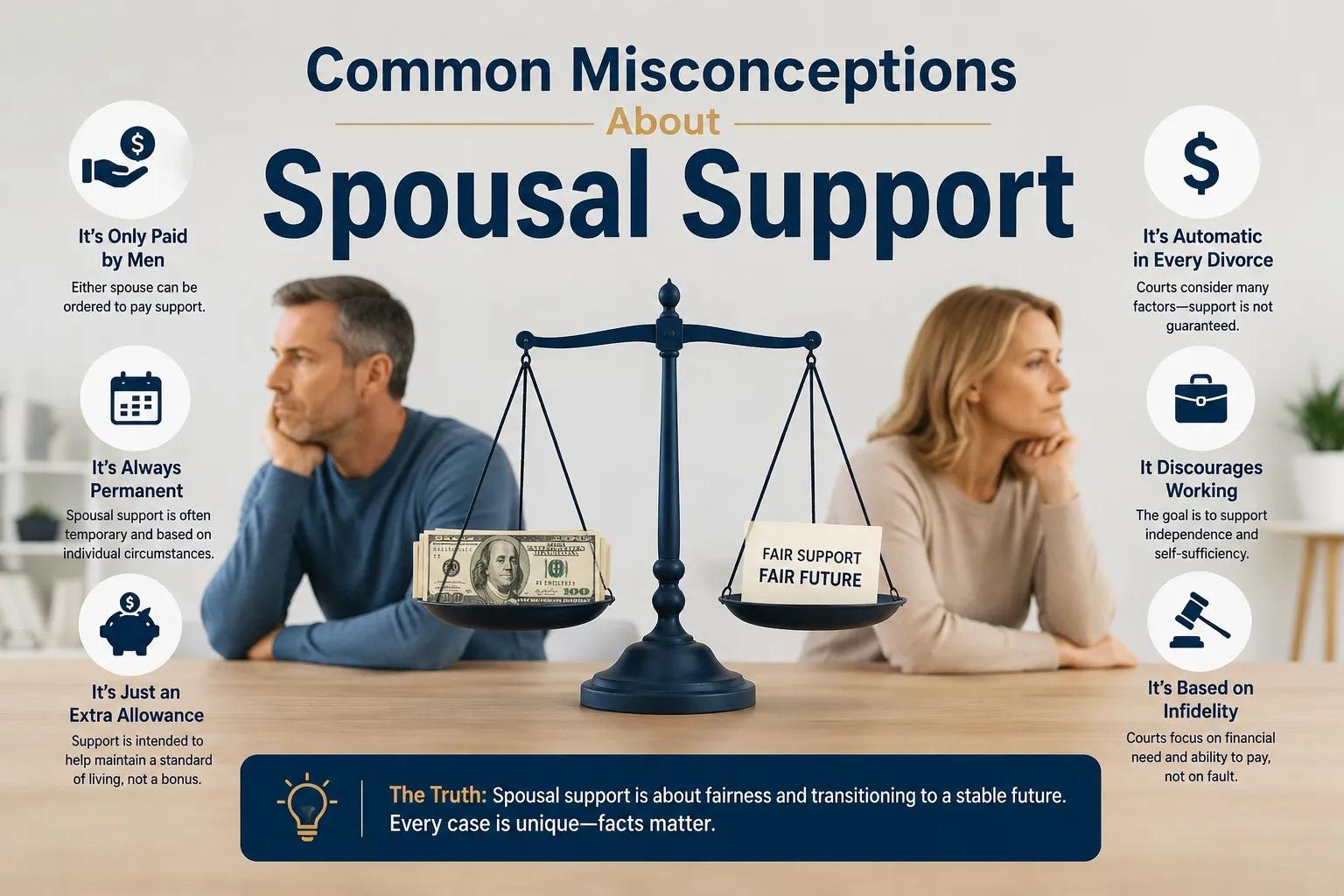
During divorce proceedings, spousal support (alimony) can be one of the most challenging topics for couples to resolve. Misconceptions about who is entitled to spousal support, how much money they should receive, and whether they can sue for it can lead to lengthy legal discussions and prevent both parties from moving on as efficiently as they deserve to.
5 Spousal Support Myths You Should Know
To help you move forward with your divorce smoothly, read ahead to learn the truth behind five common misconceptions about spousal support from a divorce lawyer.
1. You Are Guaranteed Alimony in a Divorce if Your Partner Earns More Than You
No state in America automatically grants alimony to a partner, even if the person they're divorcing has a higher income. To be granted spousal support, you must prove to the court that you have a genuine financial need. However, some states do use statutory formulas that may outline how much a person can receive, considering factors such as the duration of the marriage, each spouse's income and the standard of living.
2. Infedelity Increases Alimony
The cause for divorce does not automatically increase the amount of spousal support someone can receive. The common belief of this misconception is that alimony can function as a form of compensation for emotional damages caused by an unfaithful spouse. However, the court may not see it as such. In most cases, a person's behavior may not impact the alimony amount unless they significantly depleted shared assets during the marriage.
Each state has its own rules regarding alimony, which is why working with a divorce lawyer early in the process can be beneficial. Even if your spouse agrees to pay you support without contest, a lawyer can ensure that the figures are calculated accurately and work to ensure your greatest long-term benefit.
Furthermore, if a spouse hides income to reduce spousal support, an experienced lawyer like the attorneys at Davis & Associates can use specific legal methods to discover assets and reveal their true income and ability to pay alimony.
3. If You Get Alimony, You Can't Collect Child Support
Spousal support and child support are not the same thing, and the court will not calculate them together. These funds serve entirely different purposes. In any divorce, child support will be a top priority to ensure the safety and welfare of minor children. Spousal support is used more as a tool to maintain a former partner's standard of living and help them achieve financial independence after the divorce.
Child support lasts until a minor turns 18. Therefore, it can last much longer than many short-term forms of alimony. Child support often winds up being a greater amount than many alimony payments because it is based on a strict percentage of the paying parent's income.
When it comes to child support, the court does not consider the length of the marriage as it does in alimony cases.
4. The Amount of Spousal Support Doesn't Change
Many partners are disheartened to hear that they are not granted as much alimony as they wanted, and they falsely believe this number can't be changed. In reality, the law can and does account for major life changes and financial stressors in someone's life, such as job loss, housing crises and medical expenses. If your needs change, you may be able to seek modification and increase the amount of your spousal support.
It's important to know that alimony does not automatically have to cover all of your living expenses. It's designed to help you maintain a certain standard of living, but the court also takes the paying spouse's needs and income into account.
Certain assets are also untouchable in a divorce; inheritances, post-separation income, pre-marital assets and funds shielded by a prenuptial agreement do not qualify as shared assets and cannot be split, regardless of how much someone receives in spousal support.
5. You Can Collect Alimony Forever
Although permanent alimony was once popular, the laws have changed with the times, and many courts now set a limit on how long a person will receive spousal support. The primary role of alimony today is to serve as a rehabilitative financial safety net, which allows one partner to maintain a standard of living and, ultimately, become independent.
The length of time a person receives alimony generally depends on the length of the marriage. For short-term marriages that lasted under 10-15 years, the court typically grants spousal support for a percentage of that time.
In longer marriages that lasted over 15-20 years, the award can be much greater and even be "open durational," which means one partner pays another spousal support until the recipient retires.
When Does Someone Qualify for Spousal Support?
The main goal of alimony is to ensure a person can maintain and provide for themselves the way their former spouse once did. This is why the court will consider the marital standard of living during its calculations for alimony; the spouse seeking support must demonstrate financial need and prove they are unable to currently support themselves enough, as is often the case with parents who took time off work to care for children or did not receive an education in favor of caring for their family.
Ultimately, the paying spouse must have the funds to provide adequate support, and the person seeking support must genuinely need it. Alimony is not a way of recovering damages in a divorce; that can be handled separately as part of a marital tort claim.
For anyone seeking guidance, reach out to a lawyer who can guide you through the legal process and work in your best interest.