

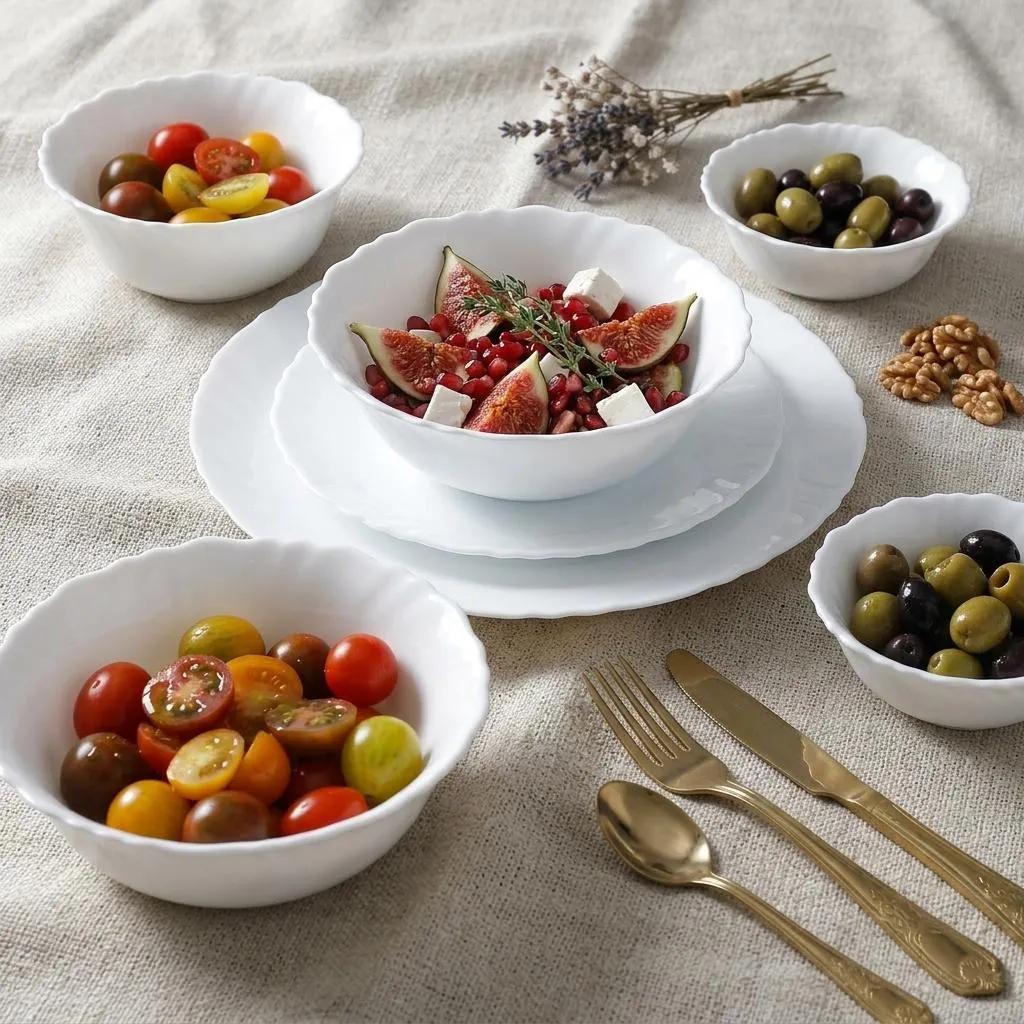
When you cook at home, the most common problem is not that the food tastes bad. It is that the dish looks a little messy once it reaches the table. Green peppers and sliced meat blend into one pile, greens start to wilt as soon as they are cooked, and a saucy dish spreads across the bottom of a flat plate. It may taste perfectly fine, but it does not look quite right.
These problems usually do not require complicated plating. Cut the ingredients a little more evenly when you prep them, do not leave greens steaming in the pan after they are done, and use a deeper plate for dishes with plenty of sauce. Those small changes can make a difference. The sections below follow the order of cooking, from color and knife work to cooking and plating. Start with the part that causes you the most trouble. You do not have to change everything at once.
How should You Combine Ingredient Colors to Make a Dish Look Better?
Use two or three ingredient colors in one dish
When choosing vegetables or other additions, first look at the color of the main ingredient. Then choose one or two colors that stand apart from it. Green pepper stir-fried with eggs is a simple example: the green pepper and yellow egg remain easy to distinguish once they are on the plate. If you happen to have some red pepper at home, you can add a little. If not, there is no need to buy it just for the color.
Several brown ingredients may taste rich together, but they can be hard to tell apart on the plate. A little green, red, or yellow can make the ingredients easier to distinguish. Still, “two or three colors” is only a useful starting point. You do not need to force extra colors into every dish. Stir-fried greens can look clean and appealing with green as the only color.
Adding too many ingredients just to introduce more color can cover up the main ingredient and make preparation more complicated. Use what you already have when possible. Get the flavor and proportions right first, then think about color.
Let the main ingredient lead, and add other colors in small amounts
More colors do not automatically make a dish look better. A small amount of diced carrot can add orange to stir-fried shrimp, but too much carrot can make the shrimp disappear.
Once the dish is plated, take a step back and look at it from the distance where you normally sit at the table. Can you still recognize the main ingredient right away? If the shrimp is buried under diced carrot, use less next time or spread the carrot out more evenly.
The same piece of carrot can end up all over the plate once it is cut into small dice. It may not look like much during prep, but after cooking it can appear everywhere. Instead of memorizing a fixed ratio for the side ingredients, look at how they are actually distributed on the finished plate.
How Should You Cut Ingredients to Make The Finished Dish Look Neater?
Cut the same ingredient into pieces, slices, or strips of similar size
If a few unusually thick strands end up in your shredded potatoes, two things can happen while they cook: the thin strands become soft while the thick ones are still undercooked, and if you keep cooking, the thin strands start to break apart. The finished dish looks fragmented because the problem was already there before anything went into the pan.
Escoffier’s knife-skills guide also connects consistent cutting with even cooking. At home, you do not need to follow professional measurements. Keeping the thickness reasonably similar already solves most of the problem.
When cutting shredded potatoes, a few small habits can help:
Cut one slice first as a reference, then try to keep the remaining slices about the same thickness.
Do not stack too many potato slices at once. Keep the stack stable before cutting it into strips so the strips do not gradually become thicker.
Before the potatoes go into the pan, take a quick look and cut any noticeably thick strands again.
The same idea applies to slices and cubes. First, try to keep pieces of the same ingredient close in size. Carrots and tofu have different textures, so do not force them into the same size just for the sake of uniformity.
Keep the shapes of the side ingredients reasonably close to the main ingredient
For pork strips stir-fried with green peppers, cut the green pepper into strips as well. For diced meat with vegetables, diced vegetables are usually easier to mix through. When the ingredients have similar shapes, they generally look less scattered once they are plated.
What makes a plate look especially untidy is having large chunks, thin strips, and tiny fragments of the same side ingredient all at once. Decide during prep what the main shape of the dish will be. That saves work later.
Of course, not every ingredient needs to be cut into pieces. Whole shrimp and intact small mushrooms already have a clear shape of their own, and keeping them whole can make the dish look better. Uniformity is not the goal. Do not cut away the features that make an ingredient recognizable.
How Can You Keep Food From Darkening or Losing its Shape While Cooking?
Serve leafy greens as soon as they are cooked instead of letting them steam for too long
Before cooking greens, put the plate you plan to use within reach. Serve the greens as soon as they are done instead of leaving them in the pan with the heat off while you wait for the next dish. The residual heat is still working, so the leaves can continue to soften and become darker.
Color changes are related to heat. A review from the American Chemical Society on green-vegetable processing explains that heating can change chlorophyll and produce pigments with a more olive-green color. In everyday stir-fried greens, the practical takeaway is simple: once the vegetables are cooked, avoiding extra time in the hot pan usually helps them retain more color and crispness.
Tender leaves and thick stems do not cook at the same rate. The University of Maryland Extension’s guide to cooking leafy greens also treats these two parts differently. For greens with thick stems, add the stems first and the leaves a little later. Otherwise, by the time the stems are tender, the leaves may already be overcooked.
Still, do not turn off the heat based on color alone. Tender spinach and thick-leaved greens need different cooking times, so judge doneness according to the ingredient.
Turn fish, tofu, and other fragile ingredients as little as possible
Once tofu is in the pan, many people cannot resist nudging it with the spatula. By the time the sauce has reduced, the edges of the tofu may already be broken. Fish behaves the same way: the more often you turn it, the more likely it is to fall apart.
Kikkoman’s stir-fried tofu with vegetables recipe also recommends turning the ingredients gently to keep them from breaking. When making braised tofu, try the following:
When you need to turn the tofu, lift it from underneath instead of repeatedly pushing it with the edge of the spatula.
After adding the sauce, push the tofu gently to distribute it, or spoon the sauce over the top instead of stirring constantly.
When serving, lift the tofu together with the sauce underneath rather than scraping it hard against the side of the pan.
When turning fish, try to support the whole piece as well. The cooking time still depends on the size of the fish and the recipe. Do not leave it undercooked just to keep its shape. If you want to compare the difference before and after changing your technique, use tofu pieces or fish portions of roughly similar size for two separate batches.
How Should You Choose a Plate’s Color and Size to Complement the Food?
Start by checking whether the plate can hold the portion comfortably. When the food is served, leaving a little space around the edge makes it easier to arrange. A small plate can make the food look cramped, while a large plate with only a small portion can make it look scattered. Once the size is right, consider the background color and pattern.
Use a plain plate so the pattern does not compete with the food
When the food already has several colors, a plain plate is often the easier choice. Green pepper and egg already provide green and yellow. If the plate also has dense patterns of flowers and leaves, the edges of the food may be harder to see.
The background of a plate can affect how people experience food. A Live Science report described an experiment involving strawberry mousse served on white and black plates, with 53 participants. A report published by NPR on June 30, 2013, and republished by WBUR also interviewed Oxford University professor Charles Spence. When discussing the test, he used the phrase “10 percent sweeter and 15 percent more flavorful”: the strawberry mousse served on the white plate was perceived as 10% sweeter and 15% more flavorful. The amount of sugar did not increase when the plate changed. What changed was the dining experience.
These results are worth considering, but they do not prove that a white plate is suitable for every dish. They also did not compare patterned plates, and the lighting, food, and arrangement in your home may be different.
If you happen to have two types of plates, you can make a small comparison using the same batch of green pepper and eggs. Divide it into two similar portions. Put one on a plain plate and the other on a patterned plate with a similar size, shape, and background color. Place them in the same spot, arrange them in roughly the same way, and look from the distance where you normally eat. Use the plate that makes the ingredients easier to see. If the difference is small, there is no need to replace the plate you already use.
Try jade-like tableware colors, which are currently popular on social media
If you want to add some color to the table, you could try white jade or pale jade green. Here, “jade-like” refers to the color and appearance. It does not mean that the tableware actually contains jade.
Pinterest’s annual color announcement, published on January 14, 2026, included Jade green among five trend colors, based on activity such as searches and saves on the platform. This shows that jade green appeared in the platform’s annual trend forecast, but it does not prove that jade-like tableware is necessarily more popular. If you want to try it, use one plate with food you regularly make at home. Seeing it in use once or twice is more useful than looking at the name of the trend.
White jade and jade green can be tested with combinations such as these:
Common home-cooked dish | Background color to try | What to look at after serving |
|---|---|---|
Red-and-yellow dishes such as tomato and eggs | White jade or pale jade green | Whether both the tomato and egg pieces are easy to see |
Stir-fried leafy greens | White jade | Whether the leaves are too close in color to the plate |
Dark-colored dishes such as red-braised pork | White jade or pale jade green | Whether the edges of the meat and the sauce are easy to distinguish |
Jointion, an opal glass tableware manufacturer, lists White Jade and Jade Green in its product color information and real-product video showcase. When choosing a color, pay attention to the shade and surface appearance shown in the product images and videos. Two pieces of tableware may both be called pale jade green but still look different in person.
White jade can be tried first with dishes that already have several colors. Jade green adds color to the background. When you use it for tomato and eggs, see whether the red and yellow ingredients remain distinct from the plate. If you use it with leafy greens and the colors are too close, switch back to white jade. Photos of an empty plate can only show you its appearance. You will know whether it works once you serve the kind of food you actually cook at home.
For specific colors and plate shapes, see Jointion’s jade-colored opal glass tableware.
How Can You Plate Ordinary Home-Cooked Dishes Without Making Them Look Messy?
Keep the food together instead of letting it spread across the plate
After serving, it is common for a few slices of meat or pieces of green pepper to fall to the side. Gently bring them back toward the center with the spatula, and the plate will look noticeably neater. Let the meat slices overlap naturally as they come out of the pan. There is no need to line them up one by one with chopsticks.
When gathering the food, do not press it into a tight mound. It is fine if a few slices sit at slightly different heights. Pressing too firmly can crush the tender parts. If one small piece is sitting by itself, move it a little closer. That is usually enough.
Use a deeper plate for saucy dishes so the sauce does not spread
When braised beef with tomatoes is poured into a flat plate, the sauce spreads outward. The beef stays in the middle while a ring of sauce reaches the edge first. If you tilt the plate slightly while carrying it, the sauce moves even farther to the side. For this kind of dish, a deeper plate is simply easier to use.
Put the beef and tomatoes in first, then add the sauce gradually. A deeper plate keeps the sauce from running everywhere and helps the ingredients stay together. But a deeper plate should not be filled to the top. If you serve too much, it can still spill when you carry it. Leave some room between the liquid and the rim.
A stir-fry with only a thin layer of sauce will usually be fine on a plate with a shallow rim. If there is a lot of liquid, use a deeper plate or a bowl. Choosing based on the actual amount of sauce is more useful than looking only at the plate’s outside diameter.
You do not need to change several things at the next meal. Cut the shredded potatoes more evenly, serve the greens as soon as they are cooked, or use a deeper plate for a braised dish. Start with just one adjustment. When you eat, look at whether the main ingredients are easier to see, whether the color has become darker, and whether the sauce has reached the edge of the plate. If the change helps, keep it. If it does not, go back to your usual method.