

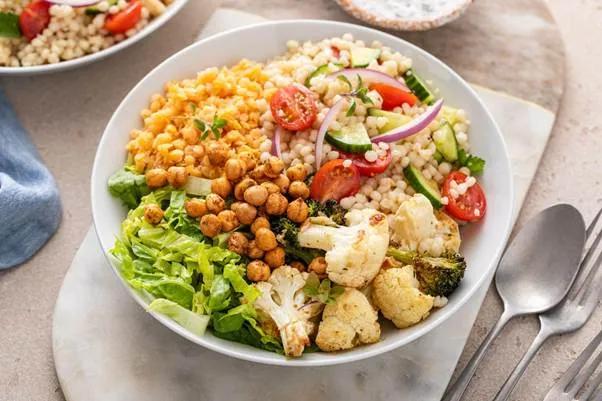
Some of the most valuable choices you make for your health happen in the produce aisle. Every vegetable, piece of fruit, bean or grain you pick up brings its own mix of fiber, vitamins, minerals and natural plant compounds, and together they help support how you feel today and in the years ahead. That's the heart of plant-based nutrition: building most of your meals around foods that grow, from leafy greens and berries to lentils, oats, nuts and seeds.
It doesn't have to mean following a strict set of rules or giving up the foods you love. It's about proportion, and letting plants take up a little more room on your plate. The encouraging part is that the research on plant foods focuses far more on what you add than on what you take away. Here's what science tells us, and how to make it work in a life that's already full.
What counts as "plant-based"?
Think of plant foods as a family with six branches:
- Vegetables, from leafy greens to root vegetables
- Fruit, fresh, frozen or dried
- Legumes, including beans, lentils, chickpeas and peas
- Whole grains, such as oats, barley, brown rice and quinoa
- Nuts and seeds
- Herbs and spices, which are easy to overlook but count too
Is plant-based the same as vegan? Not always. While all vegan foods and diets are plant-based, not all plant-based foods or diets are strictly vegan. A plant-based plate is simply one where plants take up most of the space and do most of the nutritional work, whether or not it also includes some eggs, dairy, fish or meat.
Fiber: the nutrient most of us are missing
If there's one reason to eat more plants, it's fiber (enter fibremaxxing). It's found only in plant foods, and most of us don't get nearly enough. An analysis of more than 14,600 US adults presented by the American Society for Nutrition found that only 7.4% met the recommended daily intake.
The targets are roughly 25 grams a day for women and 38 grams for men, with slightly lower goals after 50. Studies suggest fiber can help lower cholesterol, blood pressure and inflammation, and support healthy blood sugar levels.
Closing the gap is often a matter of small swaps rather than anything major. A cup of pearled barley, for example, provides around 6 grams of fiber, compared with less than 2 grams in the same amount of white rice.
Why color is more than decoration
The deep red of a beet, the orange of a carrot and the purple of a blueberry all come from phytonutrients: natural plant compounds that also give produce its distinctive aroma and flavor. Different colors signal different compounds, which is why nutrition experts encourage people to "eat the rainbow."

Researchers usually group produce into five color families: red, orange and yellow, green, blue and purple, and white and brown. Each brings something different. Tomatoes provide lycopene. Beets get their color from betalains. Berries are rich in anthocyanins.
The trouble is that many of us eat the same handful of foods on repeat. A review published in the Journal of Nutrition and Metabolism cited national survey data showing that eight in ten Americans fall short in every color category of phytonutrients. A practical goal is two or three different colors at each meal, and at least one at every snack.
Variety feeds your gut, too
Your gut is home to trillions of microbes, and they rely on the fiber in plant foods to thrive. When the American Gut Project, one of the largest microbiome studies ever published, analyzed thousands of samples, it found that people who ate more than 30 different plant types a week had more diverse gut microbiomes than those who ate 10 or fewer. That held true whatever diet they followed, whether vegan, vegetarian or neither.
It's worth being clear about what this shows; the finding is an association, and scientists are still working out exactly how microbial diversity translates into long-term health. But it does offer a useful habit: count variety, not just volume. Each plant counts once per week, and herbs, spices, nuts, seeds and grains all contribute. A sprinkle of pumpkin seeds, a handful of fresh parsley and a spoon of lentils in your soup can add three to your tally in a single meal.
How much is enough? Meet the 2 + 3 pattern
You've very likely heard of "five a day." A 2021 study in Circulation, the American Heart Association's journal, put that advice to the test. Researchers followed more than 100,000 US adults for up to 30 years and combined the results with data from 26 other studies, covering nearly two million people.
The lowest risk of death was linked to about five servings daily, split into two servings of fruit and three of vegetables. Compared with people who ate just two servings, those eating five had a 13% lower risk of death from all causes. Interestingly, going beyond five servings wasn't linked to any extra benefit.
The study also showed that not every plant food is equal. Green leafy vegetables such as spinach and kale, along with citrus, berries and carrots, were associated with benefits. Starchy vegetables like potatoes, corn and peas, and fruit juice, were not.
So when you're choosing your five, reach for color and leaves first.
Don't overlook the humble bean
Beans, lentils and chickpeas deliver protein and fiber in one inexpensive package, and they're a common thread in the diets of the world's longest-lived communities, from Sardinia to Okinawa to Costa Rica's Nicoya peninsula.
The research supports what those communities have long known. A 2004 study of older adults in Japan, Sweden, Greece and Australia found that every 20 grams of legumes eaten daily, roughly two tablespoons, was associated with a 7 to 8% lower risk of death. That's a meaningful result from a very small serving.
If beans don't agree with you at first, increase them gradually. Your digestive system adapts over time.
Plant-based nutrition at every stage of life
If you're juggling work and family, the barrier usually isn't motivation to eat better, it's a lack of time. Batch-cooking a pot of lentils or grains on a Sunday, keeping frozen vegetables on hand and adding fruit to breakfast are small moves that make the healthy choice the easy one during a hectic week. Children also learn by watching, so a colorful plate at the family table quietly sets habits for life.

If you're 65 or over, plant foods remain just as important. Appetites can shrink with age, which means every meal needs to work harder nutritionally. Fiber still matters, and legumes are a convenient way to get protein and fiber together. Soups, stews and smoothies can make a wide range of plants easier to enjoy.
Making it work: one simple change at a time
You don't need to overhaul everything at once. Small, consistent changes add up, and they're far more likely to stick. A few places to start:
- Add a handful of spinach to eggs, pasta sauce or a smoothie
- Swap white rice for barley or brown rice twice a week
- Stir a can of rinsed beans into soups and chili
- Keep a bowl of fruit where you'll see it
- Finish meals with fresh herbs for an easy boost to your weekly plant count
Even with good intentions, some weeks don't go to plan. A sports schedule takes over, a work deadline lands, or the fridge is emptier than you'd hoped. Alongside a varied diet, whole food nutrition products such as Juice Plus+ fruit and vegetable capsules can help bring a wider range of produce into your routine. They're made from fruits and vegetables including apple, cranberry, broccoli, spinach and kale, harvested ripe and dried whole wherever possible. They're designed to sit alongside the fruit and vegetables on your plate.
The bottom line
Plant-based nutrition isn't a label you have to earn or a diet you have to follow perfectly. It's a direction. Add one more color to dinner, one more bean to lunch, one new plant to your shopping cart this week, and you're already moving toward a healthier future.