


The exhaustion of repeated dieting is well documented in clinical research. The hunger and fatigue people experience during and after calorie restriction are physiological responses, not signs of inadequate willpower.
You have probably done this before. You decide to lose weight, you restrict your calories, you lose some, and then at some point it stops working. You get hungrier than you were at the start. The weight that felt like it was shifting starts to come back, even when you are still trying. You assume you have failed.
You have not failed. The diet has failed to account for what your body does when you restrict calories.
There is now a substantial body of clinical evidence explaining why calorie-restricted weight loss is so difficult to maintain. The explanation is not motivational. It is biological. And understanding what is actually happening in your body when you diet is the starting point for finding an approach that works with your physiology rather than fighting against it.
What your body does when you start eating less
When you create a calorie deficit, your body interprets it as a threat to survival. This is not a metaphor. The hypothalamus, the region of the brain that regulates appetite and energy, is monitoring signals from your gut, your fat tissue, and your bloodstream continuously. When energy intake falls, it responds with a coordinated set of changes designed to bring energy balance back to where it was.
Two of the most important changes involve ghrelin and leptin, the hormones most directly involved in hunger and fullness.
Ghrelin: the hunger hormone that rises with every diet
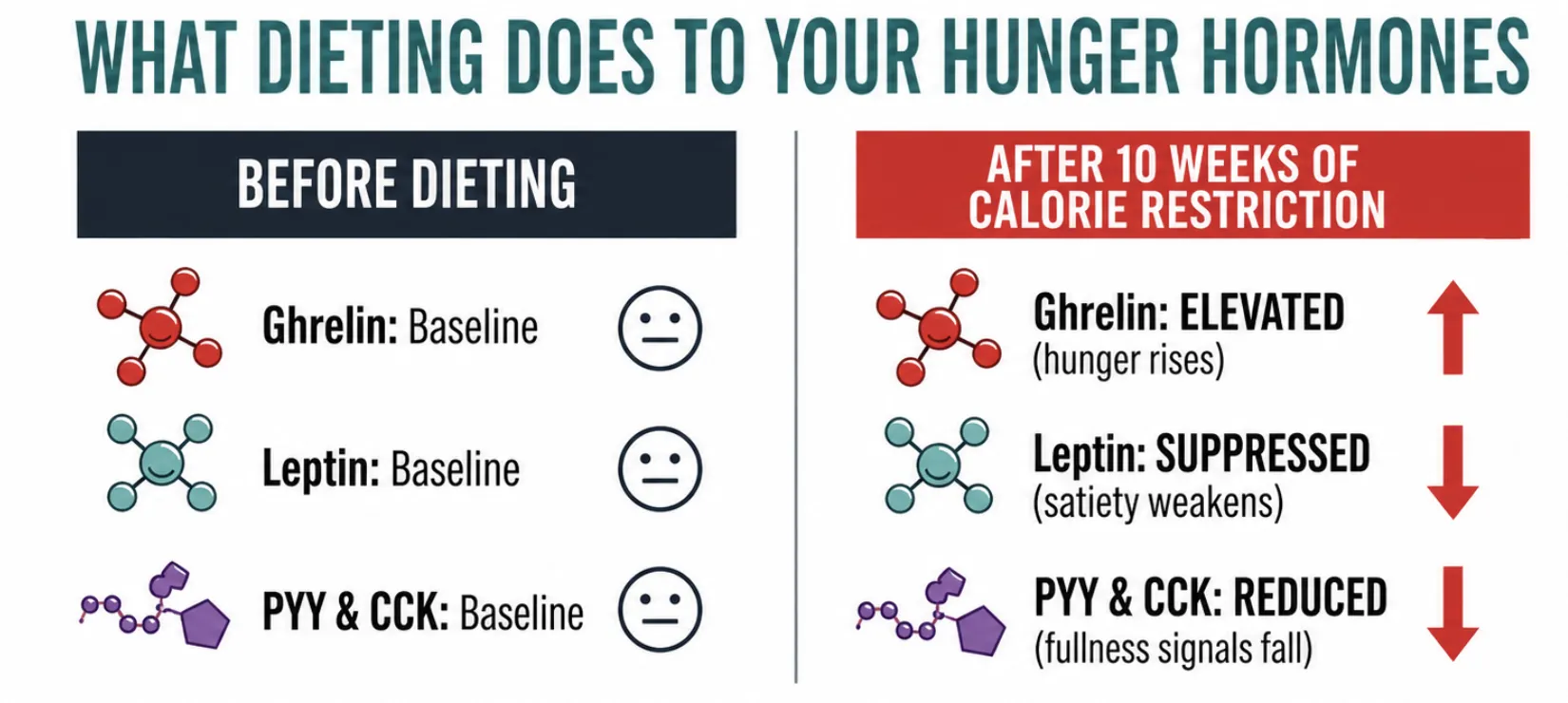
Ghrelin is produced primarily in the stomach and is the only known peripheral hormone that actively drives appetite. Under normal conditions, ghrelin rises before meals and falls after eating. During calorie restriction, ghrelin levels rise significantly and stay elevated.
This was documented in detail in a landmark study by Sumithran et al., published in the New England Journal of Medicine in 2011. Fifty overweight and obese participants followed a ten-week very-low-energy diet, losing an average of 13.5 kg. Their hormones and appetite were measured at baseline, at ten weeks, and again at 62 weeks after the diet ended.
At ten weeks, ghrelin had risen sharply and appetite ratings were significantly higher. At 62 weeks, one year after the diet had ended, ghrelin was still significantly elevated compared to baseline. Appetite ratings were still higher than before the diet began. The body had not reset.

Leptin: the satiety signal that falls and stays low
Leptin is produced by fat cells and signals to the hypothalamus that energy stores are adequate, reducing appetite. When fat mass falls during a diet, leptin levels fall accordingly. At 62 weeks in the Sumithran study, leptin levels remained 35.5% below baseline despite partial weight regain.
This matters because leptin acts as a long-term regulator of the drive to eat. When leptin is suppressed, the hypothalamus effectively behaves as if the body is in an energy-deficient state even when it is not. The brain keeps signalling hunger that the scale does not justify.
GLP-1 and peptide YY: the satiety signals that disappear
Ghrelin and leptin are not the only hormones disrupted by dieting. The Sumithran study also measured GLP-1, peptide YY, cholecystokinin, and five other appetite-regulating hormones. At one year, all of them remained significantly different from baseline. GLP-1 and peptide YY, the gut-derived hormones that signal fullness after eating, were both suppressed. The combination of higher hunger signals and weaker satiety signals creates an almost entirely unfavourable hormonal environment for weight maintenance.
The review authors concluded that long-term strategies to counteract these hormonal changes were likely necessary to prevent weight regain. Willpower is not a long-term strategy for overriding an endocrine system.
What happens to your metabolism when you restrict calories
Alongside the hormonal changes, calorie restriction causes the body to reduce the amount of energy it burns. This is metabolic adaptation: the resting metabolic rate falls disproportionately to the loss of body mass, meaning the body becomes more energy-efficient at exactly the point when it needs more food.
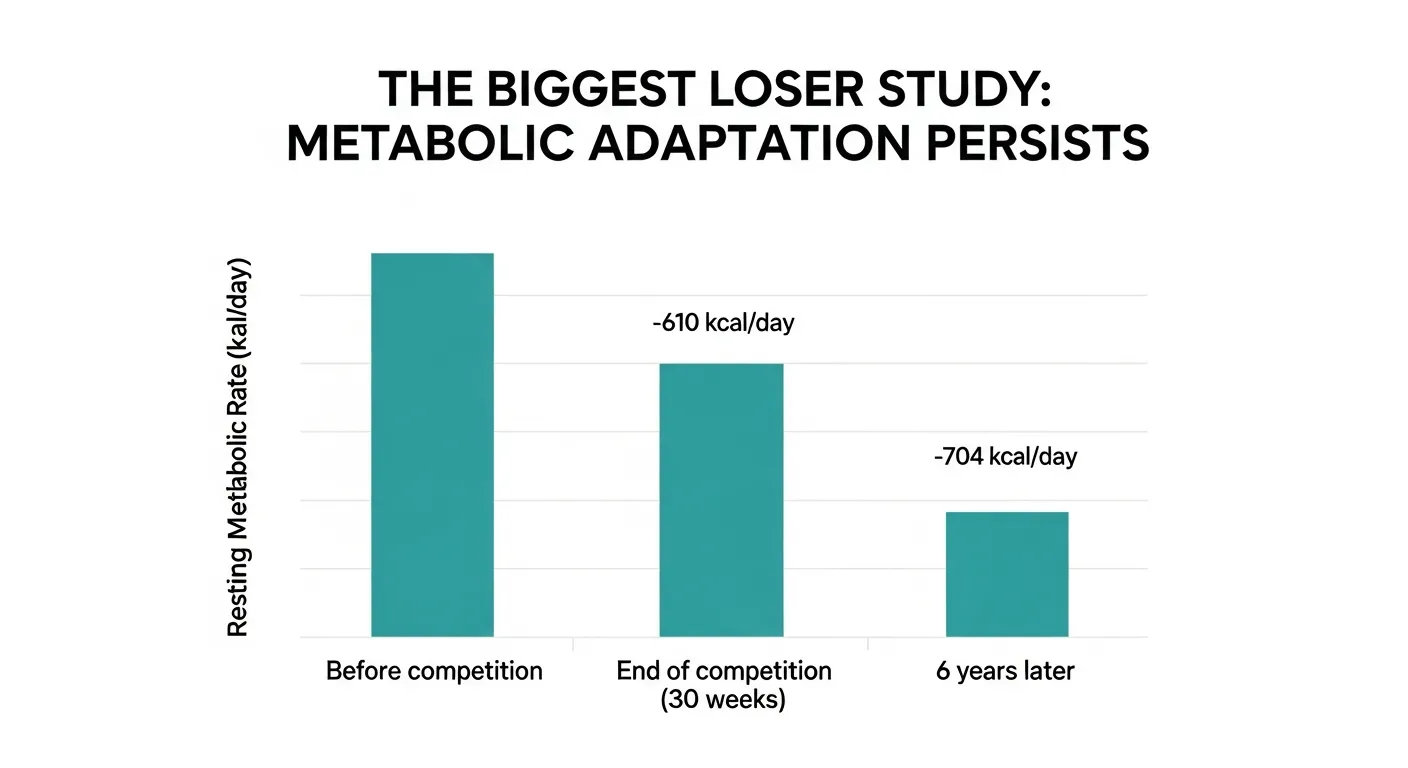
The most striking evidence for this comes from a study by Fothergill, Guo, and colleagues at the NIH, published in Obesity in 2016, following participants in a US weight-loss competition. Fourteen participants were followed at baseline, at the end of a 30-week intensive diet and exercise programme, and again six years later.
At the end of the competition, resting metabolic rate had fallen by an average of 610 kcal per day. Six years later, participants had regained a substantial proportion of their lost weight. But resting metabolic rate had fallen further still, to 704 kcal per day below baseline. Despite regaining weight, their metabolism had not recovered.

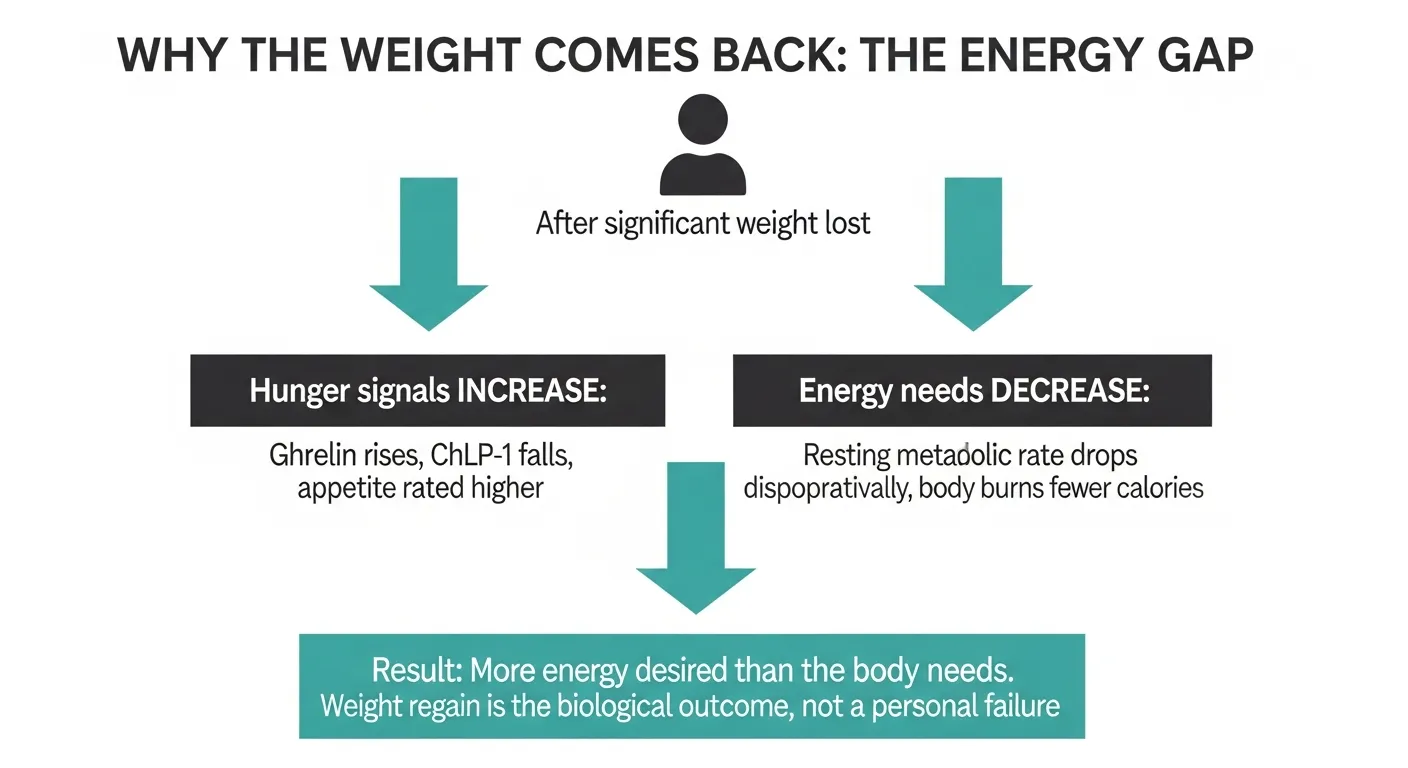
This is the energy gap that makes weight regain almost inevitable after dieting. The body needs fewer calories to function, but ghrelin is higher and satiety hormones are lower, which means it simultaneously wants to eat more and burns less. The biological environment after a diet actively favours weight regain, and it does so for months or years, not days.
Why this is not a personal failure
The framing of weight loss as a test of willpower and discipline has caused enormous harm. It has led millions of people to believe that their inability to maintain weight loss is a character failing, when the evidence clearly shows it is a physiological outcome.
A 2024 paper published in Nature added a new dimension to this picture: adipose tissue retains an epigenetic memory of obesity after weight loss. The cells themselves remember a higher body weight and show gene expression patterns consistent with obesity even after the weight has been lost. The body is not simply returning to a set point after dieting. It is actively defending a higher weight at the molecular level.
None of this is the dieter's fault. These are features of how the body regulates energy, and they apply to everyone who attempts significant calorie restriction. The more often you have dieted, the more entrenched some of these adaptations may become. This is why weight cycling is so common and why each successive diet often produces less weight loss and faster regain than the last.
What actually works instead
If calorie restriction creates a hormonal and metabolic environment that undermines weight maintenance, the logical question is what approaches change that environment rather than just working against it.
Addressing the hormonal root cause directly
GLP-1 receptor agonist medications work by directly addressing several of the hormonal disruptions that dieting creates. They activate the same receptors as natural GLP-1, suppressing ghrelin, amplifying satiety signals, and acting on the hypothalamus to reduce the drive to eat. They do not ask you to consciously override elevated hunger hormones. They reduce the hormones themselves.
Tirzepatide (Mounjaro) activates both GLP-1 and GIP receptors simultaneously, which produces appetite suppression more pronounced than GLP-1 activation alone. Semaglutide (Wegovy) activates GLP-1 receptors and has the added distinction of reducing major cardiovascular events in a dedicated outcomes trial of over 17,000 participants. Both medications work with the biology of hunger regulation rather than demanding that patients override it.
The role of supervision in real-world outcomes
The evidence gap between what diets achieve in clinical trials and what they achieve in the real world is significant. But so is the gap between what GLP-1 medications achieve in trials and what they achieve in well-supervised programmes.
In published outcome data from a supervised programme tracking over 125,000 members, 24% average weight loss was achieved at 12 months, compared to 16% in clinical trials of the same medication. The supervised model accounts for the individual metabolic variation that drives different outcomes in different people: 88% of members in that programme were on bespoke, non-standard plans, with over 3,500 distinct plan variations in use.
Programmes that treat weight as a hormonal and metabolic issue, rather than a willpower issue, are producing outcomes that dieting alone often cannot. For readers considering medical support, the next step is to check which treatment may be suitable, based on health history, BMI and personal goals.
Lifestyle factors that support the hormonal system
Medication addresses the hormonal disruptions most directly, but several lifestyle factors meaningfully improve the hormonal environment for weight management independently.
Sleep: Even one night of sleep deprivation elevates ghrelin and suppresses leptin. Consistently poor sleep creates a chronically pro-hunger hormonal state that undermines any other intervention.
Protein intake: High-protein meals stimulate greater GLP-1 and peptide YY release than equivalent calorie high-carbohydrate meals, improving satiety signalling without requiring restriction.
Resistance training: Preserves lean mass during weight loss, which is the primary driver of resting metabolic rate. Reducing lean mass loss reduces the degree of metabolic adaptation.
Stress reduction: Chronic cortisol elevation drives visceral fat accumulation and promotes leptin resistance. Stress management is not a soft intervention; it has measurable hormonal effects.
Frequently asked questions
Why do I regain weight after every diet?
Because dieting creates hormonal and metabolic changes that actively promote weight regain. Ghrelin rises during calorie restriction and stays elevated for at least a year after dieting ends. Leptin falls and stays suppressed. GLP-1 and peptide YY, the gut hormones that signal fullness, are both reduced. At the same time, resting metabolic rate falls disproportionately to weight loss and does not recover when weight returns. These changes create an energy gap in which the body wants to eat more than it needs to burn, and that gap persists long after the diet ends.
Is it true that dieting makes future weight loss harder?
The evidence suggests it can. Research on weight cycling shows that repeated rounds of calorie restriction and regain are associated with an increasingly pro-hunger hormonal profile over time, including higher baseline ghrelin. A 2024 Nature paper found that adipose tissue retains an epigenetic memory of obesity after weight loss, meaning the cells themselves show gene expression consistent with a higher body weight. Whether this makes future weight loss strictly harder is debated, but the hormonal environment does not simply reset between diets.
If dieting does not work, what does?
Approaches that address the hormonal root cause of hunger, rather than asking you to override elevated hunger hormones through willpower. GLP-1 receptor agonist medications reduce ghrelin, restore satiety signalling, and act directly on the hypothalamus to lower the drive to eat. Combined with lifestyle changes that support the hormonal system, such as adequate sleep, high protein intake, and resistance training, they address the biology that calorie restriction alone cannot.
How is GLP-1 medication different from dieting?
Dieting creates a calorie deficit and leaves the hormonal response to that deficit fully in place, which means elevated ghrelin, suppressed leptin, and a reduced metabolic rate all working against weight maintenance. GLP-1 medications directly modulate the hormones driving hunger, so the experience of appetite changes fundamentally. Most people on GLP-1 treatment describe not fighting hunger but genuinely feeling less hungry. Food noise, the persistent preoccupation with food that characterises calorie restriction, reduces significantly. The medication works with the body's existing appetite regulation rather than asking you to override it.
Does the weight come back when you stop medication?
Published evidence shows that weight regain occurs after stopping GLP-1 medications in a pattern similar to weight regain after dieting: the hormonal environment reverts, appetite increases, and weight returns. A 2026 BMJ systematic review and meta-analysis of weight regain after stopping weight management medication confirmed this pattern. This is consistent with treating obesity as a chronic condition that requires ongoing management rather than a short-term intervention. The appropriate response is structured supervised treatment with clear goals and an exit strategy developed with a clinical team, not indefinite unsupervised use.
This article is for informational purposes and does not constitute medical advice. Always consult a healthcare professional before starting any weight loss treatment. Individual results may vary. Treatment is subject to clinical suitability. Results achieved alongside a reduced-calorie diet and increased physical activity. |
Sources
• Sumithran P et al. Long-term persistence of hormonal adaptations to weight loss. New England Journal of Medicine, 2011. N=50.
• Fothergill E, Guo J, Hall KD et al. Persistent metabolic adaptation 6 years after "The Biggest Loser" competition. Obesity, 2016. N=14.
• Hinte LC et al. Adipose tissue retains an epigenetic memory of obesity after weight loss. Nature, 2024.
• West S et al. Weight regain after cessation of medication for weight management: systematic review and meta-analysis. BMJ, 2026.
• Maclean PS et al. Biology's response to dieting: the impetus for weight regain. American Journal of Physiology, 2011.
• Raza FA et al. Effect of GLP-1 receptor agonists on weight and cardiovascular outcomes. Medicine, 2024.
• Voy outcome data: published in JMIR, 2025 (N=125,000+).