

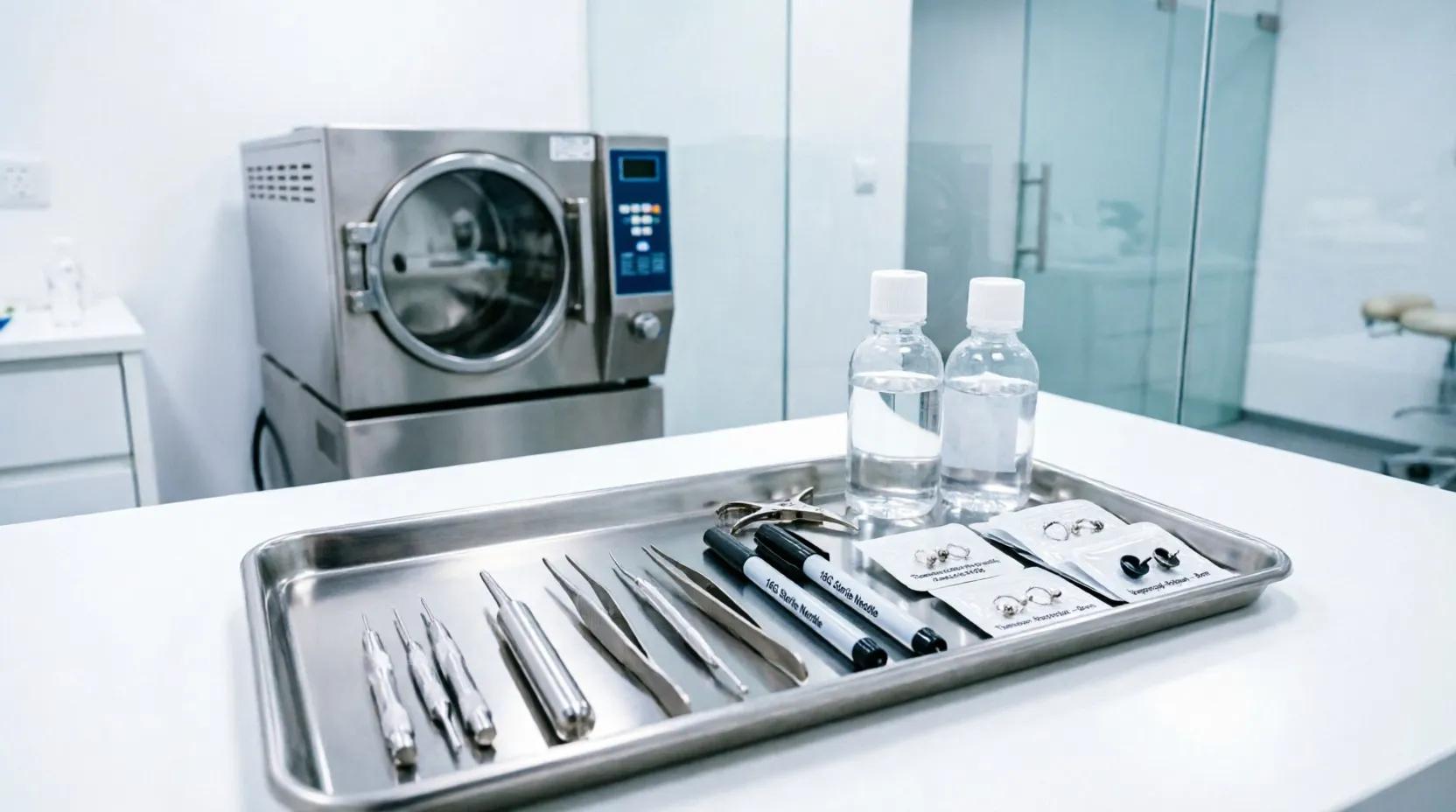
Walk into any professional piercing studio and you will notice a tray of precisely arranged instruments, each with a specific job to do. Knowing the correct piercing tools names helps you understand what your piercer is doing, why sterile technique matters, and what separates a safe studio from a risky one. This guide covers every major instrument, organized by function, so you have one clear reference for the entire toolkit.
What Are Piercing Tools?
Piercing tools are specialized instruments designed to create precise openings in skin or cartilage, guide jewelry into place, and maintain a sterile environment throughout the procedure.
Professional piercers rely on four functional categories: primary piercing instruments, supportive tools, sterilization equipment, and jewelry handling tools. Understanding each category makes it easier to see how a piercing session flows from start to finish.
Primary Piercing Tools Names and Uses
These are the instruments that directly create the piercing channel. Every other tool in the kit supports the work these primary instruments do.
Hollow Piercing Needle
The hollow piercing needle is the US standard for professional body piercing. Unlike a solid sewing needle, it removes a small core of tissue rather than displacing it, resulting in less trauma and faster healing. Needles come in gauges ranging from 18g (fine, used for nostril and helix) down to 00g for larger lobe piercings. Straight needles cover most placements; curved needles are designed for navel, eyebrow, and certain cartilage piercings where a straight path is not anatomically ideal.
Cannula Needle
A cannula needle has a hollow plastic sleeve fitted over the metal tip. After the needle passes through the tissue, jewelry is loaded into the back of the cannula and pulled through with it. Cannula needles are widely used outside the US and offer a smooth jewelry-transfer method, though they typically create a slightly larger channel than the jewelry size.
Dermal Punch
A dermal punch removes a circular plug of tissue rather than cutting a channel. It is the preferred tool for dermal (single-point) piercings on flat surfaces such as the cheekbone, collarbone, or hip. Note that dermal punches are restricted to licensed professionals in several US states.
Piercing Gun
A piercing gun forces a blunt-tipped starter earring through the lobe using spring-loaded pressure. The Association of Professional Piercers (APP) recommends against their use for any piercing because they cannot be fully autoclaved between clients and cause blunt-force tissue trauma instead of a clean incision.
Forceps and Clamps: Names and Key Differences
Forceps stabilize tissue before the needle passes through, keeping the piercing site sterile and preventing involuntary movement. Choosing the right forceps for each placement is a mark of professional technique.
• Pennington Forceps: The most widely used clamp across piercing types. Identifiable by their triangular open head, available in slotted and non-slotted versions. Best for earlobe, navel, eyebrow, and general body placements.
• Forester (Sponge) Forceps: Feature a larger oval head designed specifically for tongue piercings, where a wider flat surface is needed to stabilize the broad, flat tissue. Also available slotted and non-slotted.
• Septum Forceps: Have short tubes instead of traditional loops, allowing the piercer to access the septum without folding or compressing the nose. Also suitable for nipple and eyebrow piercings.
• Hemostat Forceps: A serrated, ratchet-lock clamp used as a multipurpose instrument throughout the procedure - holding jewelry, guiding tapers, and securing components during insertion.
Pennington forceps are the go-to for most body placements. Septum forceps stand apart because their tube structure provides access without obstructing surrounding tissue, making them the only appropriate choice for septum work. Professional piercers can find medical-grade forceps and clamps across all types in the Piercing tools collection at Obsidian Needle.
Secondary and Supportive Piercing Tool Names
These instruments do not create the piercing but are essential for accuracy, safety, and smooth jewelry placement.
Receiving Tube
A receiving tube is a small hollow cylinder held against the exit point of the piercing. After the needle passes through, it enters the tube rather than continuing into open air, protecting both the client and the piercer from accidental needle contact. Receiving tubes are most common in freehand piercings where forceps are not used.
Insertion Tapers
Insertion tapers are smooth, cone-shaped pins made from 316L surgical steel. They expand an existing piercing channel gradually so that new jewelry can slide through without force. Tapers are also used to reopen healed piercings that have partially closed and are autoclavable and reusable.
Safety Corks
Safety corks are small firm plugs placed behind the piercing site to stop the needle once it exits the tissue. They are particularly important for cartilage piercings such as the tragus or helix, where the needle exits close to the skin surface and could otherwise nick the piercer's finger.
Skin Markers and Calipers
A skin-safe, non-toxic marker is used to dot the exact entry and exit points before any needle is placed. Calipers measure the anatomy to confirm the planned placement is symmetric and that the correct jewelry length is selected. These two tools together prevent crooked piercings and migration.
Jewelry Handling Tool Names
Once the channel is created, a second set of instruments takes over to place, secure, and adjust the jewelry without contaminating the fresh piercing.
Ring-opening pliers spread the gap of a captive bead ring just enough to remove or insert the bead. Ring-closing pliers do the reverse, pressing the gap shut evenly without scratching the metal. Ball grabbers and bead holders are stainless-steel pliers with dimpled tips that grip tiny threaded balls securely. Threaded jewelry tools guide internally or externally threaded ends into place in fresh tissue without cross-threading or pulling.
Sterilization and Safety Equipment Names
No piercing toolkit is complete without the equipment that makes every instrument safe to use. Sterilization is what separates professional studios from unsafe environments.
An autoclave is a medical-grade steam sterilizer that uses high-pressure saturated steam to eliminate bacteria, viruses, and spores on reusable metal tools including forceps, receiving tubes, and tapers. Ultrasonic cleaners use sound waves in a cleaning solution to dislodge debris from instruments before autoclaving - a necessary pre-step because organic matter can shield microorganisms from steam. Sterilization pouches are single-use packaging that keeps autoclaved tools sterile until the moment they are opened chairside. Nitrile gloves (latex-free) form the final barrier, and professional protocol requires changing gloves after skin preparation, after handling any non-sterile surface, and before jewelry insertion.
Piercing Tools Names by Piercing Type: Quick Reference
Different placements demand different combinations of instruments. The list below maps each common piercing to its recommended tool set.
• Earlobe: Hollow needle 20-18g, Pennington slotted forceps. Receiving tube optional.
• Helix / Cartilage: Hollow needle 16-14g, Pennington non-slotted forceps. Safety cork strongly recommended.
• Septum: Hollow needle 16-14g, septum forceps (tube-style). Caliper essential for symmetry.
• Tongue: Hollow needle 14g, Forester oval-head forceps. Use a longer barbell to allow for swelling.
• Nostril: Hollow needle 18g, Pennington or freehand technique. Receiving tube commonly used.
• Navel: Curved needle 14g, Pennington slotted forceps. Curved barbell as initial jewelry.
• Dermal / Surface: Dermal punch, dermal anchor forceps, micro dermal post tool for anchor insertion.
• Industrial: Hollow needle 14g used twice, two Pennington forceps. Caliper is critical for bar alignment.
Matching the right instruments to each placement reduces tissue trauma and supports consistent healing outcomes across every piercing type.
Final Thoughts
Every tool on a professional piercing tray has a name, a purpose, and a direct effect on your safety and healing. From hollow needles and Pennington forceps to autoclaves and ball grabbers, the full set of piercing tools names reflects the precision and hygiene standards that separate professional piercing from everything else. If you are setting up a studio or restocking supplies, always prioritize medical-grade, properly sterilized instruments from trusted sources.