

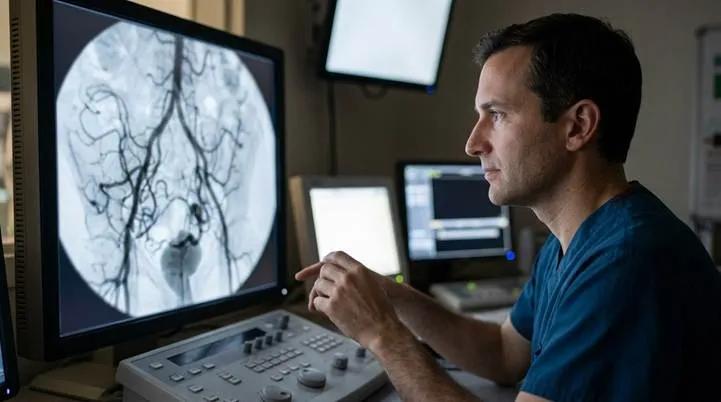
Specialists use advanced medical imaging to guide precise, minimally invasive treatments.
You've probably tried all the over-the-counter remedies. Creams, wipes, and sitz baths give you short-term relief from the itching, pain, and bleeding, but the symptoms always come back. This cycle of flare-ups and temporary comfort can be frustrating. It can make you feel like a real solution is impossible to find. The problem is that most common treatments only manage the symptoms, not the root cause.
Hemorrhoids are swollen veins. Like any problem with blood vessels, they are fed by a constant supply of blood. A different approach focuses on cutting down that blood flow. This procedure is called Hemorrhoid Artery Embolization (HAE). It is a minimally invasive treatment, meaning it doesn't involve major surgery. Instead, it targets the source of the problem. To learn more, you need to talk to the right doctors. Finding experienced hemorrhoid embolization doctors is a key step for anyone who wants a longer-lasting solution.
Quick answer: Hemorrhoid Artery Embolization is a procedure that uses medical imaging to guide a doctor. The doctor reduces blood flow to the hemorrhoid veins, which makes them shrink. It is done by an interventional radiologist, a doctor who uses imaging like X-rays to do treatments with very small incisions. This approach fixes the blood vessel problem that causes hemorrhoids, not just the swelling.
What's inside
· How Successful Is Hemorrhoid Embolization?
· How Do You Evaluate a Specialist for This Procedure?
· How Does a Physician Navigate to and Block the Right Arteries?
· Frequently Asked Questions
· A Modern Approach to a Persistent Problem
How Successful Is Hemorrhoid Embolization?
This procedure has a high rate of technical success. This means the doctor can almost always complete the treatment as planned. Clinical success, how much a patient's symptoms get better, is also high, but it can be different for each person.
It's important to know the two types of success. Technical success is about the procedure itself: Was it done correctly? Were the right arteries blocked? Clinical success is about the patient: Did symptoms like bleeding and pain get better or go away? For the person getting the treatment, clinical success is what really matters.
From a technical view, the procedure is very reliable. A recent review of studies in Frontiers in Surgery found the average technical success rate was 97.8%. This means that in most cases, doctors can use imaging to guide them to the right arteries and block them. This accuracy comes from the advanced imaging used during the treatment.
The same review found that clinical success rates were between 63% and 94%. This range shows that results can be different for each patient. Things like how bad the hemorrhoids are, how long you've had them, and how your body heals can affect how much your symptoms improve. This wide range shows why it's important to have a specialist check your case to set clear goals and see if the procedure is right for you.
❝ It's important to know that embolization doesn't remove the hemorrhoid right away. Instead, it stops the extra blood flow. This causes the swollen veins to shrink and get softer over the next few weeks. The main goal is long-term relief from symptoms, not to remove the tissue instantly.
How Do You Evaluate a Specialist for This Procedure?
The best way to check a specialist is to look at three things: their board certification, their experience with this specific procedure, and the technology they use.
A general surgeon or a gastroenterologist does not do this procedure. It is done by a specialist called an interventional radiologist (IR). An IR is a doctor who uses medical imaging, like X-rays, to guide tiny tools through blood vessels. This lets them treat problems without big surgeries. You should look for a doctor who is board-certified in this field. The American Board of Radiology says that this certification requires special training in both imaging and treatments for blood vessels. This training is key for safely working with the complex arteries in the pelvis.
Besides certification, direct experience with HAE is very important. A doctor might have done other types of embolization, but HAE uses a unique set of arteries and needs special skill. The number of HAE procedures a doctor has done is often a better sign of skill than how many years they have been practicing. When you meet with the doctor, it's fair to ask how many HAE cases the clinic handles. A doctor who does the procedure often will know more about different body types and be better prepared for any challenges.
❝ Your first meeting with the doctor should feel like a learning session, not a sales pitch. The goal is for you to understand how the procedure works, its risks, and what results you can expect. A doctor who explains in detail how they will map your arteries shows they are careful and focused on you.
The accuracy of the procedure depends on the quality of the imaging equipment. HAE is usually done using fluoroscopy, which is like a live, moving X-ray that acts as a map for the doctor. Ask what kind of imaging technology the clinic uses. Modern systems like digital subtraction angiography (DSA) can create very detailed images of blood vessels while using less radiation. The tiny particles used to block the arteries, called embolic agents, can also be different. A specialist should explain why they chose a certain type for you.
Evaluation Area | Key Question to Ask | What to Listen For |
Credentials | "Are you board-certified in Interventional Radiology?" | A clear "yes" and a mention of their training in blood vessel procedures. |
Experience | "How many HAE procedures does your clinic perform each year?" | A number that shows they do this procedure regularly. |
Technology | "What kind of imaging technology do you use for HAE?" | They should mention modern tools like fluoroscopy with DSA. |
Approach | "Can you walk me through the steps of the procedure for my case?" | A detailed explanation for your specific case, not a general one. |
How Does a Physician Navigate to and Block the Right Arteries?
The procedure uses advanced imaging and special tools to work from inside your blood vessels. It is a very precise process that avoids any cuts on the outside of your body near the hemorrhoids.
The treatment starts with a tiny opening, usually in an artery in your groin or wrist. Through this opening, the doctor inserts a catheter, which is a very thin, flexible tube. Using a live X-ray called fluoroscopy as a guide, the doctor carefully moves the catheter through your arteries to the main artery that sends blood to your lower body. This is like steering a boat through a river, with the X-ray screen as a live map.
Once the catheter is in the right area, the doctor makes a detailed map of your arteries. They inject a special dye through the catheter that makes your arteries show up on the X-ray. This lets them find the exact arteries that are feeding blood to the hemorrhoids. Everyone's body is a little different, so making this map is key to treating only the right blood vessels.
❝ Surgery cuts away the hemorrhoid tissue, but embolization is more like fixing a leaky pipe. The goal isn't to remove the hemorrhoid, but to turn down the high-pressure blood flow that feeds it. This lets the swollen area shrink and go back to normal on its own.
After finding the target arteries, the doctor guides an even smaller tube, called a microcatheter, into them. Through this tiny tube, they release microscopic beads. These beads are just big enough to plug up the small arteries and block the blood flow. This is called embolization. The blood flow is cut down right away. The doctor checks that the artery is blocked with another small amount of dye, then removes the catheter. They place a small bandage on the spot where the tube went in. The whole procedure fixes the root cause of the problem without any cuts or stitches.
Frequently Asked Questions
How much does hemorrhoid embolization cost? The final cost can change a lot depending on your insurance, your deductible, and where you have the procedure. Costs are usually lower at an outpatient center than at a hospital. The total usually includes the doctor's fee, the facility fee for the room and equipment, and any cost for sedation.
How long does it take to recover from hemorrhoid artery embolization? Recovery is usually fast. You will likely be watched for a few hours after the procedure and can go home the same day. Most people can get back to normal, light activities within a day or two, and many go back to work the next day. You might feel a mild, dull ache or pressure for a few days, which store-bought pain relievers can usually handle.
Is the procedure itself painful? Most people feel very little pain. A numbing medicine is used at the small entry spot in your wrist or groin, so you should only feel a quick pinch. Because there are no pain-sensing nerves inside your arteries, you will not feel the catheter moving. Many clinics also offer light sedation to help you relax.
How does HAE compare to a surgical hemorrhoidectomy? They are very different. A hemorrhoidectomy is surgery that cuts out the hemorrhoid tissue. It works, but it often means a longer and more painful recovery. HAE leaves the tissue in place and instead cuts down its blood supply, which makes it shrink. This usually means much less pain and a faster return to normal life.
Will my hemorrhoids come back after embolization? Because HAE treats the root cause by cutting down the blood supply from the arteries, the chance of the problem coming back is lower, but it is not zero. The same review noted that bleeding came back in some patients during follow-up. Habits that lead to hemorrhoids, like constant constipation or straining, can still cause new problems over time. A high-fiber diet and healthy bathroom habits are important for long-term success.
A Modern Approach to a Persistent Problem
Hemorrhoid artery embolization is a big change in how severe hemorrhoids are treated. Instead of removing tissue with surgery, it treats the blood vessel cause underneath. It replaces a hard surgical recovery with a procedure that lets most people get back to normal life in a day or two. The goal is not just to ease symptoms, but to find a lasting solution that fixes the problem at its source.
Your most important job is to check the specialist, not just the procedure. The success of HAE depends on the doctor's ability to move through complex arteries with great precision. A good visit should go beyond general talk. Ask about their experience with this exact procedure, the imaging they use, and how they plan to map your arteries.ional surgery.