

Most families are diligent about annual checkups, dental visits, and keeping vaccinations current. Eye exams, however, tend to get quietly moved to the bottom of the list — scheduled when someone complains, postponed when life gets busy, and skipped entirely when nobody seems to be struggling. In an era when children and adults alike are spending more hours in front of screens than any previous generation, that habit is worth reconsidering.
The eyes are quietly working harder than ever. And many of the signs that something needs attention are easy to dismiss, explain away, or simply not notice at all.
What Screens Are Actually Doing to Our Eyes
Digital screens — phones, tablets, laptops, televisions — require the eyes to perform a specific kind of sustained, close-range focusing that differs meaningfully from other visual tasks. Reading a printed book, looking out a window, or moving through the world all give the eyes natural variation in focal distance and light. Screens compress that variation, holding the eyes in a fixed near-focus position for long, often uninterrupted periods.
The result, increasingly well-documented in research, is a condition called digital eye strain, also referred to as computer vision syndrome. Symptoms include dry or irritated eyes, blurred vision, difficulty focusing after looking away from a screen, and a heavy, fatigued feeling in and around the eyes that many people simply attribute to being tired or stressed.
Children are not exempt from these effects — and in some ways, they are more vulnerable. Because children's visual systems are still developing, sustained screen use during formative years can contribute to the accelerating rise of myopia, or short-sightedness, which has become one of the fastest-growing vision conditions globally. The eye accommodates repeated near-focus demands by elongating slightly over time — a physical adaptation that makes distant vision progressively harder to achieve.
The Signs That Are Easy to Miss
Part of what makes vision changes particularly easy to overlook is that they tend to arrive gradually. Children especially have no baseline to compare against — if they have always found the whiteboard a little hard to read from the back row, they may simply assume that is how everyone experiences it.
Some of the most commonly overlooked signs that a comprehensive eye exam is overdue include:
Headaches that appear later in the day. When the eyes are working harder than they should to maintain focus, the muscles around them fatigue and strain. This often manifests as a dull headache at the temples or behind the eyes, typically emerging after sustained reading, screen time, or close work. These headaches are frequently attributed to stress, dehydration, or screen exposure — without considering that the root cause may be an undetected refractive error.
Tired or heavy eyes. A persistent sense that the eyes feel heavy, gritty, or uncomfortable toward the end of the day is a common indicator of strain. Many adults dismiss this as a natural consequence of busy, screen-heavy workdays. In children, it can show up as reluctance to read, avoidance of homework, or complaints that their eyes feel "weird" or sore.
Squinting to see clearly. Squinting partially closes the eyelid, which reduces the amount of scattered light entering the eye and temporarily sharpens a blurred image. It is an instinctive, often unconscious response to uncorrected vision problems. In children, squinting at the television, the board at school, or anything at a distance is a meaningful signal — not a habit to correct, but a cue to investigate.
Losing their place when reading. Children who frequently lose their place on the page, re-read the same line, skip words, or seem to struggle with reading despite adequate literacy skills may have an undetected vision problem affecting their ability to track text smoothly. This is often misattributed to attention difficulties or reading challenges, when the underlying issue is visual rather than cognitive.
Holding devices very close. When a child consistently holds a book, tablet, or phone much closer than seems natural, it often reflects a compensatory strategy for blurred distance vision — or in some cases, difficulties with near focus that make a closer distance feel more manageable.
Why Children Rarely Report Vision Problems
Adults generally have a reference point for their own vision. They know what sharp looks like, so when things start to blur, they notice the contrast. Children who have grown up with a visual impairment — or whose vision has shifted gradually — often have no such comparison available. If the world has always looked this way, it simply looks normal.
This is why children rarely report that they cannot see well. They are not hiding anything. They genuinely do not know that what they are experiencing is not what everyone else experiences. The child who squints at the board may never mention it because they assume the board looks the same way to their classmates.
It is also worth noting that children's school vision screenings, while valuable as a first filter, are not a substitute for a comprehensive eye exam. These screenings test basic distance acuity under controlled conditions, and they miss a significant proportion of vision problems — including those related to focusing, tracking, depth perception, and colour vision — that a full clinical examination would detect.
What a Comprehensive Eye Exam Actually Covers
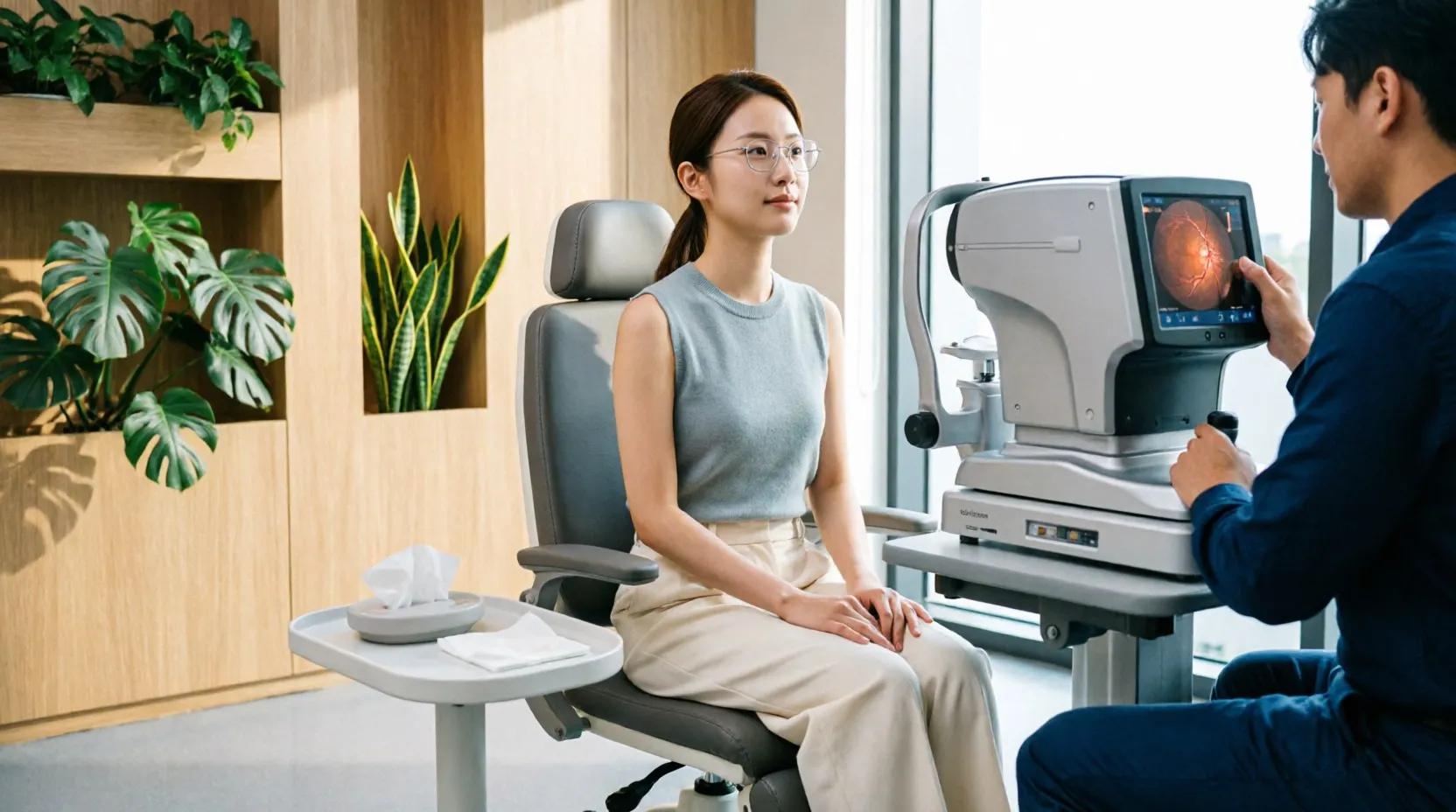
A comprehensive eye exam goes far beyond the letter chart on the wall. For children and adults alike, a full clinical examination evaluates the health of the eye structures, not just the sharpness of distance vision.
During a complete exam, an optometrist will assess refractive errors such as myopia, hyperopia (long-sightedness), and astigmatism; examine the health of the retina, optic nerve, and surrounding structures; evaluate how well both eyes work together as a coordinated system; test colour vision, peripheral vision, and depth perception; and in adults, screen for early indicators of conditions such as glaucoma, macular degeneration, and diabetic retinal changes that may show no symptoms in their early stages.
Many serious eye conditions are asymptomatic in their early phases. Regular examinations create the opportunity to detect and address changes before they progress — which in many cases meaningfully affects the long-term outcome.
For families in Ontario, booking eye exams in Toronto with a comprehensive optometry practice ensures that both children and adults receive the full scope of clinical evaluation, not a basic vision screen.
How Often Should Your Family Be Seen?
General guidelines from optometry associations recommend that infants receive their first eye examination between six and nine months of age, with follow-up exams at age two to three, before starting school, and annually throughout the school years. Adults without known vision conditions are typically advised to have a comprehensive exam every one to two years, with annual exams recommended for those over sixty, those with existing prescriptions, and anyone with risk factors for conditions such as diabetes or glaucoma.
These are guidelines, not ceilings. If a child or adult is experiencing any of the symptoms described above — headaches, tired eyes, squinting, difficulty tracking text — that is a reason to schedule an exam sooner rather than waiting for the next scheduled appointment.
Making Eye Health Part of Your Family's Wellbeing Routine
The decision to build regular eye exams into a family's health routine is not about anticipating problems. It is about creating the conditions in which problems, if they exist, are found early — when interventions are most effective, when prescriptions are simplest, and when children are not quietly struggling through a school day trying to see a board they cannot quite read.
In a world where screens are not disappearing and screen time is not declining, the eyes are under sustained demands that previous generations simply did not experience. Meeting that reality with the same consistency and care that families bring to other areas of health — annual checkups, dental hygiene, physical activity — is one of the quietest and most practical investments a family can make.
Clear vision shapes how children learn, how they engage with the world, and how they feel at the end of a long day. It shapes the same things for the adults who care for them. Protecting it is not complicated. It starts with showing up for the exam.