


Most wellness routines start from the top down. We think about sleep, nutrition, movement, maybe a meditation app downloaded in January and barely opened since. Feet rarely make the list, yet they're the only part of the body in constant contact with the ground, absorbing every step, every shift in posture, every mile of a day that adds up faster than most people realize.
If your wellness goals include better posture, steadier energy, or simply moving through your day with less friction, it's worth starting from the ground up.
The Body's Forgotten Foundation
Feet are doing more structural work than they get credit for. Each one contains over two dozen bones, dozens of joints, and an arch system designed to distribute weight and absorb shock with every step you take. When that arch isn't functioning the way it should, the effects rarely stay contained to the foot. Misalignment travels upward through a kinetic chain that connects the ankles to the knees, the knees to the hips, and the hips to the spine.
This is part of why people chasing better posture or more consistent energy sometimes overlook the most obvious variable sitting at the bottom of the chain. A body working overtime to compensate for unstable footing is a body spending energy on stabilization instead of movement. Over the course of a day, that adds up to fatigue that can feel disconnected from its actual source, showing up as tight hips, a sore lower back, or a heaviness in the legs by evening that has nothing to do with how far you actually walked.
Posture, in particular, is built from the ground up rather than the shoulders down. Coaching yourself to stand taller doesn't do much if the base underneath you is shifting with every step.
Where Arch Support Fits Into the Bigger Picture
This connection between foot structure and full-body function is part of why companies like The Good Feet Store have built their approach around arch support as a wellness foundation rather than something to address only after discomfort shows up. The idea is to treat foot health the way many people already treat sleep or movement: as a baseline that supports everything else, not a fix reserved for when something goes wrong.
Arch supports work by helping restore some of the structural stability the foot may be missing, which can ease the compensations that ripple upward through the joints. That's a different goal than cushioning alone. Comfort matters, but it tends to work best layered on top of a stable structure rather than standing in for one. A supportive arch system gives the body something solid to build on, and cushioning adds to that experience rather than replacing the support the foot actually needs underneath it.
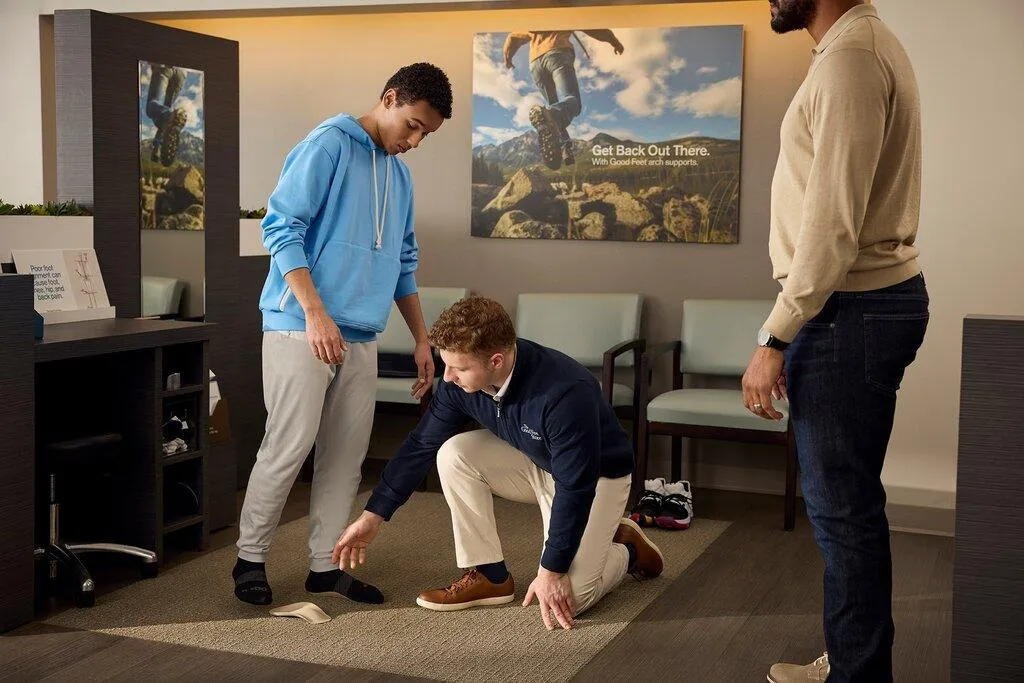
A Personalized Fit, Not a Guess Off the Shelf
One of the more common misconceptions about arch support is that any insert from a store shelf will do the job. Feet vary widely in arch height, width, flexibility, and the way weight distributes across them as you move, which means a generic, one-size-fits-all product is often working against the structure it's meant to help rather than with it.
This is where a guided, in-person fitting process makes a meaningful difference. Rather than guessing at a size or grabbing whatever's labeled "universal," a personalized fitting evaluates how an individual's feet actually move and bear weight, then matches that information to support designed around it. This kind of guided selection process often centers on a three-part system, something to strengthen the foot, something to maintain that progress, and something to ease tension at the end of the day, built to work together rather than as a single static insert. Many programs built this way also use US-manufactured supports backed by a lifetime limited warranty, and are eligible for FSA or HSA spending, which makes the personalized route more accessible than people often expect.
It's a small shift in mindset: from buying a product to going through a process. But it's often the difference between people who find lasting comfort and people who keep replacing the same budget insoles every few months without ever solving the underlying issue.
Building Wellness Habits That Actually Hold Up
Sustainable wellness isn't built on dramatic overhauls. It's built on small, structural decisions that compound over time, the same way consistent sleep or regular movement compounds into something bigger than any single day's effort. Foot health fits naturally into that category. It's not flashy, but it's foundational, and foundational things tend to be the ones that quietly determine whether everything else holds up.
For anyone already investing in posture work, mobility training, or simply trying to feel less drained by the end of the day, arch support is worth treating as part of that same routine rather than something separate from it. The body works as a connected system, and starting at the base of that system, quite literally, tends to make the rest of the work more effective. Strength training holds up better when the legs aren't compensating for an unstable base. Long walks feel different when the foot isn't working against itself with every stride. Even something as simple as standing through a long workday changes when the foundation underneath is doing its job.
None of this requires an overhaul. It requires paying attention to a part of the body that's easy to ignore until it isn't, and treating it with the same intention given to everything else on the wellness list.
A Foundation Worth Paying Attention To
Wellness routines tend to focus on what's visible: workouts, meals, sleep trackers, supplement stacks. But the foundation holding all of it up is often the part getting the least attention. Giving feet the same intentional care as the rest of the routine isn't an indulgence. It's closing a gap that's been there the whole time, quietly shaping how everything above it feels and functions.
Starting from the ground up might be the simplest adjustment in an otherwise complicated wellness routine, and sometimes the simplest adjustments end up making the biggest difference.