

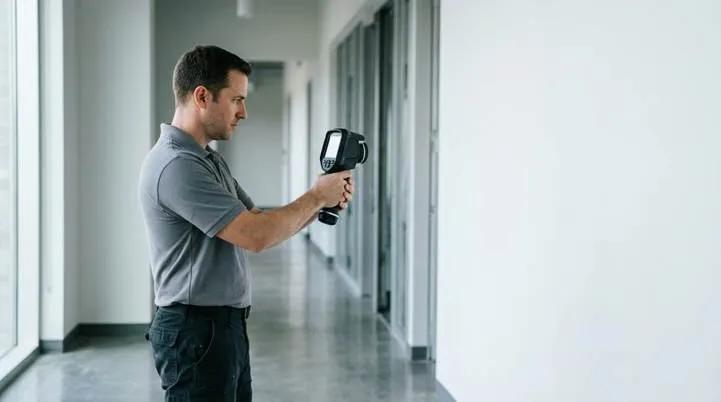
Specialized tools reveal the full scope of water damage that is invisible to the naked eye.
A burst pipe, a small fire, or a big roof leak is often just the beginning. The real cost often comes later. You might face business downtime, lost products, and lasting damage to your building. Feeling rushed to "do something" right away can lead to big mistakes. These mistakes can turn a small problem into a long and costly one.
You might think your own staff can handle it, but the wrong steps can make things worse. Using the wrong tools on wet areas can trap moisture. This can lead to mold, which is difficult and expensive to remove. Cleaning soot the wrong way can push it deeper into walls and furniture. A response that seems helpful but is actually wrong can put your insurance claim at risk and keep your business closed longer. Knowing the right steps for a professional emergency commercial cleanup is key. It helps protect your property and get your business running again fast.
Quick answer: The most expensive cleanup mistakes happen in the first two days. These mistakes often include not realizing how far water has spread, using the wrong cleaning methods that cause more damage, and not keeping the right records for an insurance claim. A planned, professional response is the best way to reduce downtime and long-term costs.
What's inside
. Why Is 'Surface Dry' the Most Expensive Lie in Water Damage?
· What Questions Separate a True Restoration Pro from a General Cleaner?
· Why Can Simply Adding More Fans Make a Water Damage Situation Worse?
· Frequently Asked Questions About Emergency Cleanup
· The Bottom Line: It's About Data, Not Just Drywall
Why Is 'Surface Dry' the Most Expensive Lie in Water Damage?
This belief is costly because water damage is rarely just on the surface. Water travels through hidden paths, creating the perfect place for mold to grow and for your building's structure to weaken.
A small puddle can fool you. Building materials like drywall and insulation act like sponges. Water soaks into them, travels under floors, and gets trapped inside walls. What looks like a small problem in one room can spread to other floors. Moisture can get trapped in ceilings and under floors, far from the original leak.
This hidden moisture means you have to act fast. According to the U.S. Environmental Protection Agency, mold can begin to grow on damp surfaces within just 24 to 48 hours. By the time you smell a musty odor, a large amount of mold has probably already grown behind a wall or under the carpet. This turns a simple water removal job into a much harder and more expensive mold cleanup project.
The cost of these hidden problems is high. Problems that aren't related to weather, like burst pipes, cause many commercial insurance claims. In fact, water damage and freezing are consistently among the costliest causes of commercial property insurance losses. This shows how often a small leak gets worse because of damage you can't see.
❝ Ask a pro to use their moisture meter on a wall that looks dry, a few feet from the wet spot. The results often surprise people. A wall can feel dry but be soaked on the inside. That's why you need a professional to check it.
Simply running fans on a wet carpet is one of the most common mistakes. Professionals use special tools like thermal cameras and moisture meters to find out exactly how far the water has spread. This check is not an extra charge. It's the only way to make sure everything that's wet is found and dried correctly. This prevents a small problem from causing expensive damage later.
What Questions Separate a True Restoration Pro from a General Cleaner?
A professional company uses data and industry standards, not just guesses.
The main difference is that they follow a "standard of care." For water damage, the main guide is the S500 Standard from the Institute of Inspection, Cleaning and Restoration Certification (IICRC). This guide explains the science and the right steps for fixing water damage. A good company will know this standard and base their whole process on it. Ask a company if their workers are IICRC-certified as Water Damage Restoration Technicians (WRT). Their answer tells you if they have paid for real, science-based training.
Besides certificates, their process should be based on data. A pro crew doesn't just set up fans. They set a "drying goal" for everything that is wet. They use moisture meters and thermal cameras to see how far the water has spread. They should give you a daily drying log. This paper tracks moisture levels in wet materials and in the air. This isn't just paperwork. It's proof that your building is back to its normal, dry state. This paperwork is often needed for your insurance claim.
The work also has serious safety rules. Cleanup work carries real injury risks, often from slips, falls, and chemical exposure. A professional team follows strict safety rules. They use the right safety gear (PPE) and set up barriers to stop contaminants like mold or bacteria from spreading.
This table shows the practical differences in approach:
Evaluation Criteria | Professional Restoration Firm | General or Untrained Responder |
Standard Followed | Follows the IICRC S500 standard | Relies on guesswork or "common sense" |
Moisture Detection | Uses moisture meters, thermal cameras | Visual inspection only ("it looks dry") |
Drying Method | Creates a drying plan with dehumidifiers | Places fans on obviously wet surfaces |
Documentation | Provides daily drying logs, moisture maps | No formal documentation provided |
Technician Training | IICRC certified (e.g., WRT) | On-the-job experience only |
In the end, you're not just hiring someone to clean up. You're trusting them to fix a serious problem that can cause lasting damage and cost you a lot of money. The right partner can prove, with data, that the job was done correctly.
Why Can Simply Adding More Fans Make a Water Damage Situation Worse?
Because proper drying is about controlling the moisture in the air, not just moving air around. Without special dehumidifiers, fans can spread moisture to dry areas. This can turn a small problem into a building-wide one.
When things are wet, the goal is to get the water out of them and into the air. This is called evaporation. Fans, also called "air movers," speed this up. They blow air on wet surfaces, helping the water turn into a vapor (a gas). But what happens next is the problem. In a closed room, that water vapor has nowhere to go. The air quickly fills up with moisture, reaching 100% humidity. At that point, no more water can evaporate. You're left with a warm, damp, still room, the perfect place for mold to grow.
This is where the science of drying becomes important. A professional restoration team doesn't just set up fans. They create a balanced drying system. The most important part of this system is a powerful dehumidifier. These machines pull huge amounts of moisture out of the air. This makes the air much drier.
❝ A professional drying system doesn't just move air. It makes the air "thirsty." A powerful dehumidifier makes the air so dry that it pulls moisture out of walls and floors. Fans are used to blow that thirsty air onto the wet spots.
This creates a cycle that keeps repeating. The dehumidifier makes the air dry. The fans blow this dry air across wet surfaces. The "thirsty" air soaks up moisture. Then, the damp air goes back into the dehumidifier, which removes the water. The cycle starts over. This controlled system is the only way to get moisture out from deep inside walls and floors. Just opening a window or using regular fans won't work. It can even push moisture deeper into your building.
Frequently Asked Questions About Emergency Cleanup
How is the cost for an emergency cleanup calculated? Unlike regular cleaning that's priced by square foot, emergency services are usually billed for time and materials. The cost depends on the equipment needed (like big dehumidifiers), how many hours the crew works, the type of water damage, and how much material has to be thrown away. You should get a detailed estimate before they start.
How long does a typical water damage cleanup take? For a small event, the drying part usually takes three to five days. But the timeline depends on how wet things are, what materials are wet (like porous concrete versus non-porous tile), and the starting humidity levels. A certified technician will set a "drying goal" and monitor progress daily to determine the exact duration.
Can our in-house janitorial team handle a small flood? While your staff can manage surface spills, they typically lack the specialized equipment to address saturation. A shop vacuum cannot remove water trapped in carpet padding and subfloors the way a weighted extraction tool can, and standard fans cannot create the dry, "thirsty" air needed to prevent mold. Using in-house staff for anything beyond a minor surface spill risks leaving behind hidden moisture that leads to much costlier secondary damage.
Who handles the cleanup after a fire in a commercial building? Fire damage restoration is a highly specialized field that goes far beyond simple cleaning. It requires technicians trained to handle the removal of corrosive soot, neutralize acidic smoke residues, and permanently seal surfaces to eliminate persistent odors. This work often involves cleaning contents, ductwork, and structural elements using specific chemical sponges and thermal fogging equipment.
What does business interruption insurance cover during a cleanup? This type of insurance is designed to cover the income your business loses while it is closed or partially closed for restoration. It can help pay for ongoing operating expenses like rent, payroll, and taxes. For your claim to be successful, you will need meticulous documentation from the restoration company, including moisture logs, photos, and a detailed scope of work, to prove the loss and the necessity of the repairs.
The Bottom Line: It's About Data, Not Just Drywall
The immediate aftermath of a commercial water incident presents a deceptive choice. It is easy to focus on the visible problem: standing water on the floor. But the real threat lies in the moisture you cannot see, trapped within drywall, subflooring, and insulation. The most critical mistake is treating the response as a simple cleaning task rather than a technical drying operation. Effective mitigation is not measured by what is removed, but by what is verifiably returned to a pre-loss condition.
Ultimately, your decision comes down to a single question: can the team you hire provide objective proof that the structure is truly dry? This proof is not a verbal assurance. It is a set of documents like daily moisture logs and a final report based on a recognized standard of care. Choosing a partner who operates on data, not assumptions, is the only way to ensure a small emergency does not become a long-term, expensive liability. The goal is not just a clean facility, but a demonstrably safe and sound one.