

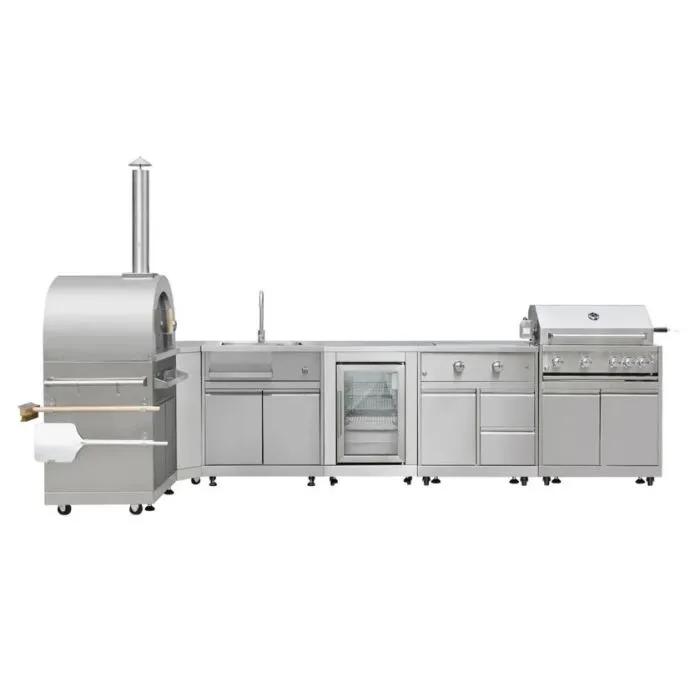
Adding an oven to a run of burners looks like an extra appliance and behaves like a change of plan. Burners put heat into a pan for minutes at a time, while an oven soaks a mass of refractory stone for an hour and then radiates it back. A TMG Industrial outdoor kitchen island built around both has to manage two completely different heat problems in one cabinet.
Cordierite Stores Heat Instead of Conducting It
The stone in a pizza oven is not there to transfer heat quickly. Cordierite has modest conductivity and high thermal mass, so it absorbs energy slowly, holds it, and gives it back to the base of a dough at a steady rate rather than in a surge.
That is why a stone needs a long preheat and why it recovers between pizzas. A thin metal plate reaches temperature in minutes and then drops the moment something cold lands on it, which is the difference between a crisp base and a pale one.
Thermal Shock is What Cracks a Stone
Cordierite tolerates heat well and sudden change badly. A cold stone put straight into a hot oven, or a hot stone hit with cold water or a frozen base, develops stresses between its hot and cold regions, and a crack is how those stresses resolve.
Two habits prevent nearly all of it:
Heat and cool the stone with the oven
Never wash a stone while it is warm
Staining is normal and permanent. A stone darkens as cooking oils absorb into the pores, which affects nothing at all about how it cooks, so the usual urge to scrub one back to its original color is the single most common way a good stone gets broken.
Spacing Matters More Than Total Output
Burners and an oven compete for the same space in an outdoor kitchen island, and an oven radiates to its surroundings for as long as it holds heat. Mounted too close to a burner section, it warms the cabinet skin, the control knobs and anything stored beneath it.
Gas appliances draw combustion air from their surroundings, so a crowded island can starve a burner while the oven is running. Clearance around the oven body is not a styling decision; it is what keeps the controls cool enough to touch and the burners breathing properly.
How Total Output Gets Divided
A figure like 48,000 British thermal units describes the whole island rather than any one appliance. Four burners share most of it, and running all of them with the oven lit means each is receiving a fraction of its individual peak.
This is the practical ceiling that shows up when cooking for a crowd. Sequencing matters: bring the oven up first because it needs the long soak, then use the burners while it holds temperature, rather than asking the whole island for everything at once.
Judging A Cabinet on How It Manages Heat
Burner count and the headline output are what get compared, and they describe capacity rather than behavior. Appliance spacing, cabinet venting and whether the stone is replaceable describe how the island will cook two summers from now.
TMG Industrial builds this one as an eleven foot run in black with four burners, a built in pizza oven and a cordierite pizza stone. An island chosen with the oven placement in mind will stay comfortable to work around on the night it actually matters.