

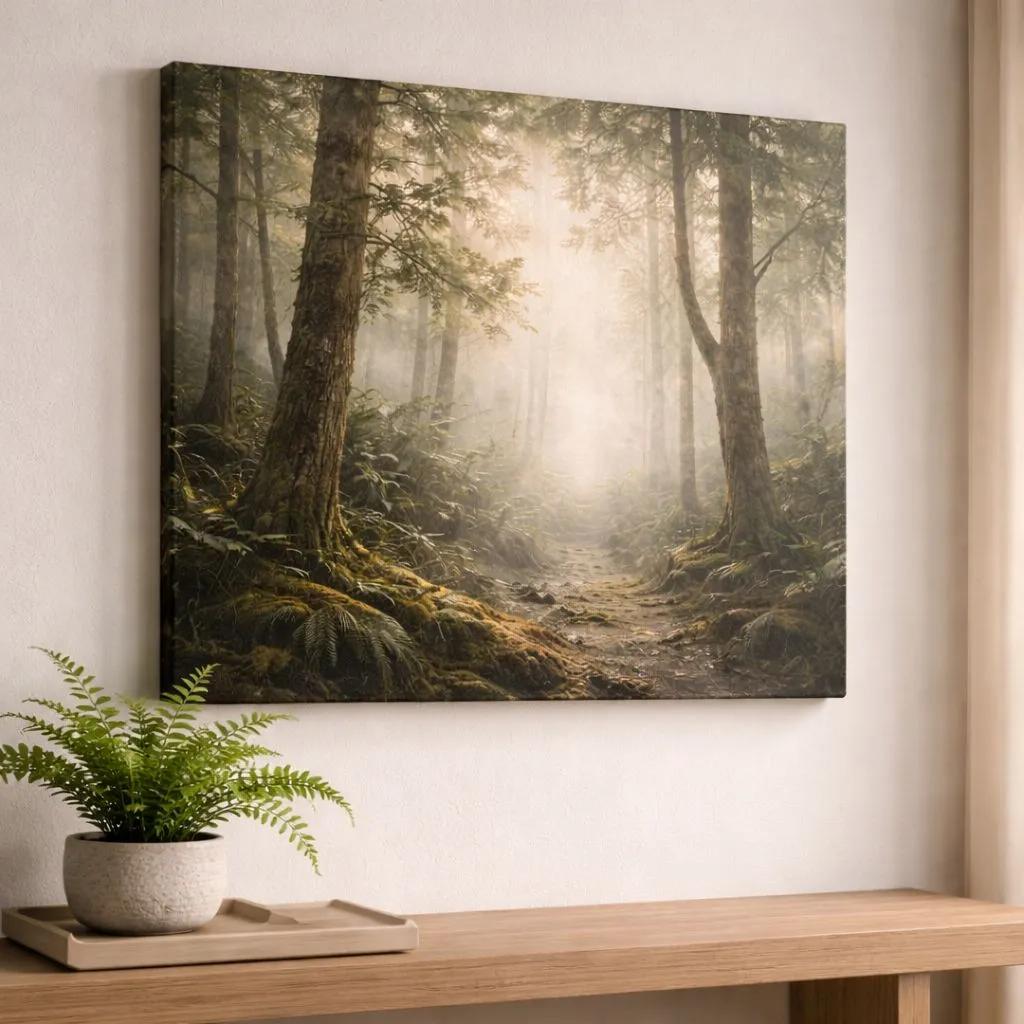
Most of us don't think carefully about what we put on our walls. A print we liked in a shop, a photo from a trip, a poster that came with a frame — these things accumulate the way apps accumulate on a phone: without intention, and without awareness of their collective effect.
But the visual environment of your home is not neutral. The images, colours, and compositions surrounding you every day are doing something to your emotional state — subtly, continuously, below conscious attention. Paying deliberate attention to that is an act of self-care that costs relatively little and returns a surprising amount.
The Science Behind It
Roger Ulrich's landmark 1984 study in Science remains the field's most cited evidence. Ulrich found that surgical patients with a window view of trees recovered faster, had shorter hospital stays, and required fewer painkillers than patients facing a brick wall. The only variable was what they could see. A 2015 meta-analysis in Psychology of Aesthetics, Creativity, and the Arts — reviewing 28 studies — found consistent positive effects of visual art on mood, stress, and sense of meaning, with the strongest effects for personally meaningful art and natural imagery.
The mechanism isn't mysterious. Natural environments engage what Rachel and Stephen Kaplan at the University of Michigan call "involuntary attention" — effortless, pleasant engagement that allows directed attention (the kind required for work and decisions) to restore. Looking at a landscape or botanical print gives your taxed cognitive systems a genuine break. That large canvas in your living room is doing something for your nervous system every time you sit near it.
Colour as a Mood Management Tool
Colour is the most immediate emotional lever in interior design, and art is the most flexible way to introduce it — far easier to change than paint. The research on colour and emotion is robust, even if individual responses vary.
Blue reduces arousal and anxiety — effective in bedrooms and anywhere you need to unwind. Yellow and warm amber lift mood and combat the flatness of poorly lit rooms. Green sits in the middle: balancing and restorative, which is why botanical prints work in almost any space. Red energises in small doses but overwhelms at scale — better as an accent than a dominant tone. Choosing art with these dynamics in mind is environmental engineering, not just decoration.
Why Personal Meaning Outperforms Generic Beauty
Research consistently shows that personally meaningful art produces stronger and more lasting emotional responses than art that is simply aesthetically pleasing. A print of a place you've loved, or an image that captures something true about how you see the world, does more for your daily emotional baseline than a perfectly nice generic print chosen to match the sofa.
Custom printing services have made this accessible. A photograph from a meaningful trip, or any image that carries personal weight, can be produced on gallery-quality canvas or metal at a fraction of what it once cost. Printseekers accepts customer-supplied images for production on canvas, metal panels, or framed prints — turning personal photographs into genuine daily wellbeing investments.
Less Is Usually More
Too much visual content can be as harmful as too little. Environments with excessive visual complexity — competing images, dense pattern, accumulated clutter — create cognitive overload that increases stress and erodes the sense of spaciousness. The "cluttered home, cluttered mind" observation isn't a cliché; it has neurological grounding.
Fewer, more intentional pieces almost always outperform many unrelated ones. A single large canvas with real presence does more for a room's emotional register than fifteen small prints competing for attention. This isn't a mandate for minimalism — curated gallery walls work beautifully — but accumulating art without curating it actively undermines the wellbeing benefits.
Choosing Art for Specific Emotional Goals
Rather than thinking about "nice art," think about what you want to feel in each space — then choose accordingly. For stress reduction: natural imagery, calm palettes (blues, soft greens, earthy neutrals), flowing abstract forms. For energy and positivity: warm tones, bold composition, visually joyful content. For focus: moderate stimulation — geometric prints, architectural photography, landscapes with clear depth.
For rest and sleep: low-contrast compositions, soft botanical or coastal imagery, nothing visually demanding. The bedroom is where the visual environment has the most leverage — you fall asleep and wake up inside it. Calm, lower-stimulation art genuinely supports better sleep onset; high-contrast or agitating imagery does the opposite.
The hallway is equally worth attention and almost always overlooked. You move through it twice every day. A single well-chosen piece with strong vertical presence can make coming home feel like arriving somewhere you actually want to be.
Refreshing Without Redecorating
Wall art is the most reversible element of any interior. Unlike paint or furniture, it can be changed quickly and at modest cost — making it the fastest lever available for improving your home's emotional environment.
If a space feels visually stale, ask honestly whether the art is serving its purpose. If not, change it. Printseekers produces individual orders at gallery quality with 1–3 day turnaround, so a new canvas or framed print can arrive within a week of deciding you want one. For the ongoing effect on your daily mood, it's one of the better investments a room allows.
Conclusion: Your Home Should Feel Like You Want to Feel
The visual environment of your home exerts a quiet, continuous influence on your emotional baseline. Art is the most personal and flexible element of that environment. Choosing it deliberately — with attention to colour, content, meaning, and the specific needs of each space — is not indulgence. It's self-care that compounds daily. Look at your walls. Ask yourself honestly: is this working for me?