

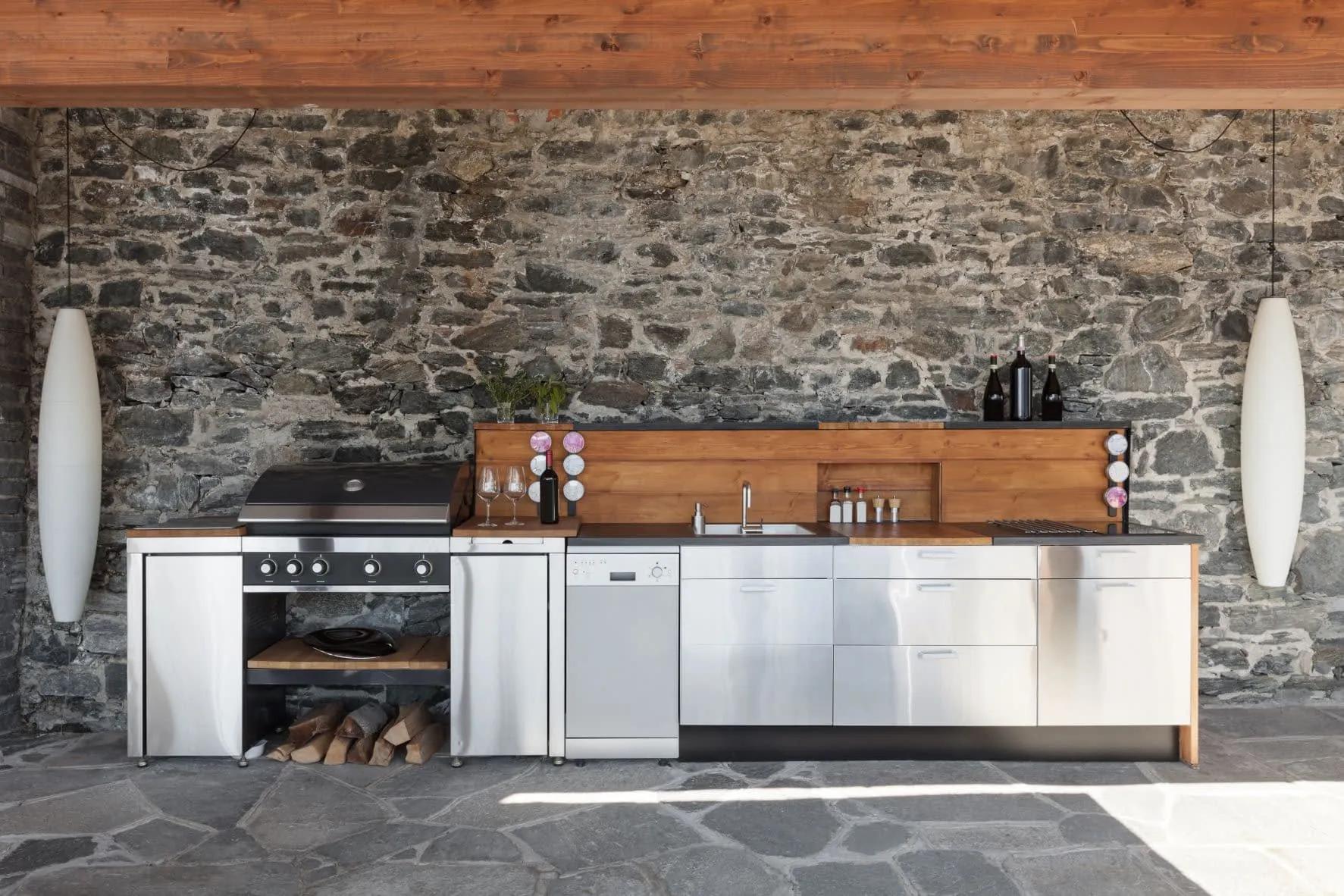
The Season That Decides How Long It Lasts
An outdoor kitchen gets judged on the summer it was bought for and survives on what happens in the other half of the year. Across most of Canada that half includes weeks below freezing, road salt in the air, and a freeze-thaw cycle that runs daily through the shoulder seasons. A stainless steel outdoor kitchen handles all of that well, with two specific exceptions that are worth knowing before the first cold snap.
Water In a Line Is the Expensive Part
An integrated sink is the one component that fails catastrophically rather than gradually. Water expands as it freezes, and a supply line with no room for that expansion splits, usually at a fitting and usually where nobody notices until spring.
Draining is the whole solution, and it is not complicated. Shut off the supply, open the tap to release pressure, disconnect the line at its lowest point and let gravity empty it. A short blast of compressed air clears what gravity leaves behind in a horizontal run. The trap under the sink holds water as well, and leaving it full is how people discover in spring that the trap has cracked.
Stainless is A Family of Alloys, Not One Metal
The second exception is that stainless does not mean rust proof. It means the alloy forms a passive chromium oxide layer protecting the steel underneath, and that layer's durability depends on the grade and on what is sitting on it.
Grade 304 contains more chromium and nickel and handles outdoor exposure well. Grade 430 costs less and tolerates salt noticeably less well, which matters near the ocean or on a property that sees salt blown off a driveway.
Either grade spots if left dirty. What people read as rust in the metal is usually contamination sitting on top of it: iron particles from a wire brush, grease carbon, or hard water deposits holding moisture against the surface.
Cleaning And Covering, in That Order
A cover over a dirty surface is worse than no cover at all:
Wash and dry the surfaces before covering
Use a cover that breathes, not solid plastic
Keep burners and igniters dry and shielded
Never clean stainless with a steel wire brush
A vented cover lets moisture escape rather than condensing underneath and sitting against the steel all winter. That single choice does more for an outdoor kitchen island than any coating, polish or protectant sold alongside it at the till.
Where The Appliances Need Separate Thought
A refrigerator built into an outdoor cabinet has its own requirements, because most are rated for a temperature range that stops well short of a Canadian winter. Manufacturers usually specify emptying, cleaning, switching off at the breaker and leaving the door ajar so the seal does not take a set.
Gas appliances are more forgiving than that. The usual precaution is simply to close the cylinder valve and protect the burner ports and igniters from moisture and insects, which between them cause more spring frustration than cold ever does.
Buying With The Winter in Mind
The specification that matters most in a cold climate is rarely burner count. It is the grade of stainless, whether the plumbing drains without dismantling anything, and whether the cabinetry sheds water rather than holding it.
TMG Industrial builds this one with six main burners, a rear and a side burner, an integrated sink and a refrigerator, which is a lot of equipment to shut down correctly. Spend an hour on it and the same kitchen lights first time next season.