

Image source: Pexels
Wealth that predates the wearer tends to announce itself softly. Families associated with old money dress in muted tailoring, worn leather, and jewelry that looks inherited even when it was bought last week. An engagement ring built for this look follows the same logic. The goal is a piece that could sit in a family collection for eighty years without looking dated, the kind of ring a shopper chasing the biggest possible stone tends to walk right past.
The result is a narrow set of choices, a handful of cuts, metals, and settings that keep returning to the hands of people who dress this way because each looks like something the family already owned.
The Quiet Luxury Principle in Ring Selection
Old money style rewards restraint. The premium is in the craftsmanship, so the ring should look considered, its quality visible in the making. Jewelers describe the current mood as quiet luxury, a preference for understated detail over obvious display. A 2025 market read placed lab grown diamonds at roughly 70% of engagement ring sales, a sign that buyers now separate how a stone looks from where it came from and what it cost.
For this buyer, that separation matters. A ring can look substantial without any signal about the receipt. The families who set the reference point for old money taste have always treated jewelry as a long-term holding, something passed down rather than replaced, and a ring chosen with that horizon in mind reads differently from one bought to impress a room.
Classic Cuts and the Tailored Wardrobe
Round brilliant diamonds still account for more than half of engagement ring sales, and their steady presence suits a wardrobe that avoids fashion cycles. The round shape has no era attached to it. It looked correct in 1955 and looks correct now.
Two other cuts belong in the same category. The emerald cut, with its long open facets, has become a staple of the quiet luxury look because its clean rectangular outline pairs with structured clothing. The asscher, an octagonal step cut, offers a near-square version of the same idea. The two look like heirloom shapes because they were popular during the Art Deco period, a design era that old money fashion still references in its tailoring and its interiors. Step cuts hide inclusions less forgivingly than brilliant cuts, so they demand a cleaner stone, which suits a buyer who treats quality as the actual point of the purchase.
Square and Step Cuts in a Tailored Frame
Angular stones occupy a specific place in this wardrobe. The emerald and the asscher both suit the tailored discipline old money favors, and a princess cut engagement ring shares their sharp geometry, its four squared corners drawing a line that pairs neatly with a structured jacket or a crisp collar. Set among other angular cuts, it never announces itself as the trend of the season.
None of these shapes read as invented for this year. They borrow from Art Deco and mid-century design, periods this aesthetic keeps returning to. A buyer choosing among them selects a shape with a documented past, which is the point when the goal is a ring that looks inherited.
Metal Tones That Age Well
Metal choice does more work here than most buyers expect. Platinum holds its color permanently and develops a soft patina that suits the worn-in quality old money style prizes. Yellow gold, out of favor for a stretch, has returned to prominence because it carries an antique association that fits the aesthetic exactly.
White gold, by contrast, needs periodic rhodium plating to keep its brightness, and that maintenance runs against the ideal of a ring that asks for nothing. The old money preference leans toward metals that improve with age.
Settings Made for Decades of Wear
A ring meant to last generations needs a setting that protects the stone without theatrics. The bezel, which surrounds the diamond with a fine rim of metal, has grown in favor precisely because its smooth silhouette looks modern and understated at once. It also guards the stone's edges better than prongs, which matters for a piece expected to be worn daily for decades.
Low-profile settings follow the same logic. A stone set close to the finger snags less and keeps a discreet outline under a shirt cuff. Hidden details reward this buyer without broadcasting anything: a diamond set into the underside of the band, a colored gemstone tucked where only the wearer knows it exists. These touches add private meaning while keeping the public face of the ring calm.
There is also a practical habit behind the preference for sturdy mounts. Families who keep jewelry across generations often reset an old stone into a new band rather than buying a fresh piece, and a protective setting is what makes that possible without chipping the diamond.
Proportion and the Question of Scale
Old money taste treats carat size as a secondary concern. A one-carat stone in a well-cut mount looks more correct on this wardrobe than a three-carat stone that dominates the hand, because the aesthetic treats size itself as a form of announcement. The oval cut shows the preference at work. Its share of engagement ring sales climbed from 21.5% in 2022 to 33% in 2025, and part of that rise comes from buyers who want a stone that looks larger at a given weight while holding a soft, classic outline. Discretion paired with quiet presence is the tone old money dressing aims for, on a weathered hand at a country house or under the cuff of a tailored coat.
Color and the Limits of Restraint
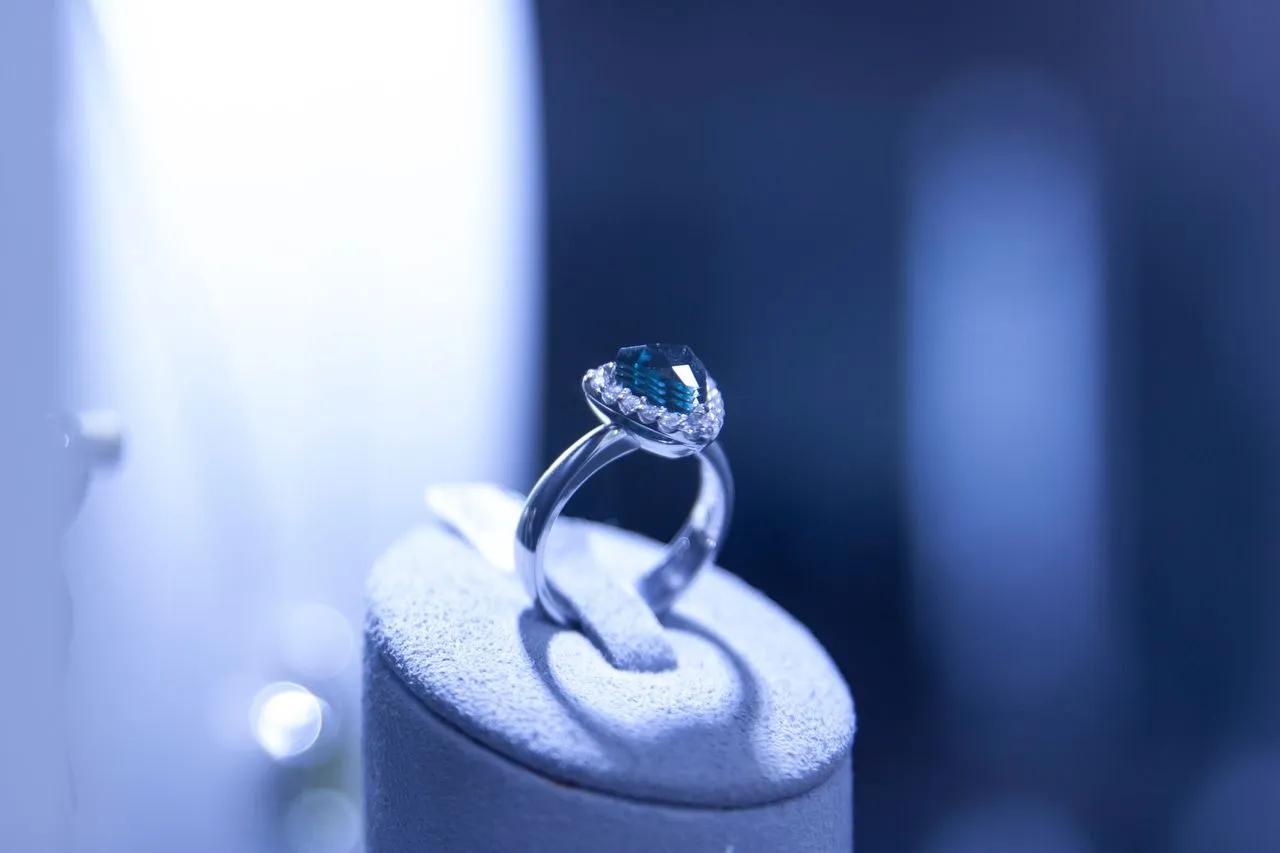
Old money taste does not forbid color outright. Sapphires and other colored center stones have a long aristocratic pedigree, and a deep blue stone in a simple setting looks traditional and restrained. Fancy yellow diamonds have also seen renewed demand, nearly doubling year on year, driven by the same interest in rarity that fuels the quiet luxury mood.
The discipline lies in scale and setting. A colored stone works when the mounting stays plain and the proportions stay moderate. The moment a ring adds halos, heavy pavé, and an oversized center all at once, it leaves the aesthetic entirely and enters the territory old money dress spends its whole grammar avoiding.
What the Old Money Ring Actually Is
Stripped of the styling language, an engagement ring for this look is a durable object chosen to last generations. It favors cuts with a documented history and settings that protect the stone without display. A princess cut in a bezel or an emerald cut in platinum gives the same impression to people who value this look, that of something a family already owned. That impression, above any single feature, is what old money fashion asks a ring to deliver.