

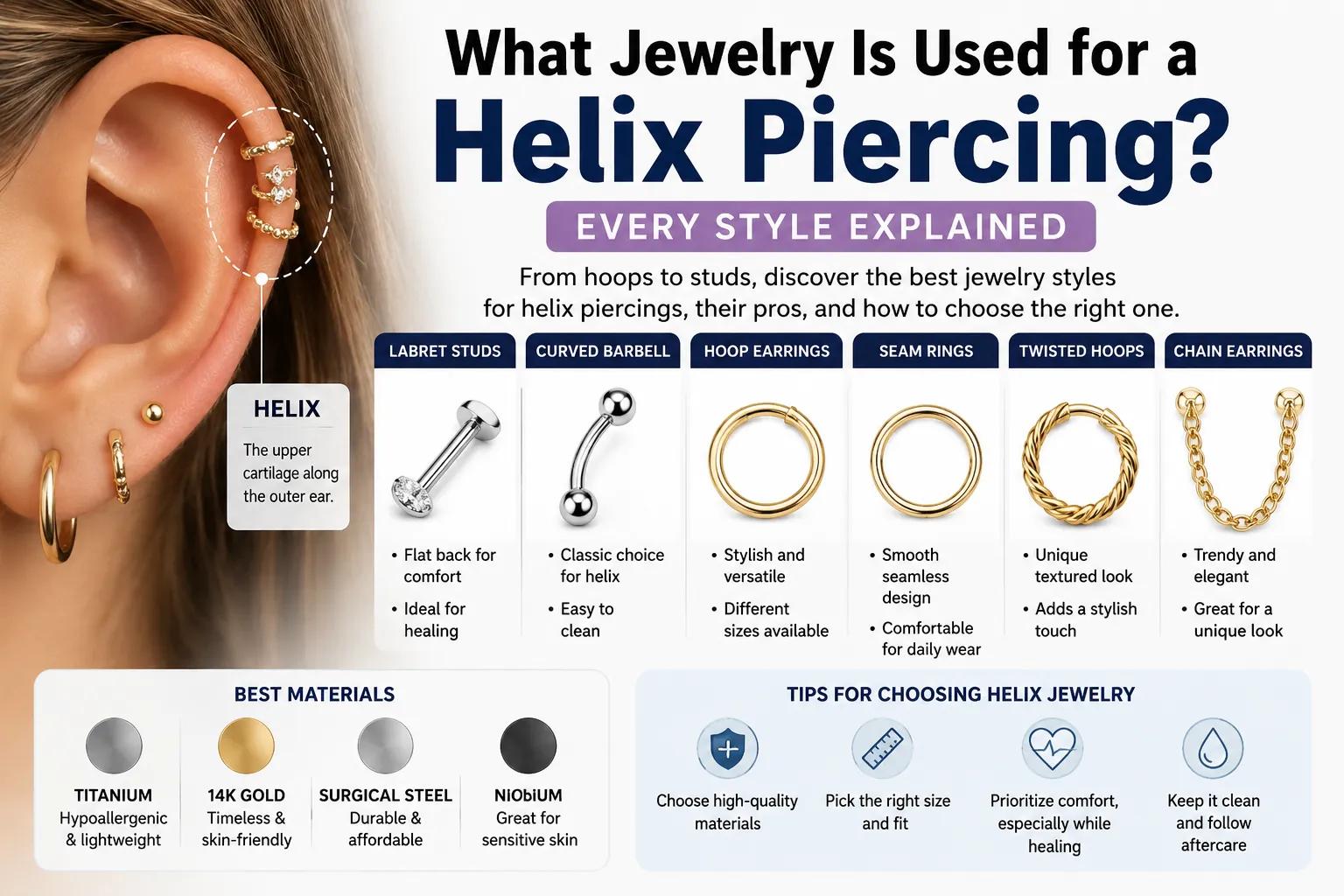
The helix is one of the most popular cartilage piercings, but it is also one of the most commonly mis-jewelried. People pick styles that look great on a healed piercing and wear them on a fresh one, and then wonder why healing stalls or irritation bumps appear. The answer to what jewelry is used for a helix piercing depends on two things: how long you have had the piercing and which variation of the helix placement you have. Get those two factors right and the rest follows naturally.
Where Is the Helix Piercing?
The helix is the outer curved rim of the upper ear cartilage. A standard helix sits anywhere along that outer rim, typically in the upper third. The forward helix is placed at the front of that rim closest to the face. A double or triple helix stacks two or three piercings close together along the same stretch of outer cartilage. The hidden helix, covered in its own section below, sits just beneath the outer fold of the rim rather than through it. Each variation calls for slightly different jewelry, though the core styles overlap.
What Jewelry Is Used for a Fresh Helix Piercing?
For a fresh helix piercing, the flat-back labret stud is the professional standard. It consists of a straight post with a flat disc on one end and a decorative top on the other. The flat disc sits flush against the back of the cartilage without pressing into it, distributes pressure evenly, and does not snag on hair, pillows, or clothing. Crucially, it does not rotate through the piercing channel the way a ring does, which means bacteria are not being moved through healing tissue every time you sleep on your ear or brush your hair across it.
The threadless or push-pin stud is an equally good option for initial jewelry and is particularly popular in fine piercing studios. The top attaches by tension rather than threading, which means no threaded surface passes through the healing channel during insertion. Both flat-back and threadless studs are available in implant-grade titanium, which is the preferred material for fresh cartilage piercings due to its biocompatibility and light weight.
Hoops, seamless rings, captive bead rings, and clickers are not appropriate for fresh helix piercings. Circular jewelry rotates through the channel as you sleep or move, dragging contaminants through healing tissue and significantly extending recovery. Most piercers will not pierce a fresh helix with a hoop and will advise waiting until the piercing is fully healed, typically a minimum of six to nine months for the helix, before switching to ring styles. Initial post length is 8 to 10 millimeters to accommodate early swelling. Once swelling settles, around the two to three month mark, the post should be downsized to 6 to 8 millimeters with the help of a professional piercer. Skipping the downsize leaves excess length that snags and creates irritation even on a piercing that is otherwise progressing well.
Jewelry Styles for a Healed Helix Piercing
Flat-Back Labret Stud
Even after healing, the flat-back labret stud remains one of the most widely worn helix styles. The comfort advantage over hoops makes it the practical everyday choice for many people, and the range of decorative tops available, from simple gold balls to gemstone clusters and shaped fine jewelry ends, means there is no shortage of aesthetic variety within the style. For a stacked double or triple helix, flat-back studs in coordinating sizes create a cohesive look without the visual density that multiple hoops in close proximity can produce.
Seamless Hoop
The seamless hoop is the most popular ring style for a healed helix. It is a continuous circle with no visible clasp or bead, opened by twisting the two ends slightly apart. The result is the cleanest, most minimalist hoop aesthetic available, with no hardware interrupting the line of the ring. Common diameters for helix use are 8 millimeters and 10 millimeters, though the right size depends on the specific placement and individual ear anatomy. A hoop that is too large will hang away from the ear; one that is too small will press against the cartilage rim. Most piercers can advise on the correct diameter for a specific placement during a downsize or jewelry change appointment.
Captive Bead Ring
The captive bead ring is a classic hoop in which a single bead is held by tension between the ring's two ends. It produces a traditional cartilage jewelry aesthetic and is fully appropriate for a healed helix. The main practical point is that safe insertion and removal requires ring-opening pliers to avoid distorting the shape, making it less convenient for frequent changes than a clicker. For people who wear the same piece daily, this is a non-issue.
Hinged Clicker Ring
The hinged clicker opens and closes via a small hinge, snapping shut with an audible click, and requires no tools for insertion or removal. It is the most user-friendly ring style for the helix. Clickers come in a wider range of design complexity than most other ring styles, from simple polished rings to ornate stone-set pieces, and work particularly well in forward helix placements where the small size and clean closure read as refined rather than bulky.
Huggie Hoop
The huggie is a small hoop designed to sit close against the ear rather than extending outward. Its compact diameter makes it particularly well suited to stacked helix piercings where multiple rings in close proximity need to avoid overlapping or touching. Two or three huggies in graduated sizes along a double or triple helix create a curated, intentional look without the visual bulk of larger hoops. Huggies are also less likely to snag than larger diameter rings, making them a practical daily wear option for healed piercings in active people.
Hidden Helix Jewelry: A Special Category
The hidden helix, also called a floating helix, is a distinct variation that requires its own discussion because the jewelry differs meaningfully from standard helix styles. The hidden helix is pierced at the upper cartilage just beneath the outer fold of the helix rim. The body of the jewelry tucks under the ear's fold and only the decorative end is visible, creating the illusion that a piece of jewelry is floating at the top of the ear with no visible piercing point. Because the channel sits beneath the fold rather than through the outer rim, the jewelry must stay tucked under that fold rather than pulling forward or rotating into view. Flat-back labret studs with longer or angled decorative ends are the standard choice, particularly styles with dangling chains, chandelier-style drops, or curved gem clusters that drape over the top of the ear. Standard hoops do not work here because they extend outward from the channel rather than sitting flush beneath the fold.
The hidden helix is anatomy-dependent and works best on ears with a prominent, well-defined helix fold. A professional piercer should assess your ear before committing to this placement. For initial jewelry, a simple flat-back labret is used during healing; elaborate dangling or chain-style pieces are introduced once the piercing is fully settled.
For those specifically exploring this style, hidden helix jewelry designed for this placement covers the flat-back labret styles and decorative options that work with the tucked anatomy of the hidden helix rather than fighting against it.
Jewelry Gauge and Size for Helix Piercings
Standard helix piercings are performed at 16 gauge in most professional studios, with 18 gauge used for finer anatomy or forward helix placements. Wearing jewelry in the wrong gauge after healing can cause irritation or tearing, so it is important to know what gauge your piercing was done at before purchasing replacement pieces. For post length, fresh piercings start at 8 to 10 millimeters, downsizing to 6 to 8 millimeters once swelling has resolved. For ring diameter, 8 millimeters suits most standard helix placements; 6 to 8 millimeters works better for forward helix placements. Never attempt the first jewelry change at home. Have a professional piercer confirm the piercing is ready and fit the new piece correctly.
Best Materials for Helix Piercing Jewelry
Implant-grade titanium is the recommended material for helix piercing jewelry at every stage of healing. It is biocompatible, non-porous, nickel-free, and lighter than steel, reducing pressure on cartilage during healing. It is also available in anodized colors beyond standard silver tones. Solid 14k or higher gold is equally appropriate for healed piercings and is the material used in most fine piercing jewelry. Implant-grade steel meeting ASTM F-136 standards is acceptable for healed piercings in people without nickel sensitivity. Avoid acrylic, plated metals, unknown alloys, and anything labeled only as "surgical steel" without a specific grade. Plated metals wear through over time and expose base metal that can cause reactions. Acrylic is porous and cannot be sterilized, making it unsuitable for any piercing at any stage.
Final Thoughts
The jewelry used for a helix piercing changes as the piercing matures, and choosing correctly at each stage is the single most important factor in how well the piercing heals and how good it looks once healed. Start with a flat-back labret in implant-grade titanium, downsize with your piercer when the time comes, and then explore hoops and more decorative styles from there. For a well-curated range of helix-specific jewelry across all styles and healing stages, PiercedAddiction is a reliable starting point.