

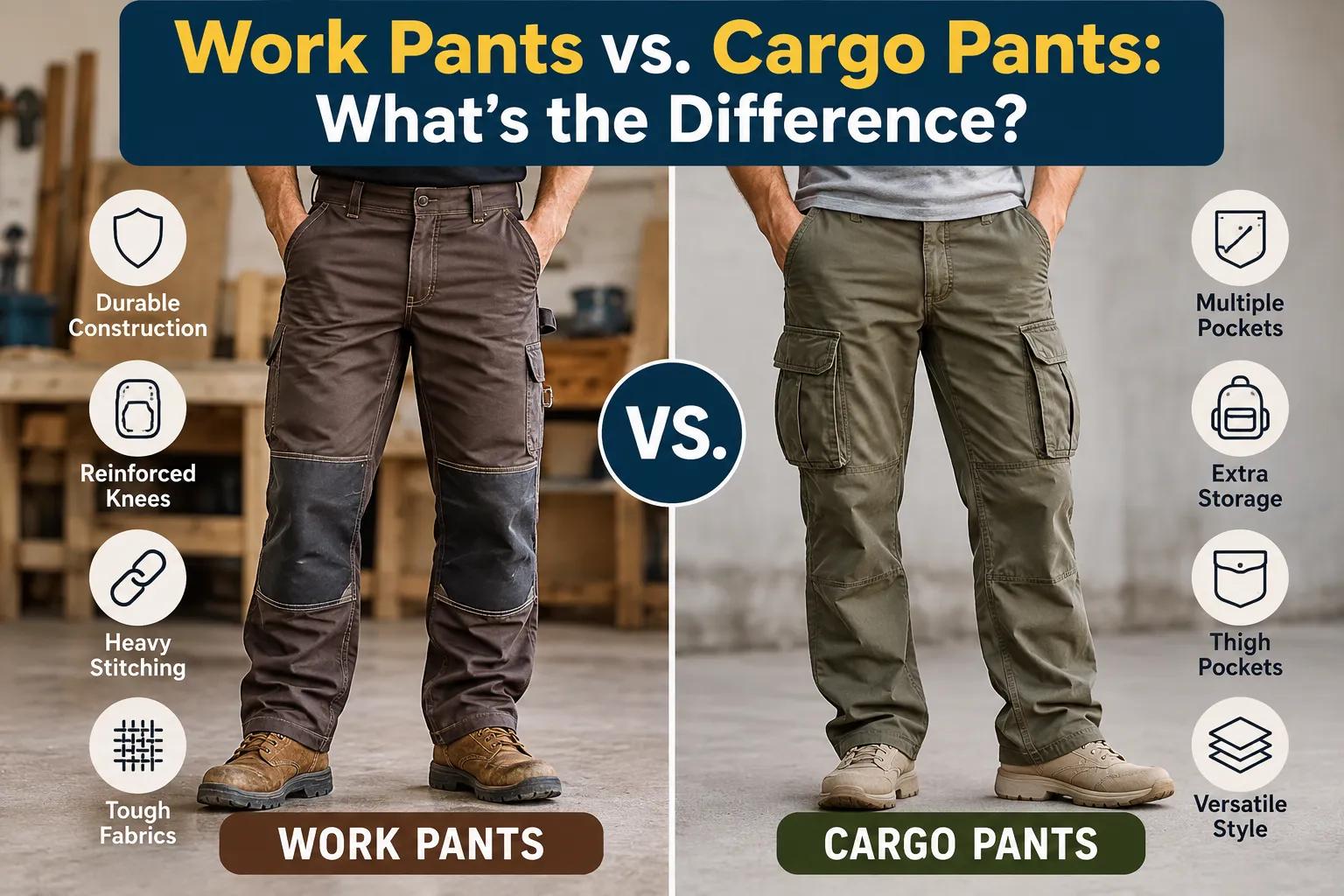
Search this question and you get a straight fight: work pants are tougher, cargo pants have more pockets, pick one. That framing is why so many people end up with the wrong trousers. The two terms are not competing options. They describe different properties, which is why plenty of pants are both at once and why the useful question is not which one wins.
This guide covers:
• Why the two terms are not actually opposites
• What "work pant" specifies about how a garment is built
• What "cargo" specifies, and what it does not
• When neither label tells you what you need to know
At a Glance
Takeaway | Detail |
The terms sit on different axes | One describes construction, the other describes pocket layout |
Work pant means built to survive | Reinforced knees, heavy stitching, bartacks, denser fabric |
Cargo means built to carry | Large thigh pockets, usually flapped or zipped, for flexible storage |
A garment can be both | Reinforced construction and cargo pockets are independent choices |
Labels stop at hazards | Neither term implies flame, arc, or visibility protection |
Fit is a safety property | Badly proportioned trousers ride, gap, and catch on things |
The Terms Are Not Opposites
Consider what each word describes. "Cargo" refers to a pocket configuration, specifically the large pockets mounted on the outside of the thighs. It is a statement about where things go. It says nothing about fabric weight, stitching, or whether the knees survive a season on concrete.
"Work pant" refers to how the garment is built: reinforcement at the points that fail first, stitching designed for stress, fabric chosen for abrasion resistance, and a cut that allows kneeling and climbing. It says nothing about pocket layout.
Because those are separate properties, all four combinations exist. A heavy duck canvas double-knee pant with only front and back pockets is a work pant that is not a cargo pant. A lightweight fashion cargo is the reverse. Plenty of trousers are both, and many are neither.
The practical version of the question is therefore two questions. What does this garment need to survive, and what does it need to carry? Answer those separately and the choice usually makes itself.
What "Work Pant" Actually Specifies
The features are specific and checkable in a shop. Reinforced or double-front knees, often with an internal opening for a knee pad. Triple-needle stitching along seams that take load. Bartacks, the dense clusters of stitching at pocket corners and belt loops where fabric tears first.
Fabric is the other half. Duck canvas and heavy twill resist abrasion in a way lighter weaves do not, which matters against brick, rebar, and lumber edges. The tradeoff is heat and stiffness, which is why ripstop and stretch blends have taken over in trades involving more movement than scraping.
Then the cut. A gusseted crotch, an extra panel of fabric at the join, stops a seam splitting when someone squats. Articulated knees are pre-shaped so fabric bends where the leg bends. Neither shows on a hanger and both decide whether the garment survives a year.
Feature | Signals a work pant | Signals a cargo pant |
Double or reinforced knee | Yes | Not necessarily |
Triple-needle seams and bartacks | Yes | Not necessarily |
Duck canvas or heavy twill | Common | Uncommon |
Large flap or zip thigh pockets | Sometimes | By definition |
Hammer loop or tool-specific pockets | Common | Rare |
Gusseted crotch, articulated knee | Common | Sometimes |
The tool-specific details are the clearest tell. A hammer loop, a tape measure clip, or pockets sized to hold particular items point to a garment designed around a trade rather than around general carrying.
What "Cargo" Actually Specifies
Cargo pockets solve a different problem: carrying things without a belt or bag. That matters more than it sounds for anyone moving between locations constantly, since every trip back to a vehicle is time lost.
The details that separate a good cargo pocket from a decorative one are closure and position. A flap or zip keeps contents in when you kneel, and an open-topped patch pocket does not. Position matters because a pocket mounted too low swings and catches, while one sitting higher on the thigh stays closer to the leg.
Fit is worth its own note here, particularly for anyone who has only ever been offered scaled-down versions of a men's pattern. Proportions differ at the waist and hip, and a trouser cut for a different shape rides, gaps, or bunches in ways that stop being cosmetic once you are climbing or kneeling. Ranges of women's cargo pants built on their own pattern rather than resized from a men's block address that directly, and the difference shows in whether loaded pockets pull the waistband out of place.
Loading matters too. Cargo pockets carry weight low and outside the leg, so filling both with heavy items changes how the trousers hang. Distributing weight rather than loading one side prevents a lot of irritation.
When Neither Label Tells You Enough
This matters most and gets covered least. Neither term implies hazard protection. If a job carries flash fire or arc flash risk, standard work pants do not protect regardless of how heavily built they are, and buying tougher is not a substitute for buying certified.
The relevant standards are specific. NFPA 2112 sets minimum requirements for flame-resistant garments protecting against flash fire, and NFPA 70E covers electrical safety including arc flash. For visibility, ANSI/ISEA 107 Class E covers lower-body garments, and it is worth knowing that Class E trousers on their own do not achieve Class 3 compliance. They have to be worn with a certified Class 3 upper garment to reach the level required near high-speed roadways.
5.11 Tactical builds across both categories, with reinforced work-oriented trousers and cargo configurations in the same ranges. Anyone comparing construction details across styles can work through 5.11 Tactical's apparel to see which features appear on which cut rather than inferring from the product name.
For anything hazard-related, the certification is the answer rather than the category label. The National Fire Protection Association publishes the flame-resistance requirements, and ANSI and the International Safety Equipment Association publish the high-visibility standard, both of which specify testing a garment has to pass rather than describing how it looks. If your employer specifies a class or standard, that specification overrides every preference discussed above.
The Short Version
Work pants describe construction and cargo pants describe pockets, so the two are not alternatives and a garment can be both. Decide what the trousers need to survive and what they need to carry as separate questions. Then check whether the job carries a hazard requiring certification, because no amount of durability substitutes for a tested garment.
Key Takeaways
• Check for reinforced knees, bartacks, and a gusseted crotch rather than trusting the word "work"
• Look for closures on cargo pockets, since an open pocket empties when you kneel
• Treat flame, arc, and visibility requirements as certification questions, not fabric questions
The reason this comparison confuses people is that the industry uses one word for how a garment is made and another for what is stitched onto it. Once you stop treating them as rivals, choosing gets considerably easier.
Frequently Asked Questions
Can pants be both work pants and cargo pants?
Yes, and many are. The terms describe independent properties, one covering construction and durability, the other covering pocket layout. A trouser can have reinforced double knees, triple-needle stitching, and heavy canvas alongside large flap-closed thigh pockets. Treating the two as mutually exclusive is the most common mistake in this category.
Are cargo pants good for construction work?
For trades carrying small tools and parts constantly, such as HVAC, plumbing, and electrical work, cargo pockets reduce trips back to the vehicle. For work involving heavy kneeling or contact with rough material, durability features matter more, so look for cargo pockets on a garment that also has reinforced knees and heavy stitching rather than choosing cargo pockets alone.
What is ANSI Class E for pants?
ANSI/ISEA 107 Class E is the high-visibility classification for lower-body garments including trousers, shorts, and gaiters. Class E items must be worn with a certified Class 3 upper garment to achieve full Type R Class 3 compliance, which is the level required for work near high-speed roadways. Class E trousers alone do not meet that requirement.
Do work pants protect against fire?
Standard work pants do not, regardless of fabric weight. Flame resistance requires garments certified to standards such as NFPA 2112 for flash fire protection, with NFPA 70E covering arc flash in electrical work. Heavy canvas resists abrasion, not ignition. If a workplace requires flame-resistant clothing, only certified garments satisfy that requirement.
What should women look for in work or cargo pants?
Pattern rather than size. Trousers cut on a women's block, instead of resized from a men's pattern, sit correctly at the waist and hip and stay in place when loaded. Beyond that, the checks are identical: reinforced knees, gusseted crotch, closures on cargo pockets, and appropriate fabric weight for the conditions.
What fabric is best for work pants?
It depends on the hazard. Duck canvas and heavy cotton twill offer the strongest abrasion resistance for construction and demolition. Ripstop and cotton-polyester blends are lighter and more breathable, better suited to hot conditions and jobs involving more movement. Stretch panels improve mobility. Where flame resistance is required, the certification matters more than the base fabric.