

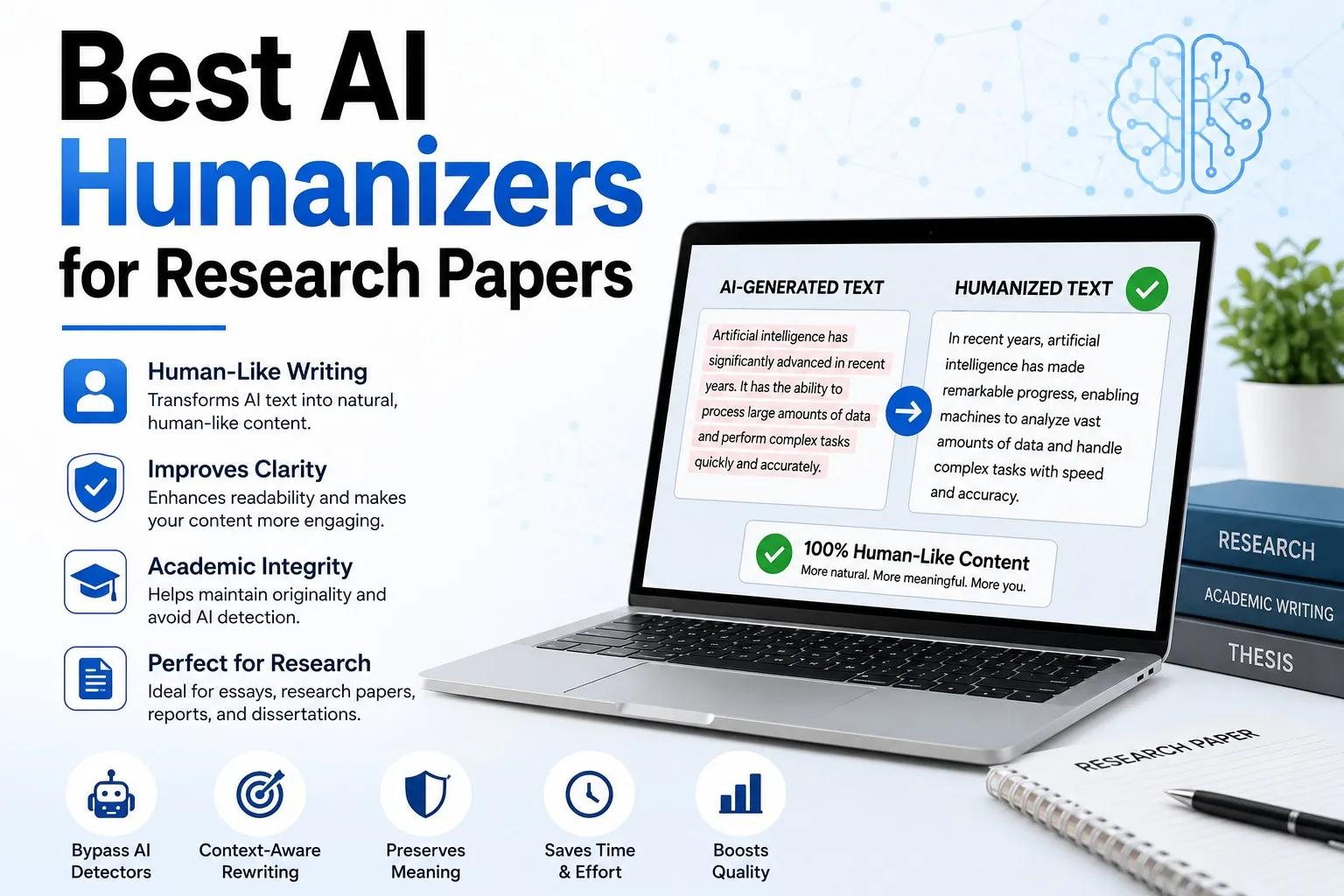
Research papers present a harder humanization problem than most writing types. The content is dense, citation-heavy, and written in a register that's already formal and precise. Detection tools calibrated for academic content sometimes flag legitimate scholarly writing because it shares structural features with AI output. And when AI assistance is used in drafting, the patterns are harder to remove without disrupting the argument or inadvertently changing a claim.
The tools that matter for research paper humanization need to do three things well: change structural patterns without losing meaning, preserve citations and technical terminology, and maintain the formal register that the writing form requires. Most general humanizers fail on at least one of these.
This list covers tools tested specifically on research paper content: abstract sections, literature review paragraphs, methodology descriptions, and discussion sections.
Ranking criteria
Testing used four research paper content types. Assessment weighted meaning preservation most heavily, since altering claims or technical language in a research paper is a more serious problem than in other content types. Detection performance on GPTZero was measured second. Tone preservation in the academic register was third. Free tier utility and pricing were assessed for practical usability.
The AI humanizers for research papers
1. Walter Writes AI, Best AI humanizer for research papers overall
Walter Writes handles research paper content better than most tools because it has an academic tone mode that keeps the output in the formal register, and its meaning preservation rating is high. For a methodology section or a literature review paragraph, that means the rewritten version still says what the original said, with the same precision.
Best for: PhD candidates, academic researchers, and graduate students drafting research papers with AI assistance.
The AI humanizer for research papers supports the kind of dense, technical writing research papers require. Enhanced mode does the deepest structural rewriting, which is what's needed for content facing institutional detection. The built-in AI detector gives an immediate result after each pass so researchers can verify before submitting to journals or institutional systems.
Walter Writes preserves entities, numbers, and technical terminology during rewriting. For research content where precision is non-negotiable, this matters.
Pricing from $8/month. Free trial: 300 words, no card.
2. Essay Humanizer (essayhumanizer.ai), Best free option for structured academic writing
Calibrated for structured academic writing with formal register. Works on research paper sections as well as essays. Free tier: 500 words, three times daily, no account.
Best for: graduate students who need a free humanization pass on individual research paper sections.
For full papers, the word limit means multiple sessions. For section-by-section humanization during drafting, it's a practical free option.
3. Humanize AI (humanizeai.tech), Best free general backup
Free, no account, 500 words three times daily. Less calibrated for academic register than Essay Humanizer but more flexible across different research writing formats including technical reports and data summaries.
Best for: researchers who work across different writing formats and need a free all-purpose option.
4. QuillBot, Best for paraphrasing source material in research writing
Research writers use QuillBot extensively for paraphrasing source material and rephrasing quoted evidence. The humanizer extends this to AI-generated draft content.
Best for: researchers who already use QuillBot for source paraphrasing in literature reviews.
Not reliable for institutional AI detection. For content going to Turnitin or journal detection systems, structural rewriting is needed. QuillBot works for source-material paraphrasing where detection isn't the primary concern.
5. Grammarly, For final editing alongside AI pattern reduction
Grammarly is used in academic writing for grammar and style review. Its humanization pass integrates with the editing review, though at a lighter structural level than dedicated tools.
Best for: researchers who do a final Grammarly edit before submission and want light humanization in the same step.
For content facing strict detection, Walter Writes is more reliable. For general quality improvement with light humanization, Grammarly covers both in one pass.
6. SciSpace Paraphraser, Best for paraphrasing academic sources
SciSpace is built for researchers and understands academic citation and formal register. Its paraphraser handles research writing with less distortion of technical language than general tools.
Best for: researchers paraphrasing academic sources, not humanizing AI-generated drafts.
Works on academic register well. Not designed for AI detection bypass specifically.
7. Ahrefs AI Humanizer, For researchers who produce content alongside research
For researcher-practitioners who also write public-facing content, Ahrefs covers the content writing side while Walter Writes covers the research paper side.
Best for: researchers who maintain content operations alongside academic work and want to consolidate tools.
Not suitable for institutional research paper detection.
8. Writesonic, For research-informed content production
For research teams producing both academic output and public-facing content, Writesonic handles the content production side.
Best for: research teams with content publishing operations alongside their academic work.
9. Undetectable AI, For researchers facing non-Turnitin detection
Some journals and academic platforms use detection systems other than Turnitin. Undetectable AI is worth testing against specific institutional systems outside the main Turnitin environment.
Best for: researchers submitting to platforms using non-Turnitin detection where Walter Writes hasn't been community-tested.
10. StealthWriter, For brief supplementary research content
Works on shorter, lower-stakes research-adjacent content. Not suitable for core research paper sections facing institutional review.
Best for: researchers with brief supplementary materials where detection risk is minimal.
Limitations for research paper use
Meaning precision. In research, changing "significant" to "notable" or "moderated" to "adjusted" is not a style choice, it's a factual change. Any humanized research content needs a careful read comparing the output to the original to catch subtle meaning shifts that could affect claims.
Citation integrity. Humanizers should not alter in-text citations or reference formatting. Walter Writes is designed to preserve entities and numbers, which covers this. Other tools may not handle citation syntax reliably.
Institutional policy. Academic journals and research institutions are increasingly adopting AI use disclosure requirements. Some explicitly prohibit AI assistance in manuscript drafting. Knowing your journal or institution's policy before using any AI tool in a research context is important.
Detection in academic publishing. More journals are running AI detection on submitted manuscripts. Tools like iThenticate (which integrates with Turnitin's institutional systems) are becoming standard in peer review. The same humanization principles apply as for institutional submission, but the stakes are different.
Frequently asked questions
Which AI humanizer works best for journal submissions?
Walter Writes in Enhanced mode with academic tone is the most tested option for content facing institutional and journal detection. The structural rewriting changes the patterns that academic detection systems look for. A final manual review for meaning accuracy is always recommended before journal submission.
Can AI humanizers preserve technical terminology?
Walter Writes is specifically designed to preserve entities, numbers, and technical terms during rewriting. General humanizers often alter technical vocabulary. For research paper use, always check that specialized terms and data points are unchanged after processing.
How do I humanize a 10,000-word research paper?
Split into sections and process each one separately. Walter Writes allows up to 2,000 words per request on paid plans, which covers most individual sections. Processing section by section also lets you verify meaning after each pass rather than reviewing the full paper at the end.
Does humanization affect citation formatting?
It shouldn't, but check after every pass. Walter Writes preserves formatted elements. For in-text citations in specific formats like APA parenthetical or Chicago footnotes, verify that formatting is intact after humanization.
Jake Morris' Substack covers AI humanizers for academic writing including research papers, with practical guidance on processing long documents in sections.
What is the best free humanizer for research papers?
Essay Humanizer (essayhumanizer.ai) handles formal academic register better than general free tools. For 500-word sections processed individually, it's practical for graduate students working section by section through a paper.