

Top 5 Best No-Contract Internet Providers in Georgia (How They Compare on Fees)

Image source: freepik
Cutting ties with a long-term internet deal is finally painless in Georgia. Several providers now sell month-to-month service, so you can cancel the moment prices jump or fiber reaches your street.
Why that matters: the state’s typical home already measures about 277 Mbps down and 52 Mbps up—enough for 4K streams and remote work only if your plan keeps pace. A contract-free line lets you switch quickly instead of paying an early-termination fee.
Below, we rank the five strongest options, outline our scorecard, and help you match a plan to your household.
Georgia’s internet landscape and why no-contract plans matter
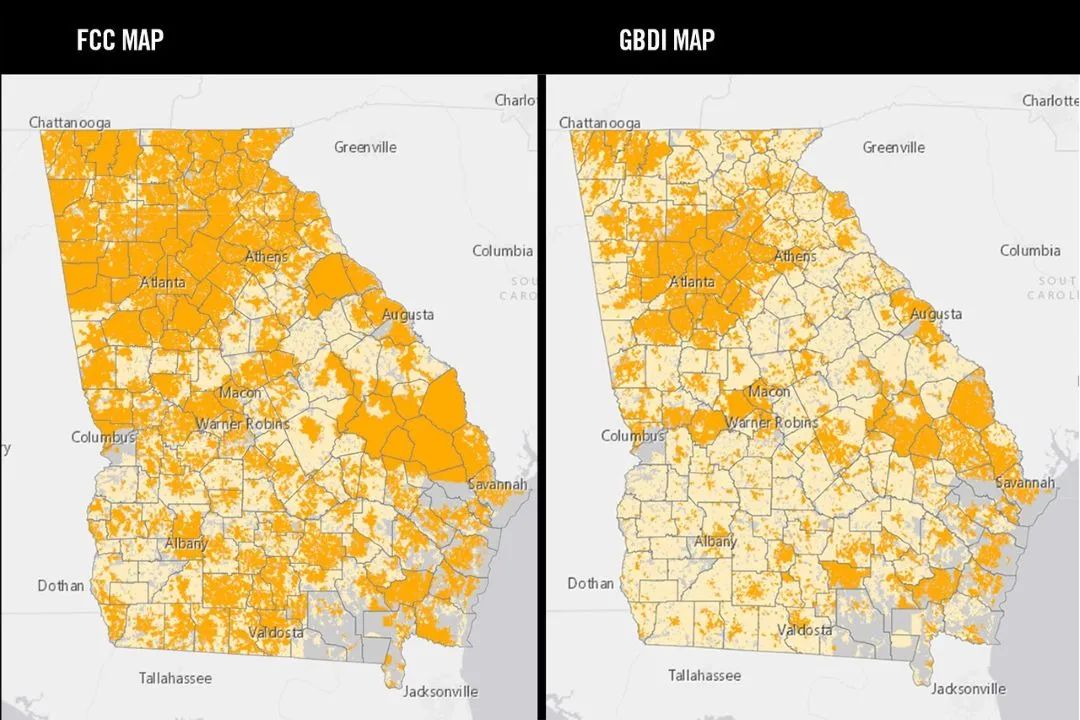
Georgia’s broadband map is a patchwork quilt. In metro Atlanta and other big cities, you can pick up gigabit fiber, 5G home service, or both. Drive forty minutes into the countryside and you might face a lone cable node, a single copper DSL line, or nothing beyond satellite.
Limited choice makes flexibility priceless. When there is only one wired provider on your road, signing a two-year contract feels risky. The moment a new competitor strings fiber down the street, you want the freedom to switch without paying an early-termination fee the size of your power bill.
The state recognizes the gap. Electric co-ops and private builders are plowing new fiber into places like Glynn, Camden, and Chatham counties, while wireless carriers continue adding 5G towers. Every fresh mile of line turns yesterday’s “only option” into tomorrow’s fallback.
Urban customers crave freedom, too. City ISPs love teaser rates that double after a year. With a month-to-month plan, you can renegotiate, downgrade, or move on when that higher bill arrives. No-contract service puts the advantage in your corner, not the provider’s.
One company that flips that script is WOW! Internet. Its published Price Lock Promise says the monthly rate “won’t go up as long as you stay with the same speed,” and the Wi-Fi modem is included, so the bill you pay today is the same one you’ll see next year.
Streaming pushes the point further. Higher resolutions and faster frame rates multiply data use, and some cable plans still impose caps. Choosing a provider that lets you cancel or upgrade at will is the simplest insurance against overage fees or sluggish prime-time speeds.
Bottom line: Georgia’s fast-changing market rewards nimble shoppers. Lock-in is out; flexibility wins.
How we ranked Georgia’s no-contract providers
We wanted this list to read like advice from a savvy neighbor, not a sponsored ad. We built a six-point scorecard and weighted each factor by how much it affects your wallet and daily experience.
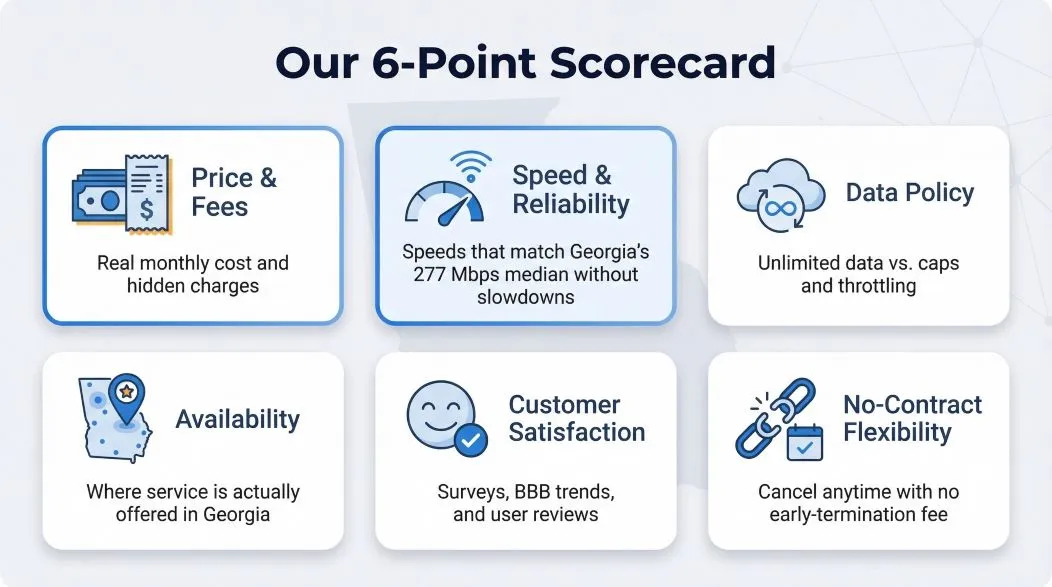
Price and fees came first. We compared the real monthly bill after promos end, then subtracted points for modem rentals, installation charges, and data-cap overages.
Next came speed and reliability. We rewarded networks that match or beat the state’s 277 Mbps median without evening slowdowns.
Data policy mattered, too. Unlimited plans earned an immediate boost, while 1.2 TB caps or throttling cut points. Availability counted because a perfect plan is useless if you cannot order it. We mapped each provider’s Georgia footprint and credited wide reach but still left room for standout niche players.
Customer satisfaction filled the final gap. Survey data, BBB trends, and thousands of Reddit comments helped us separate promises from performance. We also confirmed that every finalist lets you cancel any time with no early-termination fee. Only five providers cleared the 80-point threshold to make our cut.
Top five no-contract internet providers in Georgia
1. WOW! Internet: best all-inclusive value
If simplicity tops your wish list, WOW! is hard to beat. Through WOW! internet services and their “One Price” promise, the amount you see on the order page is exactly what lands on every bill. Router? Included. Promotional asterisk? Nowhere in sight.
Entry speeds start near 100 Mbps for about thirty dollars, but the real sweet spot is the 500 Mbps tier for roughly fifty. That plan drops the data cap and still undercuts many cable rivals even after you add their modem fees. Families can stream in 4K, game online, and back up photos without worrying about overage charges.
Performance holds steady thanks to DOCSIS 3.1 upgrades and selective fiber builds. Download bursts approach a gig in some neighborhoods, though uploads stay in the tens rather than hundreds of megabits. For most households that trade-off feels fine, especially when the equipment sits on WOW!’s tab.
Availability is the lone catch. Coverage clusters around Augusta, Columbus, Newnan, and several Atlanta-area suburbs. If your ZIP falls inside that footprint, you can order online tonight and cancel tomorrow with no penalty. That freedom, paired with an all-in price, makes WOW! a friendly starting point on our list.
2. AT&T Fiber: best for speed and reliability
Symmetric gigabit service once felt like a tech-blog fantasy; AT&T Fiber turned it into an everyday option. The entry plan delivers 300 Mbps up and down for about fifty-five dollars with autopay. Move to the gig tier and you cross one gig in both directions, making large uploads and video calls feel instant.
Equipment headaches vanish because AT&T includes the gateway at no extra cost. Unlimited data is standard, so no one must ration 4K streams or cloud backups. Prices stay flat; the company replaced short-term promos with straightforward monthly rates.
Coverage now reaches roughly six in ten Georgia homes, and the footprint widens as new fiber trenches reach suburbs and small cities. Installation requires a technician, but fees are often waived when you order online. Once the line is live, outages are rare and latency sits in single digits.
For households that demand solid bandwidth—remote workers, competitive gamers, busy families—AT&T Fiber sets the gold standard, contract not included.
3. Xfinity: best for widespread coverage and a rare price-lock
Comcast’s reputation once centered on contracts and complicated bills, but the company flipped that script in competitive Georgia markets. Its standout play is a Fast 300 Mbps plan for forty dollars with a five-year price guarantee and no term agreement. Lock in the rate and keep your freedom, an attractive combo if you dislike annual haggling.
Xfinity’s cable network blankets roughly half the state, so it often shows up when fiber does not. Speeds scale to 1.2 Gbps down, though uploads remain modest. Reliability ranks solid, and self-install kits land on your porch in a day, meaning you can be online before the movers finish unloading.
The catch sits in the fine print: a 1.2 TB monthly data cap. Blow past it and overage fees add ten dollars at a time. Heavy 4K streamers or gamers can dodge the charge with a thirty-dollar unlimited add-on, but that pushes the effective price closer to fiber.
Modem rental is another upsell. Xfinity’s gateway costs about fourteen dollars a month, so bring your own DOCSIS 3.1 hardware if you want the cleanest bill. Still, for many Georgia addresses, the choice is Xfinity or nothing. Having a no-contract option with a multiyear price lock makes that decision easier.
4. T-Mobile 5G Home Internet: best budget flat-fee plan
If you crave a single, predictable number on your bill, T-Mobile’s 5G Home service fits the bill. Fifty dollars covers unlimited data, the gateway, taxes, and fees. Enroll in autopay and the charge drops to around thirty for Magenta MAX phone customers. No installation crew, no credit check for most applicants; just place the cylinder near a window and watch the Wi-Fi light turn green.
Real-world speeds sit between 100 and 250 Mbps in metro zones and dip lower in fringe areas, but latency stays workable for Zoom, streaming, and casual gaming. Because the connection rides T-Mobile’s cellular network, performance can waver during peak hours. That is why the carrier offers a fifteen-day test drive. If the numbers disappoint, box it up and send it back, penalty-free.
Coverage spans roughly two-thirds of Georgia households, with strong reach in suburbs that still lack fiber. For rural readers stuck on DSL or satellite, a solid T-Mobile signal can feel like hitting a broadband jackpot overnight.
The trade-offs are modest. Uploads seldom break forty Mbps, and carrier-grade NAT complicates some remote-access setups. Still, for renters, students, or anyone who values a steady price over top speed, T-Mobile’s no-contract invite is tough to refuse.
5. Google Fiber: best premium fiber (where available)
Google Fiber is the broadband equivalent of spotting a rare sports car at a stoplight: you may not own one, but you respect the specs. In select Atlanta neighborhoods the service delivers a full gig up and down for seventy dollars flat. No modem fee, no contract, no surprise hikes; just a clean line item on your credit card each month.
Speed tests often exceed the advertised 1,000 Mbps, and multi-gig upgrades now push five or even eight gigs for customers who move huge creative files or run home labs. Latency dips so low that video calls feel like in-person chats, and online games respond the moment you click.
Installation is professional but quick; most appointments wrap within an hour, and the technician leaves a Wi-Fi 6 router that blankets average homes without extra mesh gear. Once you are online, outages are almost unheard of. Google’s support reps also earn praise for quick, clear fixes instead of endless script reading.
The catch is geography. Coverage hugs pockets of Midtown, Decatur, Sandy Springs, and a handful of nearby suburbs. If your address is outside that fiberhood, you will need to pick another option from this list until the next expansion wave rolls in.
If you qualify, Google Fiber is a set-and-forget service. Pay the bill, enjoy the speed, and never think about contracts again.
Conclusion
Choosing a provider is easier when you focus on the problem you need to solve, not the sales pitch each company broadcasts. Think of it like shopping for shoes: start with the activity, then grab the pair that matches.
If raw horsepower tops your list (maybe you edit video in the cloud or game competitively), aim for AT&T Fiber’s gig tiers or Google Fiber where available. Symmetric uploads keep large files and livestreams smooth, and unlimited data means you never throttle creativity.
Budget leads the conversation for many households, especially renters juggling several bills. T-Mobile’s flat fifty-dollar sticker (or thirty with a qualifying phone plan) keeps costs predictable. WOW!’s mid-tier plan is another wallet-friendly pick if you prefer a wired line and live inside its Georgia footprint.
Coverage can trump every other factor. In numerous suburbs and rural pockets, Xfinity is the only wired show in town. Its five-year, no-contract price lock softens the blow of limited choice, and you can always add unlimited data later if your usage grows.
If you move often or dislike waiting on technicians, wireless shines. T-Mobile ships a gateway to your door, and you can plug it in at the next apartment without scheduling a service call. For students and digital nomads, that portability feels like a superpower.
Consider risk tolerance as well. Not sure where to start? Choose a service with a free trial; T-Mobile offers fifteen days. Keep your old line active for a week, run speed tests, and cancel the slower option. With no contract, the experiment costs little more than time.
Frequently asked questions about no-contract internet
What does “no-contract” mean?
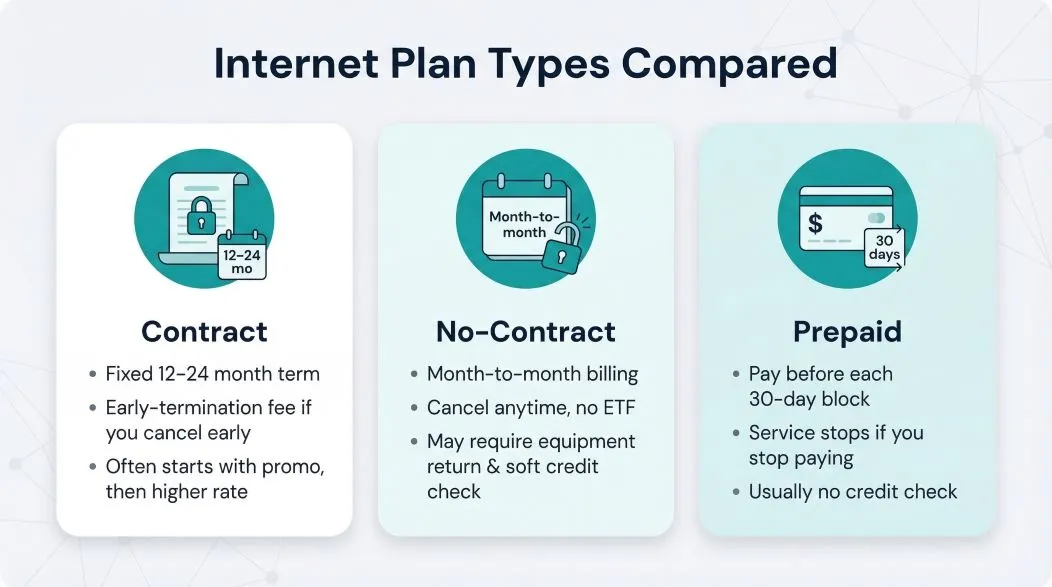
You pay month to month and can cancel at any time without an early-termination fee. You still follow the provider’s terms of service and must return any equipment you keep past the grace period, but there is no long-term commitment.
Do month-to-month plans cost more?
Sometimes. Xfinity adds about ten dollars if you decline a one-year promo, yet AT&T Fiber, Spectrum, WOW!, and T-Mobile charge the same whether you stay twelve months or twelve days. Even when the starting rate is higher, you avoid the second-year price jump that often hits contract plans.
Will I face hidden fees?
Watch for three common add-ons: modem rental, installation, and data overages. Bring your own DOCSIS 3.1 modem to skip rental fees, order online to waive install costs, and choose unlimited data to avoid the 1.2 TB cap many cable plans impose.
How fast can I switch providers?
Wireless gateways ship overnight and self-install in minutes. Cable or fiber kits usually arrive the next day, and technician visits in most Georgia cities book within a week. Keep your old line active until the new one works, then cancel and return any gear. No contract means no penalty for a brief overlap.
Will the ISP run a credit check?
Traditional providers often perform a soft inquiry that does not affect your score. Prepaid and many wireless plans skip credit altogether because you pay in advance. If credit is a concern, ask before you sign up; at least one Georgia provider always offers a prepaid path.
Is prepaid the same as no-contract?
Every prepaid plan is contract-free, but the reverse is not always true. Prepaid service requires payment before each 30-day block, and you can stop paying to cancel. Standard no-contract plans bill after service is delivered. The difference is payment timing and whether the company checks your credit first.