

There's a frustration every power user of AI tools knows too well. You spend twenty minutes giving your AI agent the full context — your project structure, your preferences, your workflow quirks — and it does a great job. Then you close the session. The next day, you open it again, and it's blank. You're back to square one. It's like hiring an intern who shows up every morning with amnesia.
That problem has been the elephant in the room for AI agents since they went mainstream. Tools like Cursor, Claude Code, and Aider are genuinely useful for coding sessions, but they're fundamentally session-bound. The intelligence resets. The context evaporates. The more you use them, the more you feel the ceiling.
Hermes Agent, built by Nous Research and released in February 2026, is the most serious attempt yet to knock down that ceiling.
What Hermes Agent Actually Is
Hermes Agent isn't a chatbot. It isn't a coding copilot tied to your IDE. It's an autonomous AI agent that lives on your server — whether that's a $5 VPS, a GPU cluster, or serverless infrastructure like Modal or Daytona — and gets measurably more capable the longer you use it.
The core idea is what Nous Research calls a "closed learning loop." When Hermes solves a difficult problem, it doesn't just forget the solution. It writes a reusable skill document describing the approach, stores it, and retrieves it the next time a similar problem comes up. These skills improve themselves during use. They're searchable. They're even compatible with the agentskills.io open standard, meaning they're portable and shareable with other users.
On top of that, Hermes maintains persistent cross-session memory using FTS5 full-text search combined with LLM summarization. It builds a model of who you are — your projects, your preferences, your environment — that deepens over time. The agent you're working with in month three is genuinely smarter and more useful than the one you started with, because it knows you.
That's a meaningfully different value proposition from anything else in the space.
The Architecture Behind the Hype
It's worth understanding why Hermes is structured the way it is, because the architecture explains both its strengths and its appeal to developers.
The agent runs on your infrastructure. Not Nous Research's cloud. Not a third-party SaaS platform. Your server. All data stays local — no telemetry, no tracking, no lock-in. For anyone working with sensitive projects or proprietary codebases, that matters enormously.
It supports six terminal backends: local, Docker, SSH, Daytona, Singularity, and Modal. The Daytona and Modal options are particularly clever — they offer serverless persistence, meaning your agent's environment hibernates when idle and wakes on demand, costing almost nothing between sessions. You get the benefits of an always-on agent without paying for always-on infrastructure.
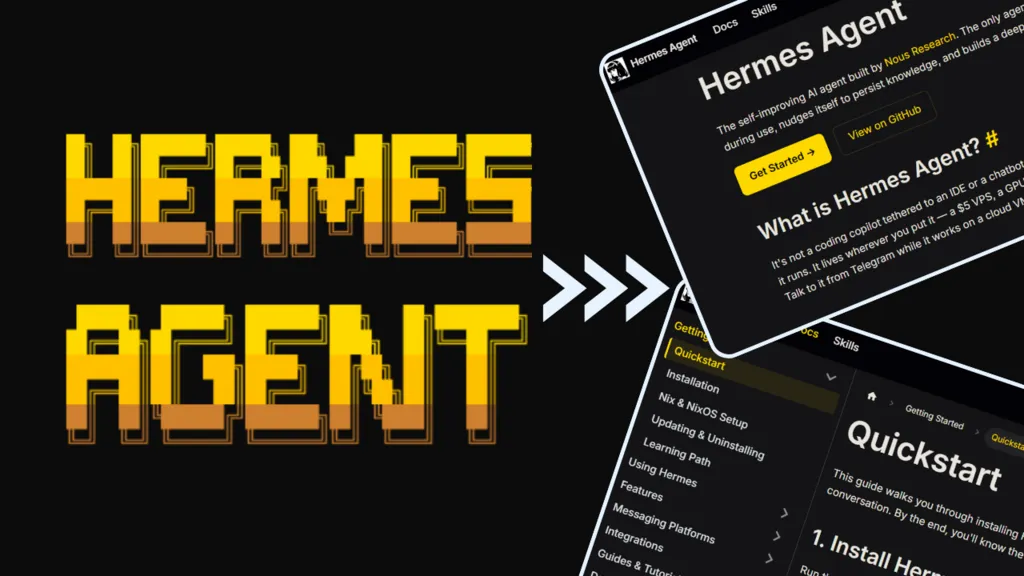
The model layer is also fully flexible. Hermes works with Nous Portal, OpenRouter (which gives access to over 200 models), OpenAI, Anthropic, NVIDIA NIM, and a growing list of other providers. You switch models with a single command — no code changes, no reconfiguration.
Skills are stored in ~/.hermes/skills/ and follow a progressive disclosure pattern. The agent sees a summary of available skills first (low token cost), then loads the full content of a specific skill only when needed. This keeps the context window lean even as your skill library grows.
Where You Talk to It
One of Hermes's most practical features is its messaging layer. The agent isn't tied to a terminal window on your laptop. It connects to Telegram, Discord, Slack, WhatsApp, Signal, Matrix, Email, SMS, and over fifteen other platforms through a single gateway process.
The workflow this unlocks is surprisingly powerful. You can kick off a long-running task from your desktop, close your laptop, and pick up the conversation on your phone via Telegram while the agent continues working on a cloud VM. Tasks that require patience — monitoring a repository for flaky tests, generating a batch of research summaries, running scheduled backups — become straightforward because the thing doing the work doesn't need to stay open on your screen.
The Numbers That Signal This Isn't a Niche Project
Since its February 2026 launch, Hermes Agent crossed 95,000 GitHub stars in roughly seven weeks. For context, that's an extraordinary adoption curve, and it's driven a visible migration wave away from OpenClaw, the previously dominant open-source agent framework.
Five major releases landed in the first twenty days. Over 700 pull requests were merged in that same window. The development pace is fast enough that the feature set feels almost alive — new messaging platform integrations, new backend options, MCP server support for extending tool capabilities, and Honcho-based user modeling have all shipped in rapid succession.
The open-source community has responded with contributions ranging from new skills to a WeChat bridge (HermesClaw) for users who live in that ecosystem.
Who Should Pay Attention
If you're a developer with long-running side projects, Hermes Agent is the most compelling reason to stop relying on session-bound tools. Install it on a cheap VPS, point it at one repository, give it a Telegram channel, and let it accumulate skills over a month. The skills it writes will tell you a lot about where AI agents are actually headed.
If you're building AI-powered workflows for your team, the Slack and Discord integrations make Hermes a viable team-wide assistant — not just a personal tool. The MCP integration extends its capabilities to virtually any external service.
For researchers and teams working on training better AI models, Hermes is also genuinely useful as infrastructure. It supports batch trajectory generation, Atropos RL environments, and trajectory compression for fine-tuning future tool-calling models.
The Bigger Picture
Hermes Agent is part of a broader shift in how people think about AI tools. The first wave gave us chatbots. The second gave us coding copilots. The third — the one we're entering now — is about agents that persist, learn, and compound in value over time.
The tools that will win in this phase aren't the ones with the flashiest demos. They're the ones that become more useful the longer you use them. Hermes Agent's architecture is explicitly designed around that insight.
For those exploring what's possible with autonomous AI systems, platforms like MyClaw are also worth keeping on your radar — they sit at the intersection of agent infrastructure and practical deployment, and that intersection is becoming increasingly important as the agent ecosystem matures.
Hermes Agent isn't perfect. The skills system is still evolving. Enterprise-grade access controls and audit logging don't exist yet in the open-source version. And the question of whether a private skill library creates network effects or just a personal silo is genuinely open.
But the core problem it's solving — AI agents that don't forget — is real, widely felt, and not going away. The architecture it's built on is sound. And the community momentum behind it suggests that whatever form Hermes takes twelve months from now, the ideas it's putting into practice are going to shape how all of us think about AI agents going forward.
If you haven't looked at it yet, now is a reasonable time to start.