

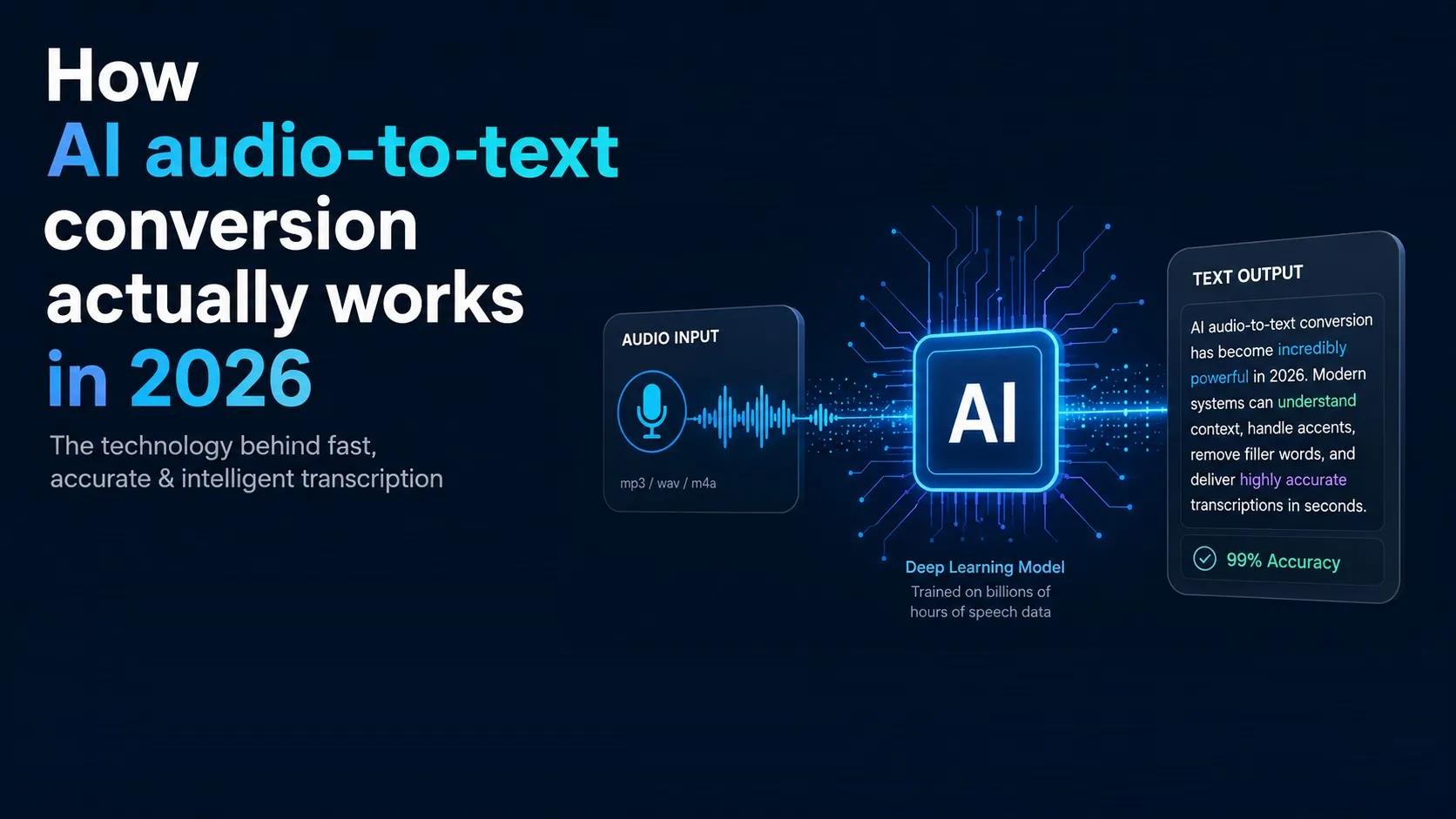
Transcription used to be a profession. A skilled human transcriber needs roughly four hours to type out one hour of recorded speech, which is why the service historically cost $1 to $2 per audio minute. Today an AI system does the same job in a few minutes for cents. What's less appreciated is how, because "the AI listens and types" skips over a pipeline of five distinct models, each solving a problem the others can't.
Understanding that pipeline is useful even if you never build one. It explains why transcripts fail the way they do, and what separates a good tool from a mediocre one in 2026.
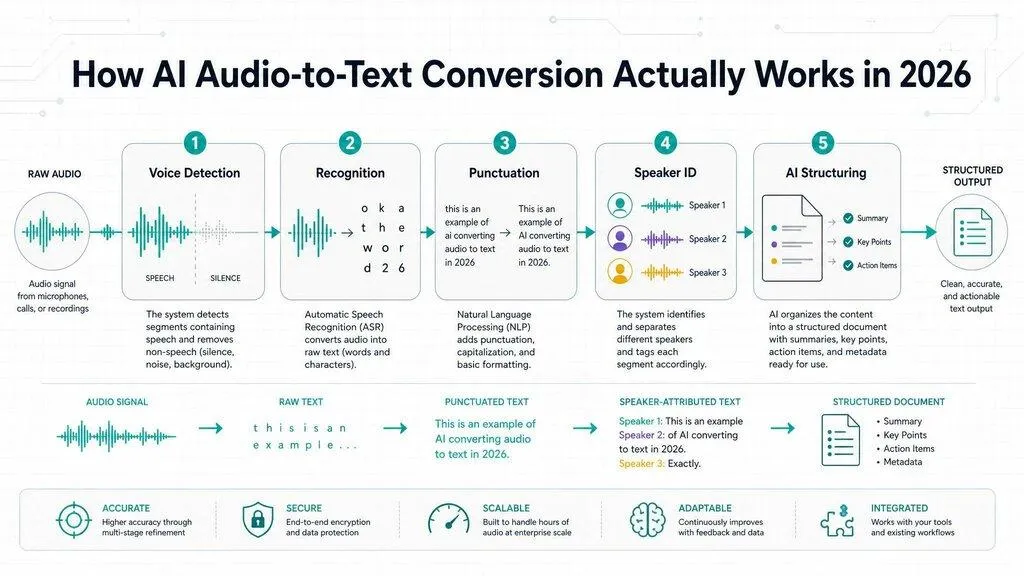
Stage one: finding the speech
Before any recognition happens, a voice activity detection (VAD) model scans the audio and separates speech from everything else: silence, keyboard clatter, the espresso machine. This matters more than it sounds. Speech recognition models process audio in windows, and if you cut a window in the middle of a word, both halves decode as garbage. VAD finds the natural pauses to cut at.
VAD also prevents one of the field's stranger failure modes: hallucination on silence. Recognition models trained on captioned video will sometimes emit phrases like "thanks for watching" over dead air, because that's what their training data paired with silence. Filtering non-speech before recognition suppresses most of it.
Stage two: recognition
The core model converts sound waves into words. Since around 2023 the dominant architecture has been the transformer, trained on hundreds of thousands of hours of multilingual audio. This is why modern tools support dozens of languages from a single model; the leading commercial services now cover 50 or more, with automatic language detection choosing decode settings on the fly.
Raw recognition accuracy has largely converged. On clean, single-speaker audio, every serious engine lands in the mid-to-high 90s. The differences show up at the edges: accents, background noise, overlapping voices, domain jargon. Vendors compete on training-data breadth here, not architecture.
Stage three: making it readable
Recognition output is a lowercase stream with no punctuation, which is technically accurate and practically unreadable. A restoration pass adds sentence boundaries, capitalization, and punctuation. Users almost never notice this stage, which is exactly the point; they only notice when it's missing.
Stage four: who said what
Speaker diarization clusters segments of audio by voice characteristics and assigns them to speakers: Speaker 1, Speaker 2, and so on. It runs on the audio in parallel with recognition, and the results are merged by timestamp afterward.
Diarization remains the least solved stage. When speakers take clean turns, modern systems label them reliably. When three people talk over each other, every system on the market degrades. The honest vendors state this plainly.
Stage five: from transcript to document
This is where 2026 differs from 2023. With recognition accuracy plateaued, the competition moved to what happens after the transcript: large language models that classify the content type, then generate a summary, timestamped chapters, and extracted action items.
The current state of the art is visible in consumer tools. A service like Vomo's audio to text converter illustrates the full pipeline in one product. Upload an audio or video file (or paste a YouTube link), and it returns a speaker-labeled transcript at 95%+ accuracy plus a structured note, with the summary, chapters, and action items built from templates matched to the detected content type. You can then query the transcript conversationally, with answers grounded in the text rather than generated freely. That grounding detail matters: it's the difference between search and hallucination.
Notably, the economics collapsed along with the technical barriers. That class of tool now runs about $1.92 a week for unlimited minutes, with free tiers for evaluation, against the $10 to $30 monthly that was standard as recently as two years ago.
What still breaks, and what's next
Three limitations worth knowing before you trust any transcript:
Proper nouns. No model knows your product codenames or colleagues' names. Expect to fix these manually.
Crosstalk. Overlapping speech degrades both recognition and speaker labels. Meeting discipline is, oddly, a transcription accuracy feature.
Audio quality floors. Models trained on noisy data handle a bad microphone, but they can't recover words that were never captured.
The near-term research direction is contextual adaptation: models that ingest your vocabulary, meeting history, and org chart to fix the proper-noun problem, and streaming architectures that cut latency from minutes to seconds. The transcription problem is mostly solved. The understanding problem is just getting started.
Contact Person : Olivia Lee
Email: [email protected]
Company Name: EverGrow Tech Inc.