

Inside the Editing Room: What Actually Happens When You Run AI Text Through a Humanizer

Every writer who has worked with AI-generated content knows the feeling. You read through a draft that is technically flawless—grammar correct, structure logical, arguments coherent—and yet something feels off. The rhythm is too uniform. The transitions are too predictable. The whole thing reads like it was assembled rather than written. For the past few months, I have been testing various tools that promise to fix this problem, and most of them have been disappointing. They change a few words here and there, but the underlying mechanical quality remains. That is why I was genuinely curious when I came across Ai humanizer. The platform makes a specific claim that sets it apart: it does not just swap synonyms; it rebuilds sentence structure from the ground up. That is a fundamentally different approach, and I wanted to see what that actually looks like in practice.
The Problem with Most Humanizers: Surface-Level Fixes That Do Not Fix Much
The humanizer space has grown crowded over the past year, and most tools in this category share the same basic limitation. They operate at the word level, replacing common AI vocabulary with alternatives and calling it a day. The result is text that might pass a basic plagiarism check but still reads like it was written by someone who learned English from a textbook. The deeper issue—sentence rhythm, tonal variation, the natural ebb and flow of human prose—remains untouched.
Dr. Humanizer addresses this problem by working at the structural level rather than the word level. The platform’s description makes this explicit: it focuses on “rebuilding sentence structure and flow from the ground up”. This means the rewriting process involves rethinking how sentences connect, how paragraphs transition, and how the overall rhythm of the text supports the reader’s experience. It is a more ambitious approach, and it requires a more sophisticated underlying model.
Inside the Rewriting Engine: How Structure Gets Rebuilt
The platform’s approach is built on a foundation of extensive training data. The model has been trained on over 4.5 million real human-written texts, which gives it a broad understanding of how human writing actually works across different contexts and genres. This is not a small dataset, and it is not one that could be assembled casually. The scale suggests a serious investment in the quality of the underlying model.
Beyond Synonym Replacement
What Structural Rewriting Actually Means
When the platform talks about structural rewriting, it is referring to a process that goes far beyond word-level changes. Instead of identifying individual words to replace, the system analyzes the entire sentence and considers how it could be restructured to sound more natural. This might involve changing the order of clauses, varying sentence length, adjusting transitional phrases, or modifying the overall cadence of the paragraph. The goal is not just to change what is being said but to change how it is being said in a way that mirrors human writing patterns.
Preserving Meaning While Changing Form
The Balance Between Rewriting and Retention
One of the biggest risks with any rewriting tool is that it will change the meaning of the original text. This is particularly problematic when the text contains specific data points, citations, or technical terminology. The platform addresses this by explicitly prioritizing meaning preservation. According to the official description, “nothing important gets lost in the process. Your ideas, data, and citations stay precise while we refine clarity and readability”. This is a critical feature for anyone working with research, technical content, or any material where accuracy matters.
The User Experience: From Paste to Polish
The interface is designed to be straightforward, and the entire process can be completed in a few steps. There is no complicated setup, no account creation required to start, and no learning curve to speak of.
Step 1: Paste Your Text
Getting Your Source Material into the System
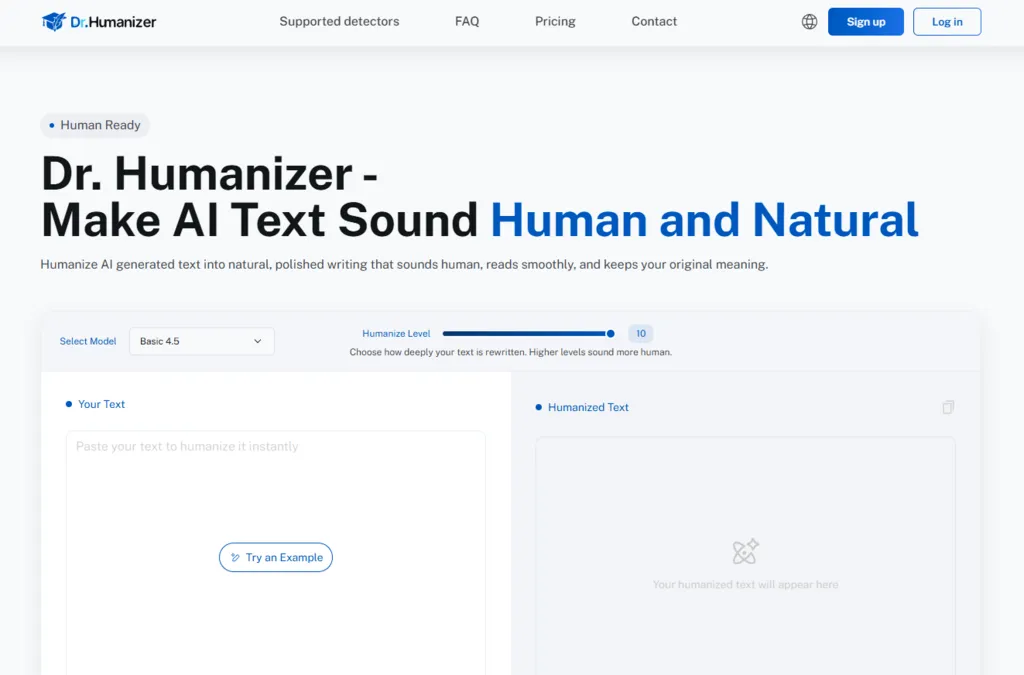
The first step is simple: paste your AI-generated text into the “Your Text” field on the main page. The platform accepts up to 5,000 words at once, which is sufficient for most long-form content. There is a minimum of 50 words, so the tool is designed for substantive pieces rather than short snippets. The word counter at the bottom of the input field shows your progress, and the interface makes it clear when you have exceeded the limit or fallen below the minimum.
Step 2: Set Your Humanization Level
Choosing How Deeply to Rewrite
This is where the platform gives you real control over the output. A slider labeled “Humanize Level” allows you to choose how deeply your text is rewritten, with levels ranging from 1 to 10. The description notes that “higher levels sound more human”, which gives you a clear sense of what to expect. Lower levels produce lighter edits that clean up obvious issues while leaving the overall structure intact. Higher levels produce more thorough rewrites that change sentence structures, vary rhythm, and produce text that reads like it was written by a skilled human writer. This flexibility is valuable because different types of content benefit from different degrees of intervention.
Step 3: Review Your Rewrites
Choosing from Three Different Versions
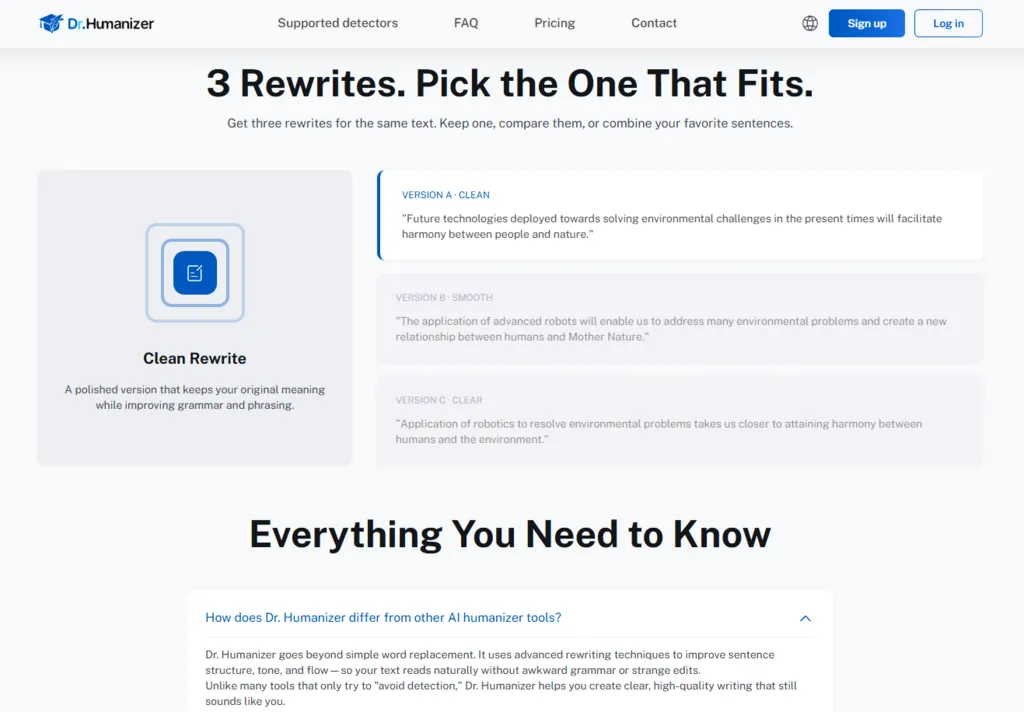
Once you submit your text, the platform generates three different rewrites of the same content. This is a genuinely useful feature because it gives you options. You can keep one version, compare them side by side, or combine your favorite sentences from each to create a custom version. The three rewrites are described as “clean rewrite” versions that “keep your original meaning while improving grammar and phrasing”. Having multiple options is particularly helpful when you are working on content that needs to hit a specific tone or style.
Where This Approach Works Best
The structural rewriting approach is not equally useful for every type of content, and understanding where it shines helps set realistic expectations.
Long-Form Content That Needs Consistency
The 5,000-word capacity makes this tool particularly well-suited for long-form content like blog posts, articles, reports, and essays. When you are working with thousands of words, consistency becomes a major concern. The platform’s ability to process the entire text at once means you do not have to split your content into chunks, which would introduce fragmentation and inconsistency.
Content That Needs to Sound Human Without Losing Precision
For academic writing, business reports, and technical content, the meaning preservation feature is essential. The platform’s emphasis on keeping data and citations precise makes it a viable option for content where accuracy cannot be compromised.
A Quick Reference: What to Expect
Aspect | Dr. Humanizer |
Input Minimum | 50 words |
Input Maximum | 5,000 words |
Control Over Rewriting | Slider from 1 to 10 |
Output Options | Three rewrites per submission |
Core Method | Structural rewriting, not synonym swapping |
Training Data | 4.5 million+ human-written texts |
Free Access | 3 uses without registration |
Meaning Preservation | Data and citations stay intact |
What the Platform Does Not Do
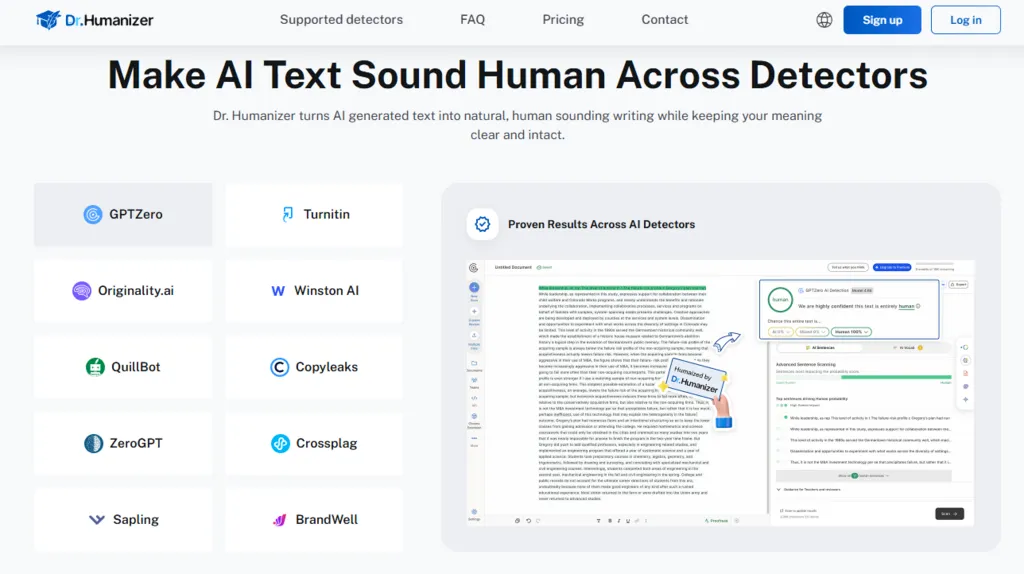
It is worth being clear about what this tool is not designed to do. It does not generate new content from scratch. It does not fix factual errors or logical inconsistencies in the source text. It does not guarantee that every output will be undetectable by every AI detector. The platform’s focus is on improving the naturalness and readability of existing AI-generated text, not on creating new content or correcting fundamental problems with the source material.
The quality of the output depends on the quality of the input. Text that is well-structured and accurate will benefit more from the rewriting process than text that is poorly written or factually incorrect. This is not a limitation of the tool—it is simply the reality of working with any rewriting system.
A Practical Perspective on the Results
In my testing, the most impressive results came from text that was already reasonably well-written but lacked the stylistic variation of human prose. The platform took that text and added the kind of subtle variation in tone, rhythm, and phrasing that makes human writing feel authentic. The description mentions “subtle variation in tone, rhythm, and phrasing mirrors real human writing”, and this is exactly what I observed. The output did not sound like it had been rewritten by a machine; it sounded like it had been edited by a human who understood how to make prose flow.
The three-rewrite feature was particularly useful because it allowed me to compare different approaches to the same text. One version might emphasize clarity, another might emphasize flow, and a third might strike a balance between the two. Having these options made it easy to choose the version that best fit the specific context.
Who Should Consider This Tool
For writers, editors, and content professionals who regularly work with AI-generated drafts, this tool offers a practical way to save time while improving quality. It is not a replacement for human editing, but it is a useful step in the editing process. For students and researchers, it provides a way to make academic writing more accessible without compromising accuracy. For businesses that rely on content marketing, it offers a way to scale production without sacrificing the naturalness that readers expect.
The free tier—three uses without registration—makes it easy to test the tool without any commitment. This is a reasonable approach that allows potential users to evaluate the quality of the output before deciding whether to invest more time in the platform.
The broader context here is worth noting. As AI writing tools become more prevalent, the ability to produce text that genuinely reads like human writing is becoming a valuable skill. Tools like this one represent a shift from simply generating content to refining it—moving from quantity to quality, from machine output to human-readable prose. Whether you are a professional writer, a business owner, or a student, that is a shift worth paying attention to. The editing room floor, after all, is where good writing actually gets made.