

The current state of generative media is often described as a "slot machine" workflow. For many creators, the process involves entering a descriptive prompt into a text-to-video engine, hitting generate, and hoping the latent space interprets the physics of light and motion with some degree of realism. While this approach is impressive for rapid prototyping, it is fundamentally incompatible with professional video production pipelines that require continuity, specific art direction, and structural predictability.
As the industry matures, the strategy is shifting from text-to-video (T2V) toward an image-to-video (I2V) methodology. In this workflow, the "first frame"—the source asset—serves as an immutable technical specification. The logic is simple: if the source image lacks clarity, consistent lighting, or compositional logic, the subsequent video will inevitably suffer from temporal drift and structural collapse. For professional editors, understanding that image fidelity is the hard ceiling for video quality is the first step in moving beyond experimental AI use cases and into reliable asset production.
The Strategic Shift from Prompt-First to Image-First Workflows
In the early days of generative video, users were enamored with the novelty of typing "a cat flying through space" and receiving a moving clip. However, as creative teams attempt to integrate these tools into commercial workflows, "prompt fatigue" has become a significant bottleneck. When you rely solely on a text prompt, you are asking the model to simultaneously invent the character design, the environment, the lighting, and the motion. The chances of getting all four variables right in a single four-second clip are statistically low.
An image-to-video workflow decouples the visual design from the motion simulation. By generating or capturing a high-resolution "anchor frame" first, the editor locks in the art direction before a single frame of motion is rendered. This allows for a level of character and environment consistency that text-to-video simply cannot match. If you are using an AI Video Generator to create a series of shots for a campaign, starting with a consistent set of source images ensures that the "visual DNA" remains constant across the entire sequence.
This shift represents a transition from "generation" to "directed simulation." When the model has a high-fidelity image to work from, its computational power is focused on predicting how those specific pixels should move, rather than trying to figure out what those pixels represent in the first place.
Anatomy of a High-Fidelity Source Frame
Not every "good" image makes a good source for video generation. Professional editors must evaluate source assets through the lens of temporal potential. A source image acts as a structural blueprint; if that blueprint is cluttered or logically inconsistent, the motion vectors will fail.
Compositional Clarity and Depth
The most common cause of video artifacts is a cluttered background with ambiguous depth. If the AI Video Generator cannot distinguish between the subject and the background, it will often "melt" the two together during movement. High-contrast subjects with a clear separation from the background provide the model with a clear "mask" to work with. For instance, a shallow depth of field in the source image helps the model understand which elements should remain static and which should move through the 3D space.
Lighting Logic and Contrast
Lighting is the primary way AI models understand volume. A flatly lit image provides very little data for the model to calculate how shadows should shift during a camera pan. Conversely, an image with strong directional light and clear highlights gives the model the necessary "landmarks" to maintain the subject's form. This is where pre-production tools like Nano Banana become essential. Refining a source asset—adjusting the lighting or removing distracting elements—before initiating the video phase can save hours of wasted generation credits.
Resolution as a Safety Net
While many models can upscale during the video generation process, starting with a low-resolution or "noisy" source image is a recipe for disaster. Small artifacts in the first frame are often interpreted by the AI as structural data. A tiny bit of pixel noise in a character's eye might be interpreted as a flickering movement, leading to "ghosting" effects that worsen as the clip progresses.
Temporal Drift and the Physics of the Latent Space
One of the most persistent challenges in generative video is "temporal drift." This refers to the gradual loss of detail and structural integrity over the duration of a clip. Because current diffusion models predict video in a frame-by-frame or latent-chunk manner, small errors in the first few frames accumulate exponentially.
The physics of the latent space are not the physics of the real world. In a real-world camera move, an object's mass and volume remain constant. In an AI Video Generator, those properties are merely "suggested" by the initial frame. If the source image has an impossible anatomy or a perspective that doesn't quite track, the model will struggle to reconcile those errors once motion is introduced.
A Moment of Technical Uncertainty: It is important to acknowledge that even with a perfect source frame, current models frequently struggle with complex biomechanical movements. Human gaits, intricate finger movements, and fluid dynamics (like pouring water) often break down because the model is essentially "hallucinating" the middle frames based on a statistical probability of movement. No matter how high the fidelity of your first frame, certain complex interactions remain outside the reliable reach of today’s generative tools.
Evaluating Platforms Through an Editor’s Lens
When choosing a platform for professional work, the criteria should not be "which tool makes the prettiest images," but rather "which tool adheres most strictly to the source frame." Editors need to know that if they upload a specific character, that character will not morph into a different person halfway through the clip.
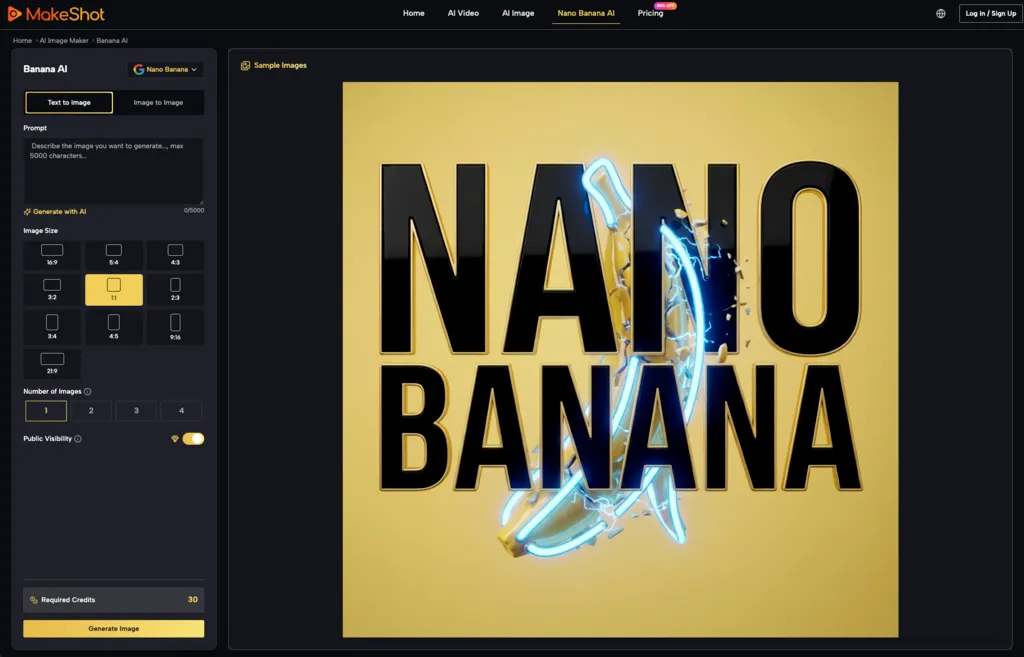
Tools like MakeShot offer an advantage by unifying multiple top-tier models—such as Kling, Runway, and Veo—under a single interface. This allows an operator to test the same source frame across different architectures. One model might be superior at "creative hallucination" (adding details not present in the prompt), while another might excel at "first-frame adherence" (keeping the output looking exactly like the input).
For a commercial editor, the goal is to shorten the feedback loop. This involves:
Refining the "Plate": Using an image editor to perfect the composition.
Low-Res Testing: Running a quick motion test to see if the model understands the depth of the scene.
High-Fidelity Execution: Only once the motion is confirmed do you scale to high resolution.
This multi-step approach prevents the common pitfall of spending significant budget on high-res renders of clips that were structurally doomed from the start.
The Limits of Procedural Control in Generative Media
As powerful as these tools are, they are not a replacement for traditional VFX or cinematography; they are an extension of them. We are currently facing what some call the "Five-Second Wall." While we can generate incredibly high-fidelity short clips, maintaining that quality over ten or twenty seconds remains a significant technical hurdle. The coherence decay is currently unavoidable for most high-motion scenes.
Expectation Reset: It is vital for creative leads to understand that AI video is currently best suited for b-roll, atmospheric textures, and "magic hour" plates. It is not yet a replacement for a narrative-driven A-roll where specific, repeatable facial expressions are required across multiple minutes of footage. Using AI for what it does best—simulating texture and light—while relying on traditional compositing for the "heavy lifting" is the current professional standard.
Conclusion: The First Frame as the Director's Lever
The future of AI in video production isn't about letting a machine take the wheel; it’s about giving the editor more precise levers. By focusing on the quality of the first frame and the source asset, creators can exert a level of control over the AI Video Generator that was previously impossible.
Professionalism in this space is defined by the ability to predict and mitigate the limitations of the technology. By prioritizing compositional clarity, lighting logic, and high-resolution source imagery, you transform the generative process from a gamble into a structured production pipeline. The "first frame constraint" isn't a limitation to be frustrated by; it is the blueprint that allows for professional-grade results in an increasingly automated world.