

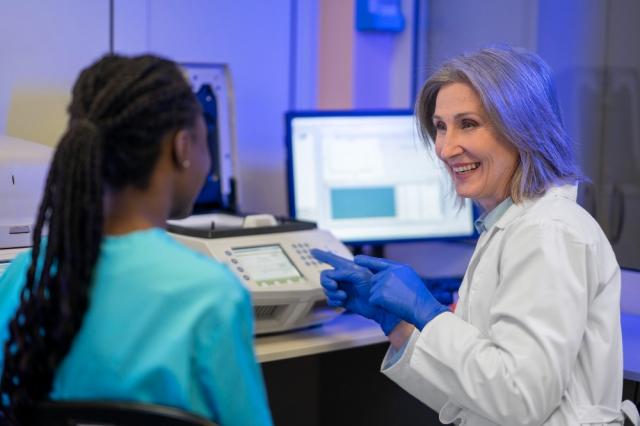
As we stand on the threshold of a new era in workplace and sports drug testing, it’s time to ask: are the technologies under development pushing us toward a fairer, safer future — or are they fast-tracking us toward new dilemmas in privacy, bias and oversight?
1. What’s changing — the technology leap
For decades, drug testing has meant urine cups, hair samplings and lab turnaround times. But now we’re seeing a surge of innovation:
- Non-invasive sampling methods such as sweat patches, saliva and wearable biosensors are increasingly viable.
- Lab-on-a-chip technologies promise near-instantaneous detection of multiple substances from minimal sample volumes.
- Artificial Intelligence (AI) and machine-learning systems are increasingly used to analyse patterns, refine detection thresholds and even predict risk of substance misuse.
These advances hold real promise: faster results, more comprehensive coverage of substances, and the ability to flag misuse early rather than simply punish it.
2. Why this matters now
Across business, sports, and public safety, the environment is shifting:
- Many jurisdictions are legalising or decriminalising substances like cannabis, making traditional “yes/no” testing less directly meaningful.
- Employers and leagues are under increasing pressure to strike a balance between safety, fairness, privacy, and trust.
- The cost, both human and financial, of mis-testing (false positives, wrongful suspensions, or firings) continues to loom.
In short, the old model (collect sample → positive/negative → sanction) is increasingly untenable, says the team at Quick Fix Urine.
3. The ethical and legal minefield
Here’s where the bright future gets a little dim: new tech brings new risks.
- Bias and fairness: AI systems are only as good as the data they’re trained on. One recent analysis warned that AI-based screening tools — including drug-testing applications — can inadvertently reinforce discrimination if not carefully audited and governed.
- Privacy and autonomy: As tests become more sensitive and ubiquitous, the question of who has access to what data, when, and how becomes critical. Are employees informed? Can they opt out? How secure are the systems?
- Defining impairment: Detecting a substance isn’t the same as proving impairment. With THC, for example, metabolites can linger long after a person is sober — so a “positive” doesn’t necessarily mean “dangerous.”
- Legal compliance and oversight: Even now, many testing programmes lack consistent standards. The leap to AI-driven or real-time testing demands regulatory frameworks that are only just emerging.
It’s not enough to invest in the latest gadget or algorithm — the human rights questions must be addressed as well.
4. What responsible organisations should do
For businesses, sports leagues, policy-makers, and labs, the path forward avoids jumping straight to “because we can, we will.” Instead:
- Be transparent: Employees and athletes must understand how and why testing is conducted, what data is used, and what results mean.
- Invest in oversight: Audit AI models, ensure diverse training data, and check for bias and accuracy.
- Prioritize context: Technology should supplement – not replace – human judgment. A “positive” test needs a meaningful dialogue, not just a sanction.
- Align with ethics and law: Ensure policies respect privacy (including data-protection laws), fairness (including non-discrimination), and due process rights.
- Keep focus on performance & safety, not mere chemistry: The real objective shouldn’t be to punish, but to protect—people, performance, and trust.
5. Final thought
The future of drug testing isn’t some far-off sci-fi vision: it’s here and accelerating. Wearables that monitor physiological markers. Chips that detect dozens of compounds in minutes. AI that predicts risk rather than simply reacts.
But the question remains: Will this future respect human dignity, fairness, and privacy — or will it edge us into a world of over-surveillance and unintended consequences?
As policy-makers, employers and leaders, we have a choice. We can lean into the technology, yes—but only if we also lean into ethics, transparency and accountability. Because the greatest innovation wouldn’t be a perfect test: it would be a system people trust.
Sources: