

The “Un-Hackable” Human: Why My Strategy to Beat AI Involves Heavy Iron, Not More Code
It happened late, the way most quiet breakdowns do.
I was staring at a blinking cursor, trying to write a complicated email—one of those delicate messages to a client that requires tact, clarity, and just enough authority to not sound defensive. I had rewritten the opening sentence four times. Nothing felt right. The tone was too stiff, then too apologetic, then too aggressive.
Out of curiosity more than hope, I pasted my messy bullet points into an AI tool.
Three seconds later, it delivered a version that was cleaner, calmer, and objectively better than anything I had written in the last twenty minutes.
I didn’t feel impressed. I felt hollow.
It wasn't because I thought I was about to lose my job. The feeling was more unsettling than that. It was the sinking sense that something uniquely mine—judgment, nuance, expression—had just been outpaced with casual ease. I was witnessing my own obsolescence in real-time, rendered in perfect syntax.
My response was predictable. I panicked. I worked harder. I bookmarked Python tutorials I would never watch. I told myself I needed to “adapt,” to become faster, sharper, more machine-like. Within weeks, my sleep worsened. My shoulders lived in a permanent shrug, glued to my ears. My thoughts raced even when my body was still.
AI hadn’t defeated me. My reaction to it had.
Why You Can’t Out-Compute a Computer
There’s a fundamental mistake many of us make when faced with intelligent machines: we try to compete on their terms.
Speed. Volume. Output. Optimization.
On those axes, humans lose every time. No amount of caffeine or hustle will allow a biological brain to outperform silicon at computation. We are not built to process infinite data streams; we are built to process survival signals. Chasing the illusion of "machine-like efficiency" only leads to anxiety disguised as ambition.
But there are things machines don’t have.
They don’t feel resistance. They don’t struggle against gravity. They don’t experience the chemical shift of effort turning into calm. AI has no body. No pulse. No nervous system that can overload—and reset.
That’s not a weakness. It’s the terrain where human advantage still lives. The future won't be won by those who think faster, but by those who can remain emotionally regulated, physically grounded, and mentally clear while surrounded by infinite digital noise. In a world dominated by “on” signals, our edge is the ability to return to the analog.
The Ritual of “Heavy” Therapy
When my mind starts spiraling—tabs multiplying, notifications stacking, thoughts looping—I don’t try to reason my way out of it anymore. You cannot think your way out of a thinking problem.
I shut it down.
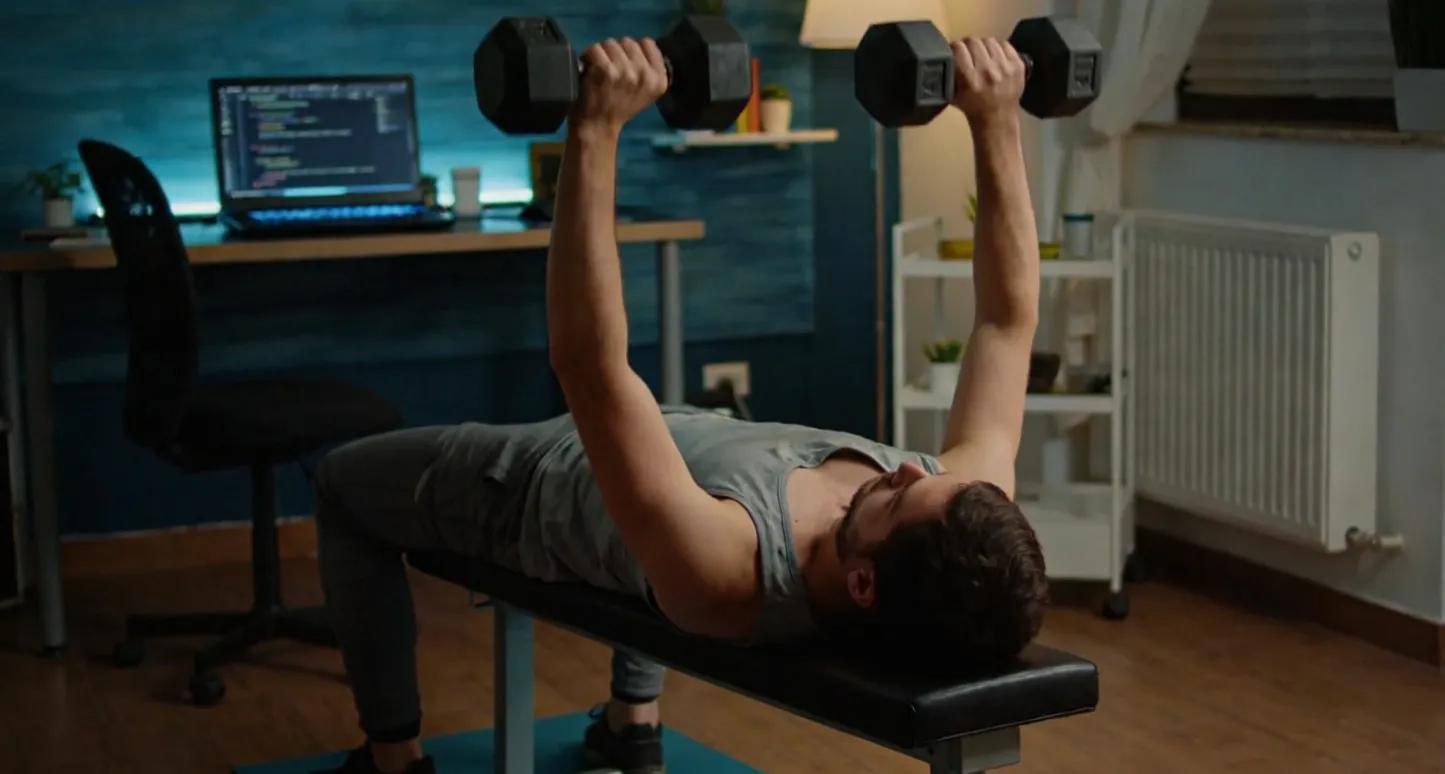
Not with meditation apps or productivity hacks, but with something far more primitive. I lie back on the floor. I grip a pair of weights. And I press.
A few slow sets are usually enough. This isn’t about fitness goals, hypertrophy, or aesthetics. It’s not discipline, and it’s definitely not motivation. It’s a forced system reset.
Pushing weight against gravity demands full attention. There’s no room for abstract fear about the future of AI when your nervous system is busy coordinating breath, tension, and control. Cortisol drops. The mental static thins out. The body reminds the brain that it still lives in a physical world, one where effort has a tangible, immediate result.
If you are new to using movement as a mental reset, understanding the mechanics helps. A proper dumbbell bench press isn't just an exercise; it's a grounding technique. It requires you to stabilize your core, plant your feet, and control a chaotic object. It pulls your focus out of the cloud and back into your hands.
Afterward, there’s a particular kind of quiet. Not exhaustion—clarity. The kind AI can’t simulate.
Designing a Physical Anchor in a Digital Cage
Of course, all of this sounds nice in theory. But reality is constrained.
Most of us live in apartments that barely tolerate a yoga mat, let alone a gym. I live in a building with paper-thin walls and neighbors who complain about footsteps. The last thing I wanted was a living room that looked like a storage unit for industrial equipment.
I needed a solution that respected my space but offered enough resistance to be real.
That is why the FED Fitness adjustable dumbbells became the cornerstone of my home office. They weren't just a purchase; they were the only logical answer to my environmental constraints.
Beyond the visual, it solves the acoustic friction. In a shared building, the fear of making noise is a legitimate barrier to starting. You hesitate to lift heavy because you don't want to be the neighbor clanging iron at dawn.
The eco-friendly PE finish on these weights eliminates that hesitation. It dampens the sound of every interaction. Whether I’m adjusting the plates or placing them back on the floor, the movement is silent and controlled. This acoustic stealth means I can attack my checklist with intensity, even in the quiet hours of the morning, without ever worrying about a noise complaint.
It’s not a fancy setup. It’s just the one that fits seamlessly into my life, removing the friction between 'feeling stressed' and 'doing something about it.
The "Anti-Fragile" Routine
My routine now is defined by its lack of structure. It is an "anti-routine."
I don't have a scheduled "workout time." Instead, I treat the weights like a pressure valve.
When I finish a Zoom call that leaves me frustrated, I do two sets of presses. When I hit writer's block, instead of scrolling Twitter, I do a set of rows.
It changes the physiology of the workday. Instead of accumulating tension in my neck and lower back for eight hours straight, I am constantly interrupting the stress cycle. I am reminding my body that it is strong, capable, and physical.
Because the equipment is right there—silent, compact, and ready—there is no barrier to entry. I don't have to change clothes. I don't have to drive anywhere. I just have to reach under the desk.
Conclusion: Becoming More Human on Purpose
AI can write cleaner code than I can. It can draft better emails, summarize books I haven’t read, and optimize workflows I didn’t know were inefficient.
But what it can’t do is feel the weight leave its hands and notice the calm that follows.
It can’t experience that moment when breath slows, thoughts settle, and the world regains depth after hours of screens flattening it. It cannot feel the satisfaction of physical competence.
The goal isn’t to beat machines at what they do best. It’s to stop trying.
In an age of accelerating intelligence, choosing to strengthen your physical, emotional, and sensory experience isn’t escapism—it’s strategy. The more digital our world becomes, the more valuable our analog experiences become.
Don’t become more machine-like to survive the future. Become more human—on purpose.