

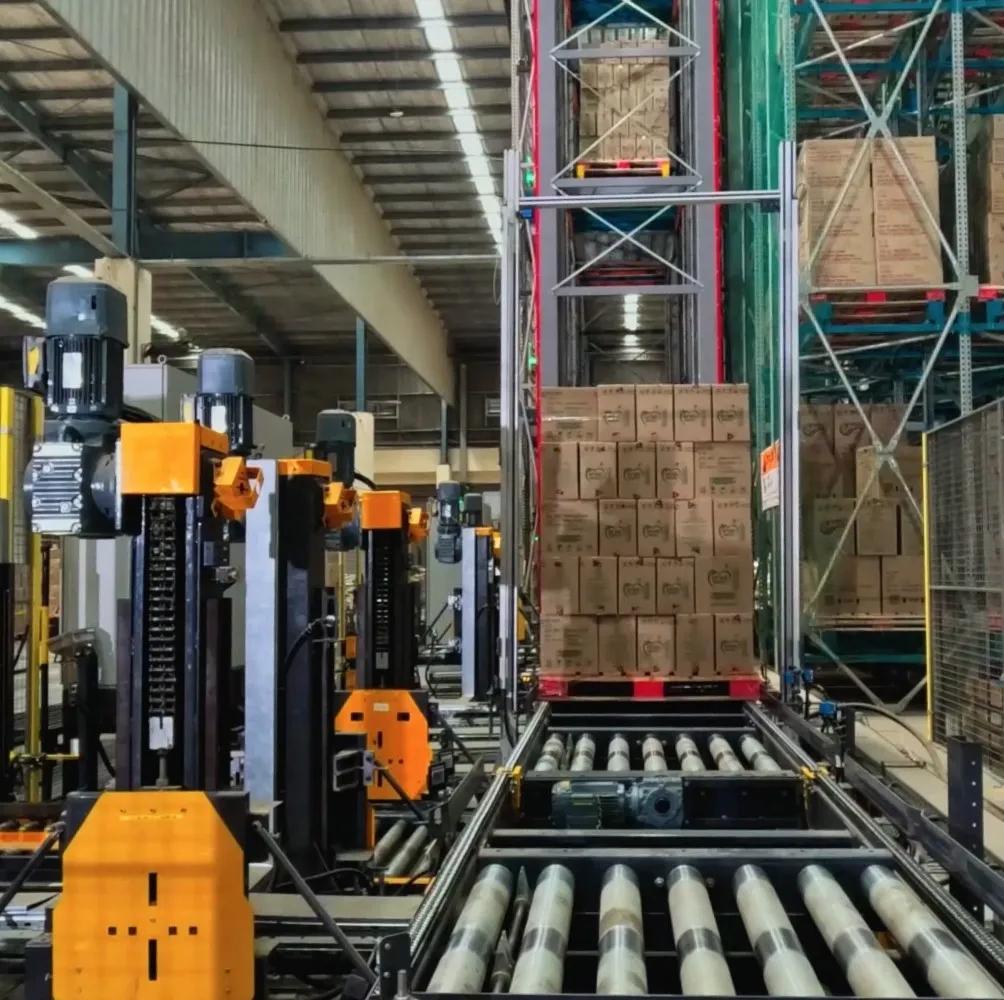
Pallet handling and related activities, such as stacking and replenishing, are also extremely labor-intensive and sensitive for a business from a safety perspective when dealing with a warehouse environment. On a general basis, it can be said that a forklift operation tends to introduce uncertainty and delays into operation when performed by a worker in a warehouse setting, and as a result, increasing demand and complex routing tend to characterize a business environment involving a warehouse location when forklift operation is concerned.
The robotic pallet handling systems provide solutions to these problems through the automatic handling of pallets with a high degree of accuracy. The robotic forklifts eliminate the manual process of handling pallets in warehouses, making the process safer, faster, and more efficient. The robotic pallet handling systems can easily be incorporated with other processes as part of an automated material handling system in order to optimize the efficiency of the whole process. This paper will investigate the key benefits of robotic forklifts and provide an insight into an essential element in modern warehouse automation strategies.
Significance Of Robotic Forklift
The robotic forklift results in an immense improvement in workplace injuries, enhanced productivity, and less reliance on human resources. The robotic forklift can be coupled with an automated material handling system and resulting in smooth pallet transportation, accuracy in putaway, and replenishment of goods in an organized way. The result helps in creating a scalable warehouse.
Key Benefits of Using Robotic Forklifts in Material Handling.
1. Enhanced Employee Safety
The issue of safety is also among the most compelling factors to implement a robotic forklift. Inherent and constant hazards exist in manual operations. These hazards include accidents, improper lifting techniques, and worker fatigue. Robotic forklifts are equipped with highly advanced sensors and vision, and collision avoidance capabilities that allow the forklift to navigate around the warehouse floor safely and reliably. The use of robotics in lifting and lowering activities ensures that pallets are moved within set safety limits and that the chances of injury are eliminated. By restricting worker interaction with heavy materials and machinery in warehouses, accidents will decrease, and safe environments will be created.
2. Less Dependence on Manual Labor
Labor shortage and staff turnover are still serious problems in warehouse management. Robotic forklifts will eliminate these problems by taking away from personnel the menial tasks of pallet movement and stacking. They can work continuously from shift to shift without any display of exhaustion and decrease in productivity, even during night and peak hours. Thus, these robotic forklifts will reduce reliance on skilled forklift drivers so that personnel can focus on supervising and monitoring these machines while performing other value-adding tasks. It will form part of the automated material handling system to produce output independent of the availability of labor.
3. Proper and Consistent Pallet Handling
Manual operations of a forklift rely on human skill and experience, which leads to variability in pallet location. A robotic forklift operates with repeatable accuracy, providing accurate pallet location every time it operates. A robotic forklift reduces errors in handling, which in turn reduces product damage. It also improves processes like picking, as it offers consistent product handling, which is stored in consistent conditions.
4. Improved Storage Utilization
This comprises very high accuracy for pallet placement and optimal use of height during stacking. Accuracy concerning stacking is promoted through robots in forklifts, which follow clear paths during their movements and stacking logic. This, in effect, promotes greater stacking within pallet racks and guaranteed stacking. Misalignment and spacing discrepancies will also be eliminated in warehouses, which will make it possible to achieve higher storage capacity without having to compromise safety for the extra capacity in warehouses. This shall indirectly promote improved space utilization without the necessity for expansion.
5. Automation Integrated Flow
The key value of robotic forklifts is realized when they are part of a broader warehouse control system, coordinating the movement of material between different activities. Within this context, robotic forklifts may be integrated with both WMS and WCS systems to accomplish some higher-level tasks, such as pallet unloading from incoming materials, put-away functions that put material into storage, replenishment activities to stage material for production, and staging to load material onto outgoing shipping.
Role of Addverb in Integrated Robotic Forklift Systems
A major element of intelligent autonomous forklift functionality provided by Addverb is the immense use of automation within developing robotics forklifts, which they deploy in their systems. The robotics forklifts developed by Addverb automate material handling systems that involve the use of automation systems like AMRs, conveyors, ASRS, and storage software. The in-house R&D capability of the firm assures proper integration of pallet handling and handling automation systems. The expertise that Addverb offers in multi-layer automation translates into effective migration from unconnected automation systems for the firm's clients.
Conclusion
Robotic forklifts provide tangible benefits to warehouses concerning safety at work, labour efficiency, and process stability. The machines are useful in automating the transport, stacking, and replenishment of pallets, thus eliminating risks associated with injuries, manual labour, and inaccuracies that always occur when handling pallets manually. Application of robotic forklifts in an automated handling system at a warehouse allows flawless operations to be carried out with various automation tools, with the guarantee that a warehouse creates a resilient environment, which will enable growth to take place effortlessly through automation by companies such as Addverb.