

A few years back, healthcare providers were confused about using AI in healthcare. Now the question is settled. According to a 2026 survey published by the American Medical Association, more than 80% of physicians have started using AI professionally. So the real question now is which AI tools can work well for a seamless workflow.
Medical practices are spending thousands of dollars in areas like billing, scheduling, and medical documentation, but still face major problems. Most of the healthcare providers report that the excessive administrative workload, coding errors, and claim denials were their pain points, even after the costly AI integration.
This blog is meant to explain why the gap persists and what AI tools can actually improve the real practice work.
Factors Making AI EHR Adoption Urgent in 2026
This section explains why the adoption of AI in healthcare is now more important than ever in 2026.
Workforce Math
There’s a growing shortage of the workforce, and hiring staff members is becoming more expensive. Already employed doctors are also leaving hospitals, not because of the patient care but due to excessive administrative workload and paperwork.
For instance, a survey published by the American Medical Association shows that about 95% of physicians reported that the main cause of their burnout was prior authorization work.
Regulatory Mandate
According to the new government regulations of 2026, physicians must follow the updated laws. If a practice still uses the old and outdated integrated systems, it might not be able to meet the new requirements.
Margin Pressure
Medical practices are reporting increased financial pressure. Many practices face high claim denial rates, taking 30-50 days to get resolved. AI-powered tools can speed up the complete process, reducing denials with faster reimbursements.
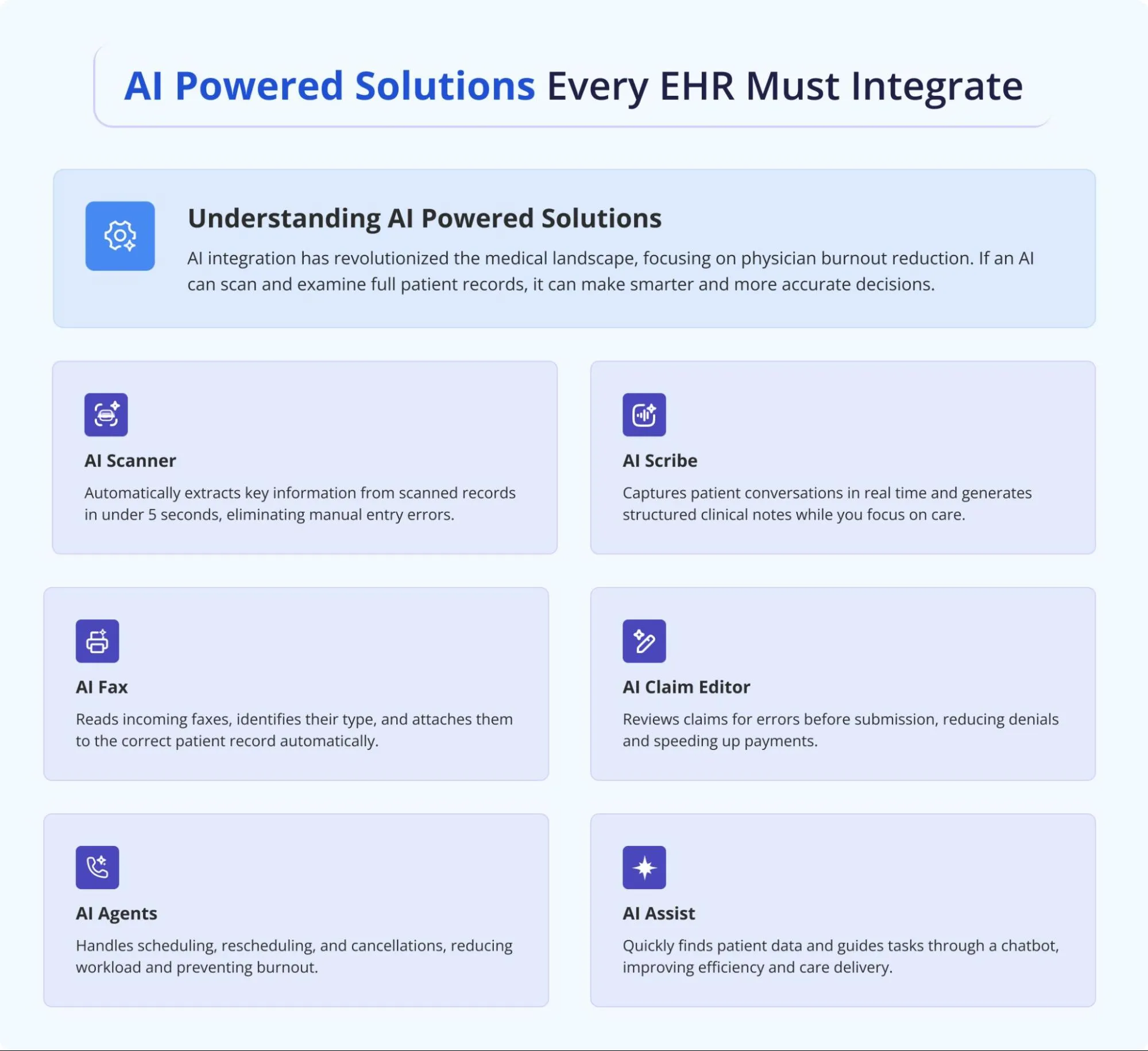
AI-Powered Solutions Every EHR Must Integrate
AI EHRs have transformed the way healthcare is delivered. AI automation has significantly reduced physician burnout and improved the overall productivity of the practice. Below are listed some of the most important AI solutions that modern practices must integrate to thrive.
AI Scanner
Healthcare providers often find it difficult to dig through handwritten notes and inconsistent medical records. Additionally, entering data manually can lead to errors, incorrect claim submissions, and high claim denials.
As of 2026, medical practices are no longer considering this a problem because they are integrating the AI Scanner tool. These specific AI tools can scan and extract key information from the scanned documents and populate the fields in under 5 seconds.
AI Scribe
Healthcare providers find it challenging to document everything while focusing on their patients at the same time. Patients also feel disconnected when their physicians are not giving them proper attention and are trying to get over them.
To avoid this frustrating and disconnected situation, practices are integrating AI Scribe. This AI tool allows physicians to listen to their patients carefully while it is generating structured notes containing all the important information shared by the patients.
According to the internal survey conducted by PracticeEHR, AI scribe increased patient interaction time by 56%.
AI Fax
Small medical practices often find it arduous to sort faxed medical records, referrals, insurance forms, and other credentials. Every document needs to be attached to the right patient profile. This can take hours and still be an error-prone process.
To keep the complete process error-free and seamless, medical practices are also installing AI automated fax systems. AI Fax from PracticeEHR alleviates physician burnout to a great extent. It automatically reads and scans the incoming faxes and arranges the documents accordingly.
AI Fax successfully eliminates errors, reduces the administrative workload, and makes fax sorting stress-free.
AI Claim Editor
Managing medical claims is not a physician's job, but still, they have to keep the record alongside treating patients. This is extra unpaid work that physicians need to do so that their practice does not face any problems. Most of the physicians manage claims manually, which causes errors in coding and data entry, which eventually leads to claim denials.
This is exactly where AI Claim Editors changes the equation. Physicians are integrating AI claim editors into their practice for error-free and faster claim submission and approval. The AI claim editor does this by reviewing the claims, detecting the errors, and then suggesting the edits to the physicians.
AI claim editor reduces the chances of claim denials from health insurance companies, ensuring faster reimbursements.
AI Chatbot Assistant
Navigating through the complex interfaces of some EHRs can be challenging for healthcare providers. Searching for patients’ previous medical records and treatment plans can take a lot of time, adding extra work on the physician’s shoulders. It may slow down the responses, also leading to patient frustration.
AI chatbot assistants live inside EHRs and simplify the navigation and streamlines everyday tasks. For example, PracticeEHR offers an AI chatbot called AI Assist, where users can simply write their query or questions, and AI Assist guides them to take the right course of action without digging into manuals.
AI-Driven Clinical Transformation: The Future of EHR
The future of electronic health record software is already in the market; it is just not evenly distributed across practices. Modern practices that have realized the worth of integrating AI into the clinical workflow are already using it. This transformation speeds up the clinical workflow and reduces physicians' burnout, improving overall productivity of the practice.