


Why I Started Looking for a Portable Power Station
Last month, I hit a wall. Three straight weeks of video calls, the same white wall, the same sunlight coming in at the same angle. I needed a real escape.
Friday night, a friend texted: "Weekend trip to Joshua Tree. You in?"
My first thought: "Can't, got two deadlines Monday." Five minutes later, I texted back: "Wait, why not?"
That's how I started researching portable power stations. I ended up getting two: the PF200 and PF300. This article is what I learned with my own money.
The Math You Have to Do Before You Leave
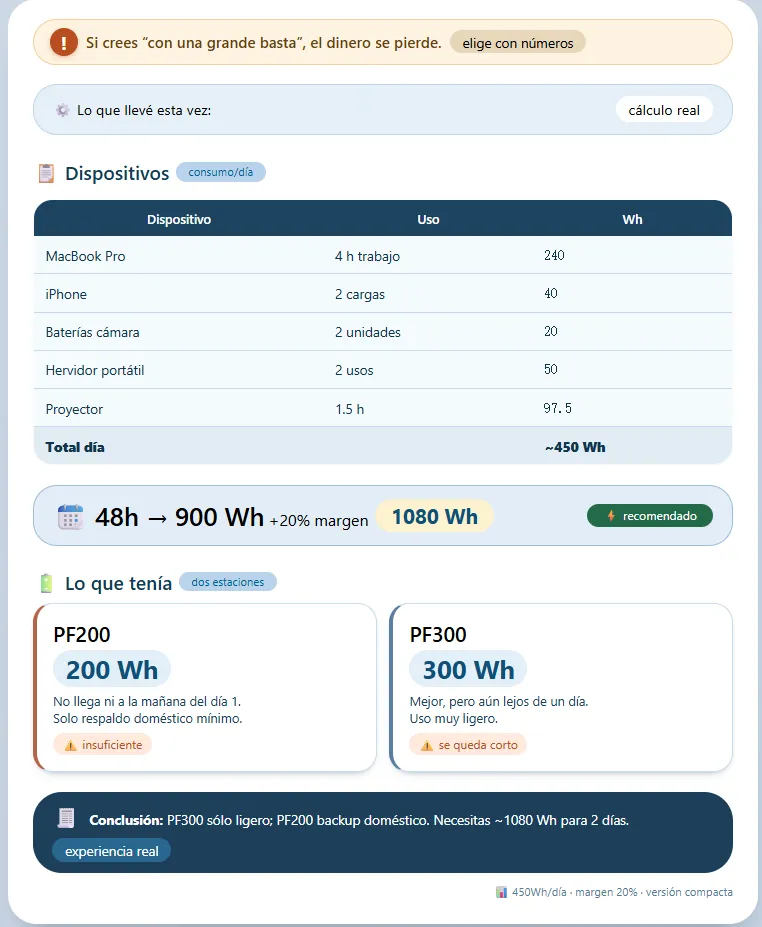
If you think "I'll just grab a big one and it'll be fine," you're probably going to waste your money.
Here's everything I brought this trip:
MacBook Pro (4 hours work, 240Wh)
iPhone (2 charges, 40Wh)
Camera batteries (2 charges, 20Wh)
Portable kettle (2 uses, 50Wh)
Projector (1.5 hours, 97.5Wh)
Daily total: about 450Wh
For 48 hours that's 900Wh. Add a 20% safety buffer, andyou're looking at around 1080Wh.
Then I looked at the two power stations I had:
PF200(200Wh): Wouldn't even make it through morning coffee
PF300(300Wh): Better, but still not enough for one day
That's when I realized: the PF300 is only good for light use, and the PF200 is really just a backup at home.
The Real Trap: Ports
Get the capacity right and you're good to go? I learned the hard way.
First time I took the PF200 out, I confidently opened my MacBook, plugged in USB-C---nothing. Tried another port---still nothing.
Half hour on Google later: MacBooks needUSB-C PD protocol. Not all USB-C ports can charge them.
Here's the key thing:The PF200 and PF300 haveexactly the same ports---both have 60W USB-C PD fast charging, both have AC outlets, both have 3 USB ports. The only difference is battery size.
So if your device works with the PF200, it'll work with the PF300. The only question is how long it'll last.
Both can charge a MacBook about 40% in half an hour---enough for another hour of video calls.
48 Hours with the PF300 at Joshua Tree
Location:Joshua Tree National Park
Time:Late April, daytime 28°C
Day 1: Arrived at 2 PM
First 4 hours of work went fine---emails, writing, the PF300 dropped from full to 20%. Then I charged camera batteries and phones, down to 7%. That's when I tried to boil water for coffee---kettle kicked on, PF300 shut right down.
Staring at the dead screen, coffee cup empty, I had some thoughts.
Lesson learned:The kettle pulls 300W, and the PF300's rated output is exactly 300W. But when the battery's low, voltage gets unstable and it trips. Ended up boiling water over my friend's campfire, and topped up the PF300 with the car charger before bed---got back to 30%.
Day 2: Learned to respect the battery
8 AM, PF300 at 30%. Pulled out my solar panel, let it soak up sun for 3 hours---back to 70%. Worked 4 hours, down to 20% again. Another 2 hours of sun, back to 47%. Watched an hour of projector that night (carefully), went home with 15% left.
Made it through, but I was watching that battery level the whole time---that anxious feeling when your phone's at 10% and you can't find an outlet.
PF200 vs PF300: Which One Should You Get?
PF200 is for you if:
You mainly charge phones, tablets, headphones
You're doing day trips, no overnight
You want a home backup for emergencies
You're on a budget and want to start somewhere
PF300 is for you if:
You need to charge a laptop (this is the big one)
You do weekend camping, short trips
You want to bring a kettle, fan, projector
You don't mind spending a bit more for more capacity
My honest take:
If you're unsure, start with the PF300. It's the one I've used the longest and never regretted.
The Mistakes I Made So You Don't Have To
Only looking at capacity, ignoring ports
Check this before you buy: how many watts fast charging does your laptop need? Both the PF200 and PF300 do 60W. If you've got a 16-inch MacBook Pro that wants 100W, 60W will charge it slow---that's not the product's fault, it's you picking the wrong one for your needs.
Not leaving a buffer
First time out with the PF300, I calculated exactly. Then a friend needed to charge their stuff, and my whole plan fell apart. Now I always plan for "needs × 1.2."
Thinking solar panels were a gimmick
After that first trip, I got a 100W solar panel. Next time, 3 hours of sun gave me 150-200Wh---like having an extra PF200 for free.
Ignoring temperature
April in Joshua Tree, 28°C daytime. Left the PF300 in the sun for a bit and it throttled itself. Now I know: power station in the shade, solar panel in the sun. They work better apart.
My Advice for You
Step 1: Grab a pen, make a list
Write down every device you might bring. Check the wattage, calculate the time. It's the most basic method, but it works.
Step 2: Match your needs
Under 100Wh per day: PF200 is plenty
100-200Wh per day: PF300 is the sweet spot
Over 200Wh per day: Look at bigger options
Step 3: Leave room in your budget for accessories
A solar panel doubles your runtime. Spare cables save the day when you lose one. A waterproof bag is cheap insurance outdoors.
A Few Final Thoughts
Here's how I pack now:
Day trips:Just the PF200, nice and light
Weekend camping:PF300 + 100W solar panel, does the job
More than 3 days:Borrow a bigger one from a friend, or bring both PF300s and rotate
If you ask me which one to get, my answer is:it depends how long you're going and what you're bringing.Both are solid. They just serve different people, different trips. If you're camping overnight a lot, the PF300 makes sense. If you're just out for the day, the PF200 is plenty and lighter.
Me? I got both. Sometimes I want light, sometimes I want long. They're tools, not a one-or-the-other choice.
Used a portable power station before? What mistakes did you make? Drop a comment below.