

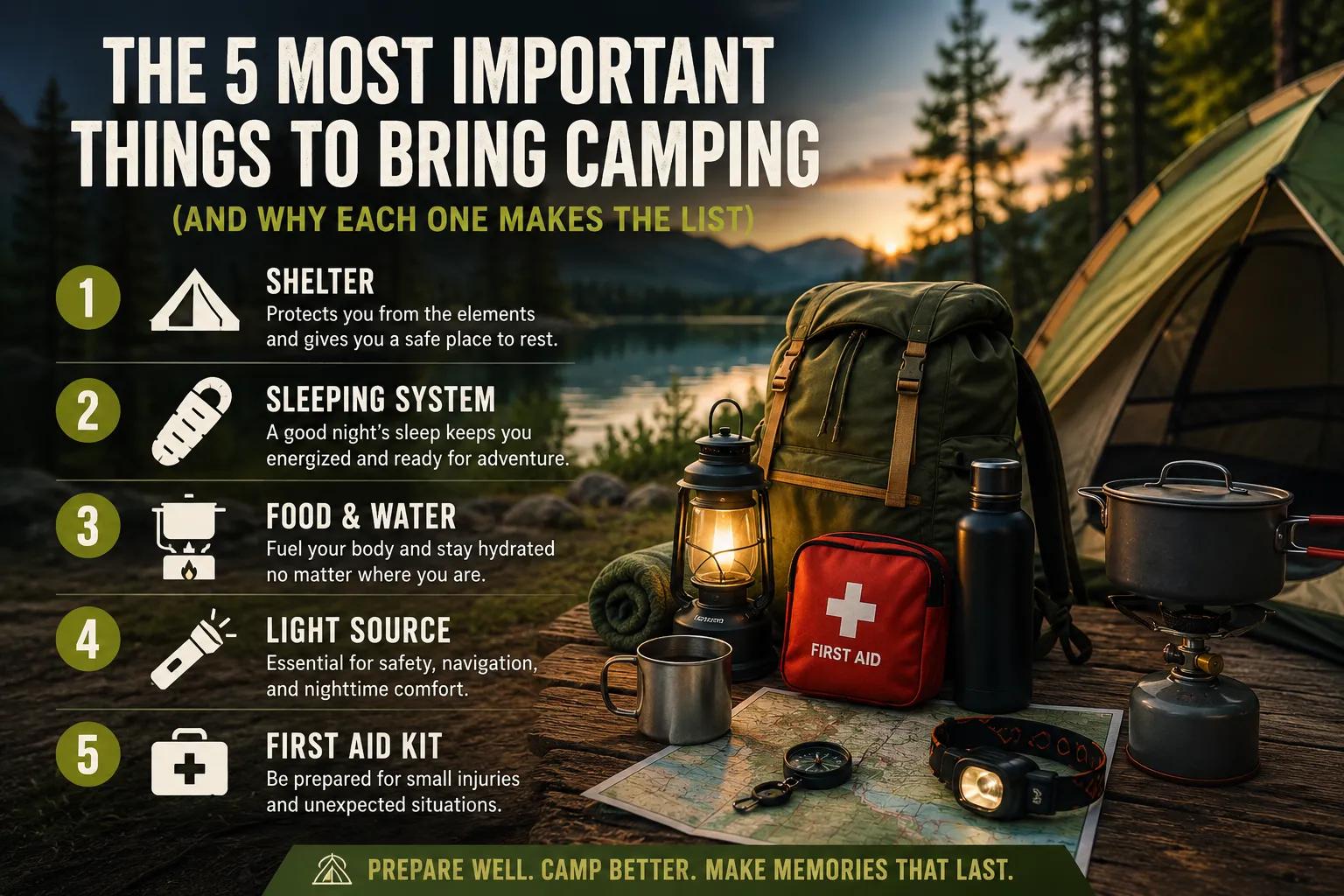
Most camping packing lists run to fifty items or more. That is useful when you have time to prepare, but it does not tell you what actually matters most. The 5 most important things to bring camping are the ones that, if forgotten, genuinely compromise the trip. Everything else on those long lists is either replaceable, optional, or something you can improvise. These five are not.
How to Think About Camping Priorities
Every item on a camping packing list belongs to one of three groups: things needed to get through the night safely, things that ensure a good sleep, and things that improve the overall experience. The key essentials cover all three areas in that order of importance. If something does not protect you, support rest, or add meaningful comfort, it can be considered secondary.
The framework is simple: survival first, rest second, experience third. Each essential item earns its place because it contributes to at least the first two priorities, and often all three.
1. Shelter: Tent and Groundsheet
Your tent sits at the top of the 5 most important things to bring camping, and it only works properly when paired with a groundsheet.
Shelter protects you from wind, rain and temperature drop. Without it, everything else becomes secondary within a few hours. A sleeping bag rated to 0°C is useful in a tent; in the open, it is not enough. The tent is also your only secure storage space on site, your changing room, and your retreat when the weather turns.
A groundsheet keeps moisture from rising through the tent floor and protects the base from punctures. Pitch the tent at home before the trip to confirm all poles, pegs and guy ropes are present. Discovering a missing pole in the dark on arrival is one of the most common first-trip problems.
2. Sleeping System: Sleeping Bag and Mat
A poor night of sleep affects everything the next day. A sleeping system is the second of the 5 most important things to bring camping and the one where most people underinvest.
The sleeping bag and mat work as a pair. The bag insulates from above and the sides; the mat insulates from below, where cold from the ground conducts far more effectively than cold air. Many campers invest in a good bag and then sleep on a thin foam mat, which undermines the bag's rating entirely. Both need to be appropriate for the overnight low, not the daytime high.
Check the temperature rating on your sleeping bag before the trip and add a liner if conditions are likely to be cold. A self-inflating mat in the 3–5 cm range balances warmth, packability and comfort well for most trips.
3. Food, Water and a Basic Cooking Kit
Food and water rank third in the 5 most important things to bring camping. Water comes before food: you can manage a day without eating, but dehydration in an outdoor environment becomes a problem much faster.
Most managed campsites have a tap on site. If yours does not, bring two to three litres per person per day for drinking and cooking, more in warm weather. A basic cooking setup covers the rest: a camp stove, fuel, one pot, and utensils are enough to boil water, heat a meal, and make a hot drink in the morning.
A campfire can serve as a backup cooking source, which is one of the reasons firewood makes this list at number five. If your stove fails or runs out of fuel, a good fire and a grill grate give you a reliable way to cook. Packing the two systems together means you are never left without a way to heat food.
4. First Aid Kit
The first aid kit is number four in the 5 most important things to bring camping, and the one most likely to be left at home because it feels unnecessary until needed urgently.
Camping produces a reliable set of minor injuries: cuts from knives, blisters from walking in new boots, burns from the campfire or camp stove, splinters from handling wood, and twisted ankles on uneven ground. None of these are serious with the right kit available. Without it, a blister can sideline the rest of the trip and a burn can become infected over two or three days outdoors.
A basic kit needs plasters in several sizes, blister pads, antiseptic wipes, a bandage, pain relief, tweezers, and burn gel. Add any personal medication, and keep the kit in a waterproof bag where everyone in the group can find it.
5. Dry Firewood and Firelighters
Firewood is the item most often left off the list or left to chance. That is a mistake that shapes the entire evening.
A campfire provides warmth when temperatures drop, a backup cooking source if your stove fails, and the focal point that makes a camping trip feel like a camping trip. Foraging on site is prohibited at most managed campsites, and what you find is almost always too damp to light reliably. Bringing your own dry firewood removes the uncertainty entirely.
A one-night trip typically needs one bundle of kindling and two to three bags of logs. Kiln dried hardwood logs burn longer and produce more heat than softwood, so a smaller quantity goes further. For added convenience, Kiln Dried Logs offers kiln-dried firewood delivered directly to your door, ready to be packed into the car before you set off.
Quick Packing Checklist: The 5 Essentials
Use this as your final check before leaving home. If all five rows are ticked, you are ready to go.
Item | What to Pack | Ready? |
Shelter | Tent, groundsheet, pegs, poles, guy ropes | [ ] |
Sleeping system | Sleeping bag (rated for overnight low), sleeping mat | [ ] |
Food, water and cooking | Water (2-3L/person/day), camp stove, fuel, pot, utensils | [ ] |
First aid kit | Plasters, blister pads, antiseptic, bandage, pain relief, burn gel | [ ] |
Dry firewood | Kiln dried logs (2-3 bags), kindling bundle, firelighters, matches | [ ] |
All five items are in the essential column for the same reason: none of them are reliably replaceable once you are at the campsite.
What Happens If You Forget Each One
The table below shows the consequence of forgetting each of the 5 most important things to bring camping, and whether anything on site can replace it.
Item | Forget It And... | Replaceable at Campsite? |
Shelter | Exposed to rain, wind and cold with no protection | Rarely — most sites do not hire tents |
Sleeping system | Cold, broken sleep that ends the trip early | No |
Food, water and cooking kit | Hungry and dehydrated within hours | Sometimes, depending on campsite facilities |
First aid kit | A minor injury becomes a much bigger problem | Basic items sometimes, full kit rarely |
Dry firewood | No fire, cold evenings, no cooking backup | Wet foraged wood only — unreliable and often prohibited |
The firewood row is the only one where the campsite alternative exists but is genuinely poor. Wet foraged wood is not a like-for-like replacement for dry firewood, which is why bringing your own is the only reliable option.
Final Thoughts
The 5 most important things to bring camping cover the same ground every time: a place to sleep protected, a way to sleep warm, food and water to keep going, safety cover for the unexpected, and a fire to make the evening worth having. Get these five right and the rest of the list becomes optional. Forget any one and the trip works around that gap from the moment you arrive.