

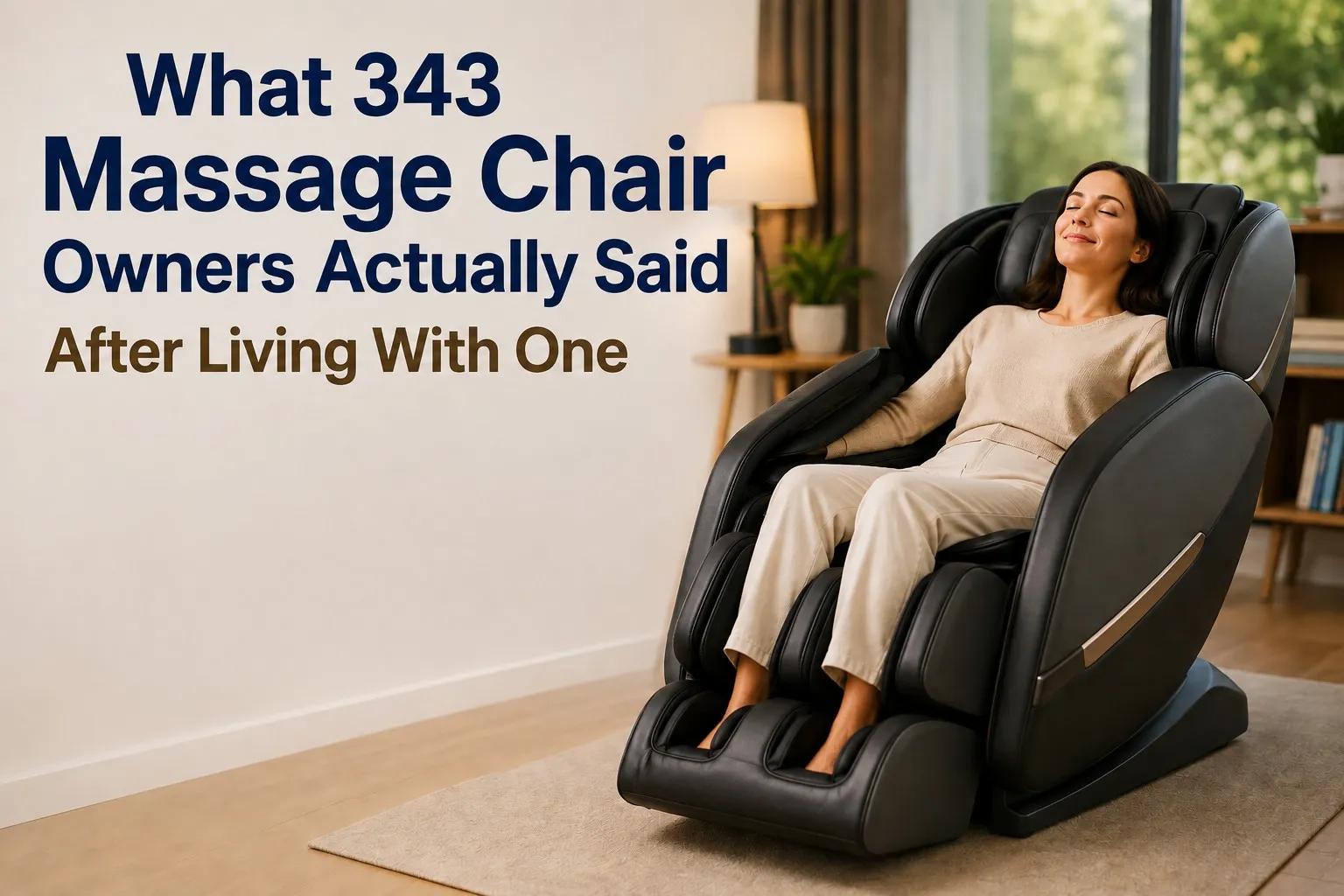
Almost everything written about massage chairs falls into one of two piles. Either it is a clinical study with a few dozen participants in a lab, or it is a product roundup written by somebody who has never owned one.
Neither answers the question most people actually have, which is simply this: if I put one of these in my living room, will I still be glad in three years?
I run a furniture company in British Columbia and we sell massage chairs, so start by assuming I am biased, because I am. But we do have something most people writing about this do not, which is what our own buyers said afterwards. Between January 2022 and June 2026 we collected 343 verified reviews on a single full body massage chair model. The average rating was 4.81 out of five.
Here is what those reviews say when you actually read all of them, including the bad ones.
The honest caveat first
This is owner satisfaction data, not medical evidence. It tells you whether people felt the purchase was worth it. It does not tell you that a massage chair treats any condition, and nobody should read it that way. It also comes from customers of one retailer, which means people who already decided to buy. That is a real limitation and you should weigh it accordingly.
What it is good for is the question the clinical studies cannot answer, which is what ownership is actually like once the novelty wears off.
95 percent of owners stayed happy
Of the 343 reviews, 325 were four or five stars. That is roughly 95 percent. Eighteen were three stars or lower.
The thing I did not expect when we pulled this together is how stable it was over four and a half years. The reviews from 2022 read about the same as the reviews from 2026. If massage chairs were mostly an impulse buy that ends up as an expensive coat rack, you would expect the older reviews to sour. They did not.
The phrase that comes up more than any other is some version of "I use it more than I expected to." One owner in a two bedroom condo wrote that she worried it would dominate the room and then found she used it daily. Another said he and his wife both use it every day. Whatever else is true, the people who buy these mostly do not abandon them.
What the unhappy 5 percent were actually unhappy about
This is the more useful half, and it is the part no retailer publishes.
Of the eighteen reviews rated three stars or lower, seven were about delivery rather than the chair. Drivers leaving a very heavy item at the door, a screen arriving cracked, one order that did not arrive at all. Six were about the massage itself not matching expectations, described as fine but underwhelming, or in one case too aggressive. Three were from taller owners, including one at six foot five and one at six foot four, who found the chair simply did not fit them properly and missed the neck entirely.
That last group matters more than its size suggests. A massage chair is fitted furniture. If you are much above six feet, the rollers may not line up with your neck and shoulders no matter what the specification sheet claims. That is not a defect, it is a fit problem, and it is the single most predictable way to be disappointed.
So if you are tall, sit in one before you buy. That is genuinely the whole advice.
Where a massage chair is the wrong purchase
I would rather say this plainly than have somebody buy one and regret it.
If what you want is treatment for a specific injury or a diagnosed condition, see a physiotherapist. A chair is not a substitute for someone who can assess you.
If you are buying it for a guest room or a space you rarely use, skip it. These are heavy, they take real floor space, and the satisfaction in our data comes overwhelmingly from people who use them habitually. Occasional use does not justify the cost or the footprint.
If you are between two chairs and the cheaper one is significantly smaller, be careful. Compact models are the ones that generate the fit complaints.
And if you cannot get it up the stairs, that is a real problem. These commonly weigh well over two hundred pounds in the box. Several of our unhappiest reviews are entirely about that moment.
What to actually check before buying
Sit in it if there is any way to do so. Bring the tallest person who will use it.
Ask specifically what the delivery includes. Curbside means the driver leaves it at the end of your driveway, and with an item this heavy that distinction is the difference between a good day and a bad one. Whether the retailer charges a flat rate or quotes per address matters far less than knowing exactly where the box gets left, and whether anyone is carrying it inside.
Ask about the warranty on the mechanical parts specifically, not just the frame, since the rollers and motors are what eventually wear.
Measure the recline space. Most of these need clearance behind them to lie back, and people forget that when they measure the footprint.
The part I find most interesting
The reviews that stayed positive years later almost never mention the features. Nobody writes back in year three about the number of massage programs or the bluetooth. They write about having a place to sit down after work.
That is probably the honest case for one of these. Not that it fixes anything, but that it makes a daily habit easy, and daily habits are what actually change how you feel over time.
If you want to see what a full body chair actually costs in Canada, we list ours openly along with the dimensions, and you can compare massage chairs without giving anyone an email address first. And if you would rather sit in one, Forward Furniture has showrooms you can walk into.
Buy one because you will use it every day. That is the only reason in the data that holds up.